
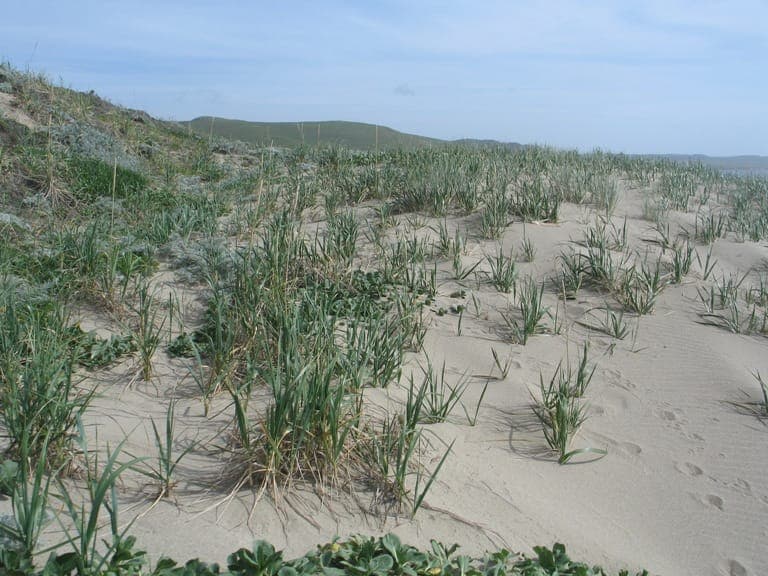
Robert Steers/NPS / CC0, via Wikimedia Commons
American dune grass: complete guide
Leymus mollis
Want to see American dune grass: complete guide in your garden?
1 minute, no credit card
Overview
American dune grass (Leymus mollis) is a vigorous, broad-leaved grass native to the coastal dunes and sandy shores of North America, the Russian Far East, Japan, and northern China. It was formally described in 1947 and belongs to the Poaceae family. Common names include American dune grass, sea lyme grass, strand grass, American dunegrass, and strand wheat - the last name reflecting the striking resemblance of its seed heads to compact ears of wheat. It is closely related to the European lyme grass (Leymus arenarius), but is generally considered slightly less aggressively spreading and produces foliage with a softer texture.
Ecologically, Leymus mollis is a pioneering dune stabiliser of major importance. Its dense rhizome network binds loose sand, prevents erosion, and helps build dunes in the face of wind and wave. It is among the most salt-tolerant grasses available for garden use, making it invaluable for seaside and coastal garden settings. On gardenworld.app, American dune grass appears regularly in design concepts for coastal garden styles, Scandinavian minimalist planting, and New Perennial-inspired borders where strong blue-grey foliage provides structural contrast.
Appearance and bloom cycle
American dune grass is an upright, clump-forming to spreading grass with broad, flat to slightly inrolled leaf blades 8-15 mm wide and up to 30-60 cm long. Leaf colouration is a striking blue-grey to glaucous blue-green, produced by a waxy bloom on the leaf surface that also provides protection against salt spray and drought. Total plant height, including the flowering stems, ranges from 60 to 120 cm depending on growing conditions.
The inflorescence is a dense, erect spike 10-25 cm long, appearing in summer - typically July to August in northern European conditions. Spikelets are arranged in two compact rows, giving the spike the wheat-like appearance that inspired the name "strand wheat". The flowering display is architecturally interesting rather than colourfully showy, but the upright blue-grey spikes rising above the leaf mass make a strong structural statement in the summer garden.
The plant spreads by rhizomes, gradually expanding sideways. In light, sandy soil this spread can be reasonably vigorous; in denser, heavier soil it tends to remain more contained. The spread is useful for covering large areas of sandy ground but should be monitored in smaller gardens.
Ideal location
Full sun is the preference for American dune grass. Part shade is tolerated but results in paler leaf colouration and a looser, less compact habit. In its natural coastal habitat it grows on fully exposed, open sandy slopes with maximum sunlight, salt-laden wind, and minimal competition.
Salt spray tolerance is one of the outstanding features of this species. The waxy leaf coating protects the foliage against salt damage that would harm most other garden plants, making Leymus mollis suitable for gardens right on the coast - the first row of houses back from the shoreline, or along estuaries and tidal zones.
For inland gardens, a warm, open position with good air circulation gives best results. Avoid planting in frost pockets or overly sheltered spots where humidity builds up; good air movement helps prevent any fungal issues on the dense leaf mass.
Soil
American dune grass is adapted to poor, sandy, free-draining soils and is one of the grasses that actively thrives on lean conditions. Rich, fertile garden soil is not necessary and can actually be counterproductive, producing soft, floppy growth and a less intense leaf colour.
Light sandy soil, coastal sand, or well-drained loam is ideal. On heavier clay soils, incorporating coarse grit and sand throughout the top 30-40 cm will make conditions more suitable. A pH of around 6.5-7.5 (neutral to mildly alkaline) is appropriate; chalky and lime-rich soils suit this grass well.
Avoiding waterlogged conditions is important, particularly in winter. While the plant tolerates seasonal drought with ease, extended periods of saturation can cause rhizome rot. Good drainage is the single most important soil requirement.
Free design
Want to see American dune grass: complete guide in your garden? Make a free design now.
Watering
Once established, Leymus mollis is remarkably drought-tolerant - one of its key garden virtues. Established plants need no supplemental watering in an average growing season in northern European climates. In its Arctic and subarctic natural range, summer precipitation can be minimal, and the plant is fully adapted to these conditions.
In the first growing season after planting, regular watering every seven to ten days helps the rhizomes establish and spread into the surrounding soil. Water at the base of the plant. By the second growing season, the plant should be self-sufficient on rainfall under normal conditions.
Only exceptional drought - more than three weeks of high temperatures and no rainfall - warrants intervention for mature plants. When watering is needed, apply it deeply and infrequently rather than giving frequent light sprinklings, which encourages surface rooting.
Pruning
Pruning of American dune grass is simple and infrequent. The main annual maintenance is a hard cut-back in late winter or early spring (late February to early March), cutting all growth to within 10-15 cm of the ground before new shoots emerge. This removes the previous season's old leaves and makes space for fresh, strongly coloured new growth.
Alternatively, the plant can be cut back in autumn after the seed heads have dried. Some gardeners choose to leave the dried stems and seed heads standing through winter, where they catch frost, dew, and light beautifully and provide habitat value for overwintering insects.
If the plant is spreading beyond its intended boundary, simply insert a spade vertically into the soil along the desired line and remove any unwanted rhizomes. Do this in spring or early autumn. Division every four to five years also refreshes the plant and provides propagation material.
Maintenance calendar
February - March: Cut back all growth to 10-15 cm before new shoots emerge. Remove old leaf debris from around the base.
April - May: Fresh blue-grey growth emerges. Check the perimeter and remove any unwanted rhizome spread with a spade.
June - July: Main growing season. No intervention needed in normal conditions.
July - August: Flowering period. Seed spikes are at their best. No pruning required.
September - October: Optionally remove seed heads after they have dried. Alternatively, leave for winter structure.
November - January: Dormant period. Leave standing for winter interest or cut back in late autumn.
Winter hardiness
American dune grass is exceptionally winter-hardy - more so than many other ornamental grasses. Being native to the Arctic and subarctic coastlines of Alaska, Canada, and Greenland, it tolerates extreme cold with ease. It is rated for USDA hardiness zones 3 to 9, tolerating minimum temperatures of approximately -40 degrees Celsius in zone 3. For gardens in the Netherlands, Belgium, northern France, and the UK (zones 7-8), the plant is fully winter-hardy and requires no protection whatsoever.
The rhizomes survive even the coldest European winters underground. If the above-ground foliage is killed by frost, new growth emerges vigorously in spring. No mulching or other winter protection is needed.
Companion plants
American dune grass combines beautifully with other coastal, drought-tolerant, and sun-loving plants. For a coastal planting theme, pair it with Ammophila arenaria (European marram grass), Eryngium maritimum (sea holly), and Crambe maritima (sea kale) for an authentic maritime planting with ecological coherence.
For a more designed, garden-style combination, try it with Erigeron glaucus, lavender, Achillea varieties, and Salvia nemorosa - all thrive in the same sunny, dry conditions and provide long seasons of colour and pollinator interest alongside the structural blue-grey foliage of the grass.
In a contemporary minimalist planting scheme, Leymus mollis pairs well with Festuca glauca, Nassella tenuissima, and Helictochloa sempervirens - all sharing a cool blue-grey palette. Look for American dune grass at specialist nurseries and grass specialists; it is occasionally stocked at larger garden centres during the spring season.
Closing thoughts
American dune grass is a genuinely outstanding plant for anyone gardening in coastal, dry, or windswept conditions. Its combination of architectural blue-grey foliage, exceptional drought and salt tolerance, reliable winter hardiness, and low maintenance demands makes it a go-to choice for tough spots where other plants struggle. Whether you are stabilising a sandy bank, creating a coastal-themed front garden, or simply want a bold structural grass that requires minimal attention, Leymus mollis delivers.
For personalised garden design ideas featuring American dune grass and other coastal and drought-tolerant plants, visit gardenworld.app, where tailored garden plans can be created to match your site conditions, soil type, and design preferences.
Want to see American dune grass: complete guide in your garden? Make a free design now.
Upload a photo, pick a style, and get a photorealistic design with plant list in under a minute.
10,000+ gardens designed already
No credit card required


Similar plants
Lyme grass: complete guide
Leymus arenarius
Lyme grass (Leymus arenarius) is a striking blue dune grass with erosion control and dramatic landscape value. Learn cultivation, benefits, and xeriscaping applications.
Ammophila arenaria: complete guide
Ammophila arenaria
Marram grass, nature's dune builder. Learn everything about cultivating this impressive beach plant. Valuable for dune conservation and coastal garden design.
Elymus canadensis: complete guide
Elymus canadensis
Canada wild rye: North American grass for erosion control. Extremely hardy, valuable for bird food, suitable for challenging terrain conditions.