
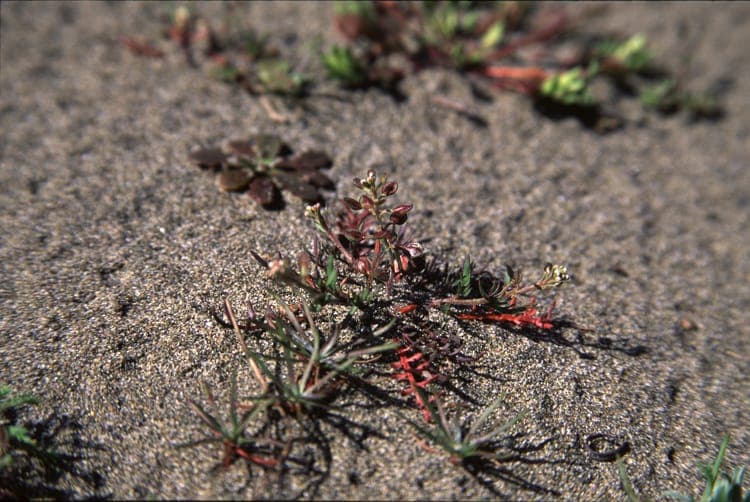
Gordon Leppig & Andrea J. Pickart / Public domain, via Wikimedia Commons
Shining pepperweed: complete guide
Lepidium nitidum
Want to see Shining pepperweed: complete guide in your garden?
1 minute, no credit card
Overview
Lepidium nitidum, known in English as shining pepperweed or shining pepperwort, is an annual or biennial herb in the mustard family (Brassicaceae). Described by Nuttall in 1838, it grows natively along the western coast of North America from Washington and Oregon through California to Baja California and the Mexican Pacific Islands. Remarkably, the species also has a native presence in central and southern Chile, giving it an unusually wide geographic range for an annual herb. The name 'nitidum' means 'shining' or 'lustrous' in Latin, a direct reference to the distinctively glossy surface of the ripe seed pods - one of the features that makes this species identifiable among the many Lepidium relatives of the Pacific Coast. As a largely coastal and near-coastal plant, it favours open, grassy habitats, disturbed ground, and field margins in areas with mild winters and dry summers. Gardeners interested in native coastal plantings will find creative ideas for naturalising such species at gardenworld.app.
Appearance and bloom cycle
Shining pepperweed forms a somewhat spreading plant, typically 10 to 35 cm tall, with multiple ascending stems arising from a basal rosette - a multi-stemmed growth form that gives it a slightly bushier appearance than some of its relatives. The leaves vary in shape along the stem: the lowest are stalked and pinnately divided or deeply lobed, while upper leaves are narrower, less divided, and often partially clasp the stem. The glossy finish that characterises the ripe fruits is also partially visible on the upper leaf surface, which has a slightly lacquered look in bright sun. Flowers are small, white, and four-petalled, arranged in elongating terminal racemes. Bloom time runs from February through May depending on coastal elevation and local climate. The signature feature of this species is its silicles - the small seed pods of 3 to 5 mm that develop after flowering. Unlike the hairy pods of Lepidium lasiocarpum, the silicles of L. nitidum are smooth and conspicuously glossy, which catches the light and gives the fruiting plant a distinctive visual quality. Seeds are dispersed by wind or animal contact in late spring to early summer.
Ideal location
This species thrives in open to lightly shaded positions with reasonable air movement. In its natural coastal habitat it grows on grassy hillsides, sandy flats, field edges, and disturbed ground - often in areas with some wind exposure. It is well adapted to the mild, wet winters and dry summers of the California and Oregon coast. In garden settings it is suitable for naturalistic borders, gravel beds, open lawn margins, and coastal rock gardens. It tolerates slightly more shade than most Lepidium species, though bloom is heaviest in full sun. USDA hardiness zones 7 through 10 describe the range where the species can be grown as a self-sustaining perennial presence; in cooler zones it can be treated as a spring annual.
Soil
Lepidium nitidum prefers free-draining, lightly acidic to neutral soil with a pH of 5.3 to 7.5. In the wild it grows on sandy coastal loams and occasionally on light clay soils where drainage is adequate. Heavy clay soils that hold water are unsuitable and lead quickly to root rot. Incorporating coarse sand or fine gravel into heavier garden soils before sowing significantly improves drainage and creates more suitable growing conditions. The species is not demanding in terms of nutrients and performs well on moderately poor ground; over-fertilised beds produce lush but weak plants with reduced drought resistance.
Free design
Want to see Shining pepperweed: complete guide in your garden? Make a free design now.
Watering
Shining pepperweed is reasonably drought tolerant once established, but it has somewhat higher moisture requirements than the driest-adapted Lepidium species, reflecting its origin in the moister coastal climate of the Pacific West. During germination and early growth, regular moderate watering helps seedlings establish. Once growing well, the plant survives dry periods without lasting damage, but it flowers more freely when the soil does not dry out completely. In a Mediterranean garden climate with dry summers, watering once a week to once a fortnight during the flowering season gives good results. Standing water and waterlogged soil should always be avoided to prevent fungal problems at the root level.
Pruning
As an annual or biennial, Lepidium nitidum completes its life cycle at seed set and then dies back naturally. Conventional pruning is not relevant. Gardeners who want to limit self-seeding can remove the fruiting stems as the silicles approach full maturity but before they release seeds. In a naturalistic planting, allowing the plants to seed freely is the simplest approach and ensures reliable colonies in subsequent years. The glossy seed clusters are attractive enough to leave in place for much of the summer; dried stems can be removed once they have turned fully brown and the seeds have been dispersed.
Maintenance calendar
January - February: prepare seed beds by clearing weeds and improving drainage if needed. February - March: direct-sow seeds at the soil surface or with a light covering; coastal sites at low elevation can be sown as early as February. March - May: flowering period; minimal intervention needed. May - June: silicles ripen and take on their characteristic gloss; collect seed if desired or allow natural dispersal. July: remove dried stems or leave as light mulch. August - September: a second generation may germinate with early autumn rains on mild coastal sites. October - November: in zones 8 and above, germinated rosettes can overwinter successfully. December: dormant period; no active care needed.
Winter hardiness
Lepidium nitidum overwinters primarily as seed in annual mode. In the mild coastal climates of its native range - USDA zones 8 through 10 - it can also behave as a biennial, with a frost-tolerant basal rosette overwintering and then producing flowers and seeds in the following spring. In zone 7, top growth is killed by hard frost but seeds in the soil germinate reliably the following spring. The species is not suited to prolonged hard winters below zone 7 as an outdoor perennial. In cooler regions it can be grown as a spring annual, sowing seed in early spring after the last frost. On gardenworld.app you can find design ideas for incorporating such self-seeding annuals and biennials into naturalistic planting schemes that stay interesting across multiple seasons.
Companion plants
Shining pepperweed combines naturally with other native coastal and meadow species of western North America. Good companions include Camassia leichtlinii and Camassia quamash for moist but well-drained settings, Sidalcea malviflora (checkerbloom), low-growing Clarkia species, and small native onions such as Allium unifolium. In drier garden settings it pairs well with California poppy (Eschscholzia californica) and Phacelia tanacetifolia. Its glossy fruits provide an attractive textural contrast to the matte foliage of drought-adapted perennials, and the light green colour of the flowering stems adds freshness to plantings that are otherwise dominated by silver-grey or brown tones. Local pollinators - particularly small native bees - visit the flowers regularly during the bloom period.
Closing thoughts
Lepidium nitidum is a little-known but genuinely distinctive species that deserves wider attention from gardeners drawn to native western North American flora. Its glossy seed pods, modest but freely borne white flowers, and self-seeding habit make it a reliable presence in naturalistic planting schemes. It asks for little beyond good drainage and a sunny position, thrives on lean ground, and returns year after year when conditions allow - a quiet but valuable contributor to any low-maintenance, biodiversity-oriented garden.
Want to see Shining pepperweed: complete guide in your garden? Make a free design now.
Upload a photo, pick a style, and get a photorealistic design with plant list in under a minute.
10,000+ gardens designed already
No credit card required


Similar plants
Hairy-pod pepperwort: complete guide
Lepidium lasiocarpum
A full growing guide for Lepidium lasiocarpum, the hairy-pod pepperwort from the American Southwest. Location, soil, and care tips.
Mountain pepperweed: complete guide
Lepidium montanum
Full growing guide for Lepidium montanum, the mountain pepperweed from western North America. Location, soil, hardiness and companion planting covered.
Lepidium campestre: complete guide
Lepidium campestre
Learn all about Lepidium campestre (Field pepperwort), a charming annual herb. Cultivation guide, soil requirements, care tips, and garden design ideas.