
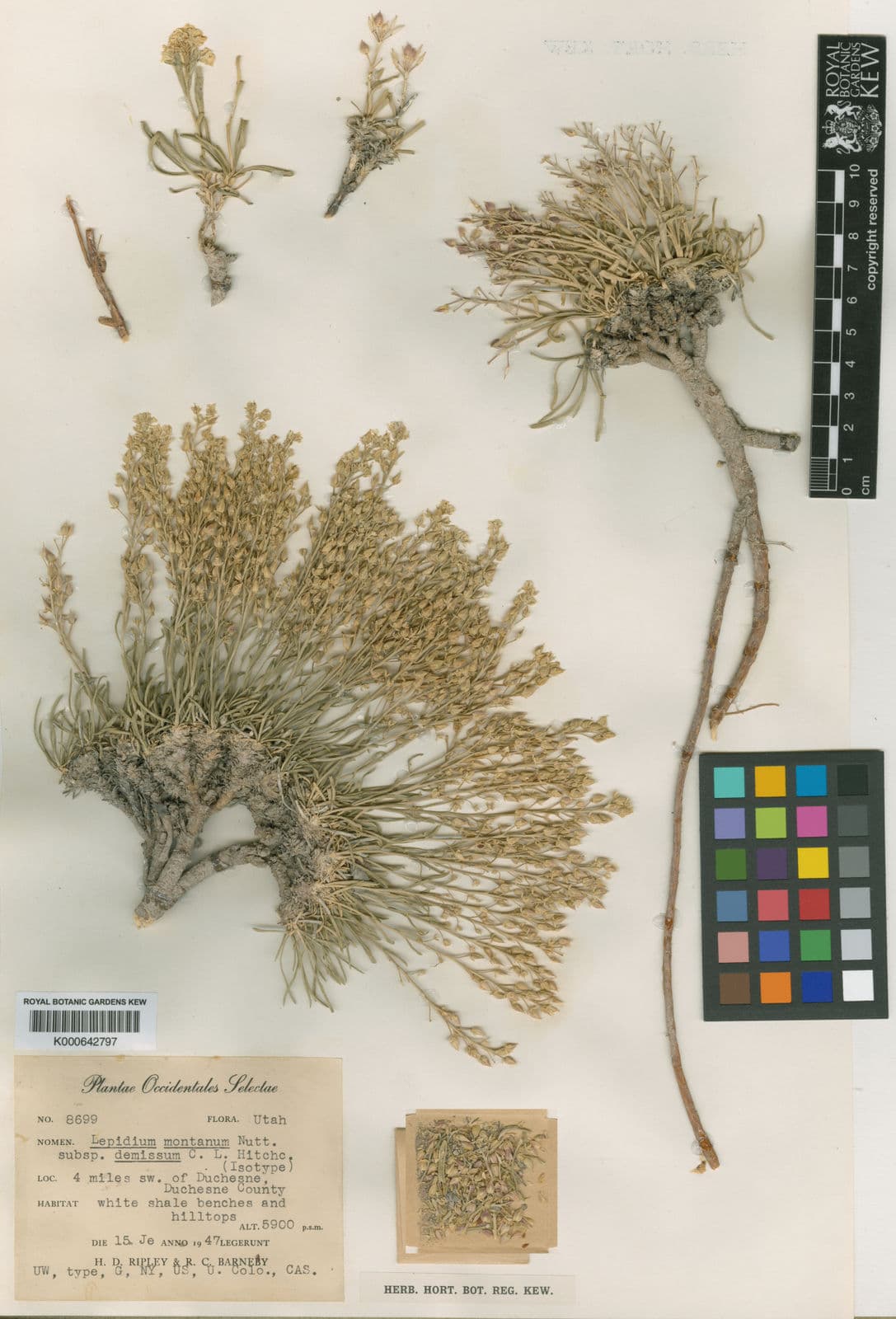
Barneby's pepperwort: complete guide
Lepidium barnebyanum
Want to see Barneby's pepperwort: complete guide in your garden?
1 minute, no credit card
Overview
Lepidium barnebyanum, known in English as Barneby's pepperwort or Barneby's pepperweed, is a rare annual to perennial herb belonging to the family Brassicaceae. It is a strict endemic species found only in western Utah, in Uintah County and surrounding areas - one of the most geographically restricted distributions of any North American member of the Brassicaceae family.
The species was named after Rupert Charles Barneby (1911-2000), one of the most influential American botanists of the twentieth century. Barneby was a specialist in western North American flora and described hundreds of new species during his decades-long career at the New York Botanical Garden. His namesake plant, Lepidium barnebyanum, was described as a new species in 1985, long after Barneby had made his first major botanical contributions.
The rarity of Lepidium barnebyanum stems directly from its exceptionally specific habitat requirements. The plant grows exclusively on gypsum-bearing soils in the dry basin landscape of western Utah, at elevations ranging from 1,400 to 1,900 metres. Gypsum soils are sulphate-rich, calcium sulphate-dominated substrates that are toxic or uninhabitable for most plants due to high sulphate concentrations, low water retention and a specific mineral balance. Only a small number of plant species are specialised to survive on this extreme substrate - Lepidium barnebyanum is one of them.
Due to its extremely limited range and sensitivity to habitat disturbance, Lepidium barnebyanum is listed as a threatened or vulnerable plant and subject to strict protection in its native habitat. In the gardening world the plant is virtually unknown, but for the specialist and enthusiast of rare drought-tolerant plants it is a fascinating species with an extraordinary story.
At gardenworld.app you can explore garden designs that show how rare and distinctive drought-tolerant plants can take a prominent role in modern, low-water front gardens - an inspiration for anyone who takes the rock garden concept seriously.
Appearance & bloom cycle
Lepidium barnebyanum is a compact plant of 10 to 25 cm in height with a spread of 15 to 30 cm. The growth habit is cushion-forming to rosette-like, with a central rootstock that produces multiple flowering stems during the growing season. The leaves are narrow, linear to spatulate, grey-green in colour, 1 to 4 cm in length, with a smooth to lightly hairy surface.
The flowering period falls in April to June. The flowers are small - 2 to 4 mm across - but white and present in large numbers in compact racemes above the foliage. Individual flowers have four white petals in the typical cruciform pattern of the Brassicaceae. Due to the small scale of individual flowers, the mass blooming is nonetheless convincing: a well-growing specimen is temporarily covered with a carpet of tiny white flowers that together create a considerable visual impact.
After flowering the plant produces small, disc-shaped fruits (siliculas) of 3 to 5 mm diameter, characteristic of the genus Lepidium. The fruits are green to grey-green, turning brown as they ripen, and typically contain two small seeds per fruit. Seed dispersal occurs via wind and mechanical disturbance - the dry, lightweight seed pods open on contact or in a gust of wind.
The overall habit of Lepidium barnebyanum is modest but distinctive. In its natural habitat the plant stands out through its compact, ordered form against the otherwise harsh gypsum landscape. The grey-green leaf colour, white flower clusters and small disc-shaped fruits give the plant a subtle elegance that catches the experienced eye among the spiny and grey desert vegetation.
Ideal location
Lepidium barnebyanum requires a fully sunny position with maximum direct sun throughout the day. The plant is adapted to the intense sun of the Utah highlands, where cloud cover is rare and solar radiation is strong. In European gardens a south-facing or south-west-facing position is the preferred choice.
Given the plant's extremely specific habitat requirements - gypsum-rich soils with excellent drainage and minimal organic matter - cultivation in European garden conditions is a challenge. The plant thrives best in specially constructed rock gardens or in large, well-draining containers with a substrate that approximates the gypsum conditions of its native range.
An open, airy position without competition from trees or large shrubs is essential. Lepidium barnebyanum is not a good neighbour for large, aggressive plants that compete for space, light and mineral resources. Its compact size and specific soil requirements make it more suitable as a specialist specimen in a carefully designed dry border than as a mass planting in a mixed border.
In its native range the plant grows in a dry continental climate - hot summers, cold winters and little precipitation year-round. The climate differences from temperate European conditions are significant, but the plant is adaptable provided soil conditions are right. Visit gardenworld.app for inspirational examples of specialist rock gardens and dryscape designs.
Soil requirements
The most critical factor in successfully growing Lepidium barnebyanum outside its native range is soil composition. The plant is specialised for survival on gypsum-bearing soils - soils dominated by calcium sulphate (CaSO4) and related sulphate minerals. These are exceptionally lean, poorly water-retaining soils with a specific mineral balance that is uninhabitable for most plants.
For planting in a European garden, mimicking gypsum conditions is the key to success. Mix the soil with broken gypsum or gypsum granules (calcium sulphate, available as a building material or garden product), coarse quartz sand and fine grit in an approximate ratio of 1:2:1. The pH of such a mixture settles around 7.0 to 7.5, which closely matches the alkaline native environment of the plant.
Avoid any addition of organic material - compost, leaf mould, peat or bark - since Lepidium barnebyanum is adapted to the absence of organic nutrients. Overly rich soil promotes lush but vulnerable growth that harms rather than benefits the plant.
Drainage is critical. The gypsum-rich soils of western Utah are porous and dry. Water must never stagnate around the roots. In areas with high water tables or heavy clay soil, raised beds or container culture is the only viable option.
For container cultivation: use a terracotta pot or container with at least four drainage holes, filled with the gypsum-sand-grit mixture above. Place the pot on a stand to guarantee free water drainage from the base.
Free design
Want to see Barneby's pepperwort: complete guide in your garden? Make a free design now.
Watering
Lepidium barnebyanum is extremely drought-tolerant, adapted to the arid desert conditions of its limited native range in western Utah. In its natural habitat, precipitation falls mainly in winter and early spring as snow and rain, with a dry, hot summer. Total annual rainfall in this area is only 200 to 300 mm - comparable to the driest parts of southern Spain.
In European gardens - where total rainfall is considerably higher than in Utah - the greatest risk factor for Lepidium barnebyanum is waterlogging, not drought. Excellent soil drainage is the most fundamental requirement.
In the first growing season after planting, water once per week in dry, warm conditions during the first six weeks. Then drastically reduce watering frequency. Always wait until the soil is completely dry to a depth of at least 10 cm before watering again.
From the second season onward, supplemental irrigation in the Dutch or Belgian climate is generally entirely unnecessary. Watering in autumn and winter is strictly inadvisable - this is the most common cause of losses with this species in European gardens. Only during extreme summer heat of more than four weeks without any rainfall is a modest watering permitted.
At gardenworld.app you will find multiple examples of drought-tolerant garden designs where irrigation is reduced to an absolute minimum.
Pruning
Lepidium barnebyanum requires virtually no pruning. The compact, rosette-like growth habit of the plant determines its own form without human intervention. Restraint in pruning activity is the best approach.
After flowering in June or July you can clip off spent flower stems if you want the plant to look tidier. This is not strictly necessary - the small seed pods are also decorative and provide food for small seed-eating birds. If you want to limit self-seeding, remove the seed heads before they are fully ripe and shatter.
In early spring, at the beginning of March, remove dead or frost-damaged stems. Cut back to just above the first live shoots at the base. Always use sharp, well-cleaned secateurs. Disinfect tools to prevent transfer of fungal diseases.
Pruning in summer or autumn is generally unnecessary for Lepidium barnebyanum - the plant is compact enough to manage its own size. Hard cutting back, reducing the plant to the ground, is dangerous and can lead to the death of the plant, especially in combination with wet soil.
The general rule for this fragile endemic: less is more. Any intervention that weakens the plant in its already specific survival balance can prove fatal.
Maintenance calendar
January and February: Full dormancy. Check drainage during prolonged rainfall or thaw. Ensure no water stagnates around the base. No pruning and no irrigation.
March: Inspect for frost damage. Carefully remove dead stems. Check for new green shoots at the base. No fertilisation.
April: Flowering begins. Enjoy the small white flower clusters. No pruning during flowering. No supplemental watering unless the winter was extremely dry.
May and June: Peak flowering. Attractive to small insects. After flowering: optionally remove flower stems to limit seed dispersal.
July: Clip away spent stems or leave for birds. During extreme summer heat of four or more weeks of drought, a limited watering is permissible.
August and September: Summer rest. High temperatures are well tolerated. No pruning and no fertilisation.
October and November: Autumn. No pruning. No irrigation. Check that drainage around the plant continues to function during autumn rainfall.
December: Full rest. Do not disturb the plant. Check drainage during prolonged rainfall.
Winter hardiness
Lepidium barnebyanum is hardy to USDA zone 5 to 6, corresponding to minimum temperatures of -23 to -15 degrees Celsius. This makes the plant theoretically suitable for gardens in the Netherlands, Belgium and large parts of Germany and Great Britain. In practice the picture is more nuanced.
The plant's winter hardiness depends heavily on soil conditions. In its native Utah habitat, Lepidium barnebyanum survives cold, dry winters with temperatures well below freezing thanks to the excellently draining, gypsum-rich soil that holds no water and keeps roots dry even at low temperatures. In European winters - which are typically wetter and milder but also more temperature-variable - the risks are greater.
The combination of wet soil and frost is potentially lethal for this plant. Roots can freeze in wet soil at lower temperatures than in dry soil. Good drainage is therefore the absolute first priority in winter preparation.
In areas with mild winters (USDA zone 8 and warmer), Lepidium barnebyanum can generally overwinter without problems, provided drainage is good. In colder regions a light protective layer of dry grit around the plant base is advisable during periods of hard frost.
For container culture: bring the pot into a cool, frost-free but unheated space when temperatures fall below -10 degrees Celsius. This protects the roots from freezing through the container walls. Visit gardenworld.app to discover how to design low-moisture borders that work year-round.
Companion plants
Due to its specific soil requirements, Lepidium barnebyanum is not an easy partner for most garden plants. The best results are achieved by combining it with other plants that thrive on gypsum-rich, dry, alkaline soils - a select group of specialists.
Suitable garden partners that tolerate comparable extreme soil conditions:
- Lepidium alyssoides (mesa pepperwort): the closely related species from the same genus is also adapted to dry, alkaline and mineral-rich soils. The two species make an interesting botanical combination in a gypsum rock garden.
- Atriplex canescens (four-wing saltbush): a sturdy sub-shrub of 60 to 120 cm that thrives on alkaline, gypsum-rich soils. Grey-white foliage provides colour contrast.
- Eriogonum corymbosum (cyme buckwheat): a low desert shrub of 30 to 60 cm with small yellow-white flower clusters, naturally occurring in the gypsum-rich deserts of Utah and Nevada.
- Cryptantha flava (yellow cryptantha): a small, low plant of 10 to 20 cm with yellow to white flowers, also specialised for gypsum substrates in the Intermontane West.
- Phlox austromontana (mountain phlox): a compact, cushion-like phlox of 10 to 20 cm with pink to white flowers, tolerant of dry, mineral-rich positions.
Avoid pairing with common garden plants that prefer nutrient-rich, moisture-retaining soil, such as roses, hostas or astilbes. The soil conditions required for Lepidium barnebyanum are incompatible with those of most standard garden plants.
Closing
Lepidium barnebyanum is a botanically exceptionally rare and ecologically fascinating plant that few gardeners will ever encounter in the wild. Its extremely limited range in western Utah, its sensitivity to habitat disturbance and its status as a protected species make it a plant that above all deserves protection in its native habitat.
For the specialist gardener who enjoys extreme challenges and extraordinary plant stories, however, Lepidium barnebyanum is a unique acquisition: compact, weather-resistant on the right soil, and steeped in the botanical history of a remarkable discovery journey in the desert landscape of Utah. Visit gardenworld.app for more inspiration on how rare drought-tolerant specialists like Lepidium barnebyanum can be integrated into a modern, low-water garden design.
Want to see Barneby's pepperwort: complete guide in your garden? Make a free design now.
Upload a photo, pick a style, and get a photorealistic design with plant list in under a minute.
10,000+ gardens designed already
No credit card required

