
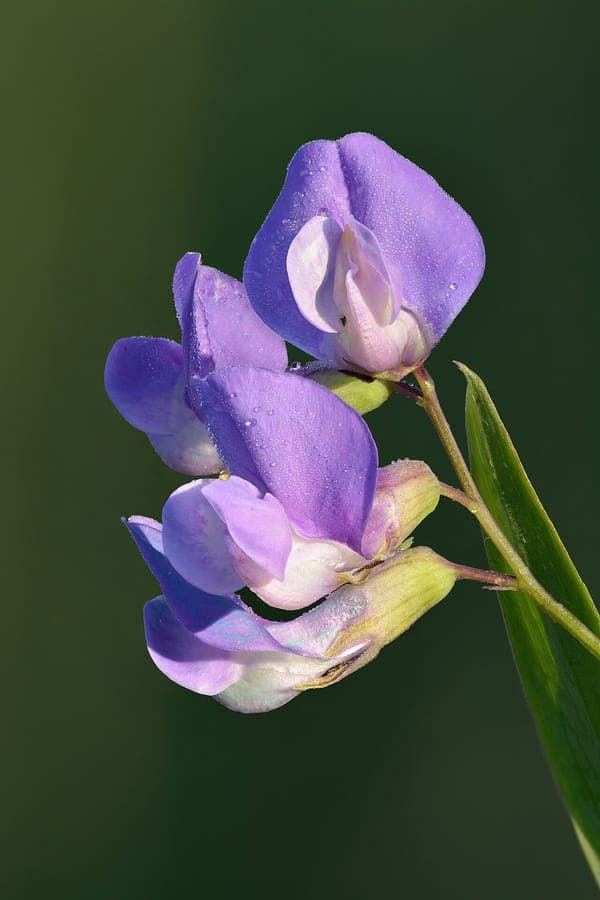
Ivar Leidus / CC BY-SA 4.0, via Wikimedia Commons
Marsh vetchling: complete guide
Lathyrus palustris
Want to see Marsh vetchling: complete guide in your garden?
1 minute, no credit card
Overview
The marsh vetchling (Lathyrus palustris) is a slender, delicate wildflower native to subarctic and temperate regions of the Northern Hemisphere. This perennial thrives in vulnerable, wet soils - marshes, wetlands, and damp grasslands - where its enchanting purple flowers stand out against green vegetation. Though underutilized in gardens, it offers exceptional ecological value and fits perfectly in wetland-inspired garden designs.
Marsh vetchling combines exceptional hardiness (USDA 3-9) with a love of wet conditions, making it ideal for gardens in the Netherlands, Belgium, northern France, and Germany. On gardenworld.app, you could integrate this plant into water-margin plantings, wetland gardens, or ecological designs where water management is central.
Appearance and bloom
Marsh vetchling grows as a delicate, climbing perennial reaching 40-80 cm tall, with fine, blue-green foliage and thin, flexible stems that wind upward through surrounding plants via tendrils. The leaves are pinnate, composed of four to six pairs of leaflets, each 2-3 cm long, with a simple, elegant appearance.
Flowers appear in June and July in loosely arranged clusters of 3-8 blooms per raceme. Each flower is approximately 1.2 cm long, violet to purple, with the characteristic butterfly-flower form. They grow on thin stalks, creating a delicate, nature-friendly impression. Following bloom, small linear seed pods (3-4 cm) develop, ripening in August.
Ideal location
Marsh vetchling flourishes in wet to damp soils, especially where seasonal water or permanent moisture occurs. It thrives in half-shade to full sun environments (at least 4-5 hours of daylight). It is not fussy about sunlight provided the soil remains consistently moist.
In garden designs on gardenworld.app, position it along water margins, in wetland planting zones, or in moist low-lying garden areas where other perennials struggle. It combines beautifully with other moisture-tolerant perennials.
Soil and nutrition
Marsh vetchling grows optimally in heavy, moist clay soils rich in organic matter. It even tolerates periodic flooding. It adapts to pH 6.0-7.5 but also grows in slightly acidic conditions. As a legume (Fabaceae), it fixes its own nitrogen, so artificial fertilization is rarely needed.
During initial root establishment, work compost into planting holes. Thereafter, natural soil enrichment via organisms suffices. In very poor soils, light kelp fertilizer in early spring helps, but usually this is unnecessary.
Free design
Want to see Marsh vetchling: complete guide in your garden? Make a free design now.
Watering
Marsh vetchling demands consistently moist soil - this is its paramount requirement. In dry summers, water regularly, especially in the first growing year. Ideally, maintain permanently moist or even intermittently wet conditions, mimicking its characteristic habitat.
During very dry periods - more than 2-3 weeks without rain - water deeply. Once established (after year 2), it is relatively robust, provided it never completely dries during critical growth periods.
Pruning and maintenance
Marsh vetchling requires minimal maintenance. Allow it to grow and climb naturally through surrounding plantings. After flowering (September), remove dead stems. Since it self-seeds freely, harvest seed pods before splitting if you wish to prevent unwanted seedlings.
In spring, clear away previous year's dead foliage before new growth emerges. No pruning is needed - the plant is elegant and delicate by nature.
Maintenance calendar
April-May: Young plants emerge. Monitor soil moisture levels.
June-July: Flowering period. Water regularly during dry spells.
August-September: Seed pods ripen. Harvest seeds for future sowing.
October-November: Foliage dies back. Allow natural senescence.
December-March: Winter dormancy. Monitor soil moisture status.
Winter hardiness
Marsh vetchling is exceptionally winter-hardy in USDA zones 3-9. It tolerates temperatures to -35°C without damage. This makes it ideal for northern Europe, Scandinavia, and throughout the temperate north. In the Netherlands, Belgium, France, and Germany, no winter protection is necessary. The plant survives harsh winters effortlessly, especially in wet, boggy habitats where ice provides insulation against extreme cold.
Companion planting
Marsh vetchling pairs beautifully in moist planting zones with:
- Other moisture-lovers: Lobelia cardinalis (cardinal flower), Filipendula (meadowsweet), or Iris sibirica create layered texture.
- Climbing companions: Alongside other climbing plants in wetland settings, providing support for tendrils.
- Ground covers: Mentha (mint) or Lysichiton as a base layer for structural variety.
- Tall accents: Lythrum (loosestrife) or Eupatorium as background for depth.
On gardenworld.app, visualize these wet, ecological planting zones perfectly in 3D.
Final tips
Marsh vetchling is an enchanting plant for those with wet garden sites. Ensure soil moisture remains consistent - this is essential. Plant alongside other moisture-tolerant perennials for a harmonious ecological design. Seeds can be verified for multiplication or future sowing.
For a perfectly laid-out wetland or marsh garden design featuring marsh vetchling, create a design on gardenworld.app. With photorealistic 3D visualization, see how this delicate climber winds through your moisture-rich zones. Design now and create your ecological dream garden.
Want to see Marsh vetchling: complete guide in your garden? Make a free design now.
Upload a photo, pick a style, and get a photorealistic design with plant list in under a minute.
No credit card required


Similar plants
Meadow vetchling (Lathyrus pratensis): complete guide
Lathyrus pratensis
Discover meadow vetchling, a vital host plant for butterflies. Growing tips, June-July bloom, and role in biodiversity gardens.
Narrow-Leaf Everlasting-Pea: complete guide
Lathyrus sylvestris
Learn about Narrow-Leaf Everlasting-Pea (Lathyrus sylvestris): growing, care, and tips for this hardy climbing perennial.