
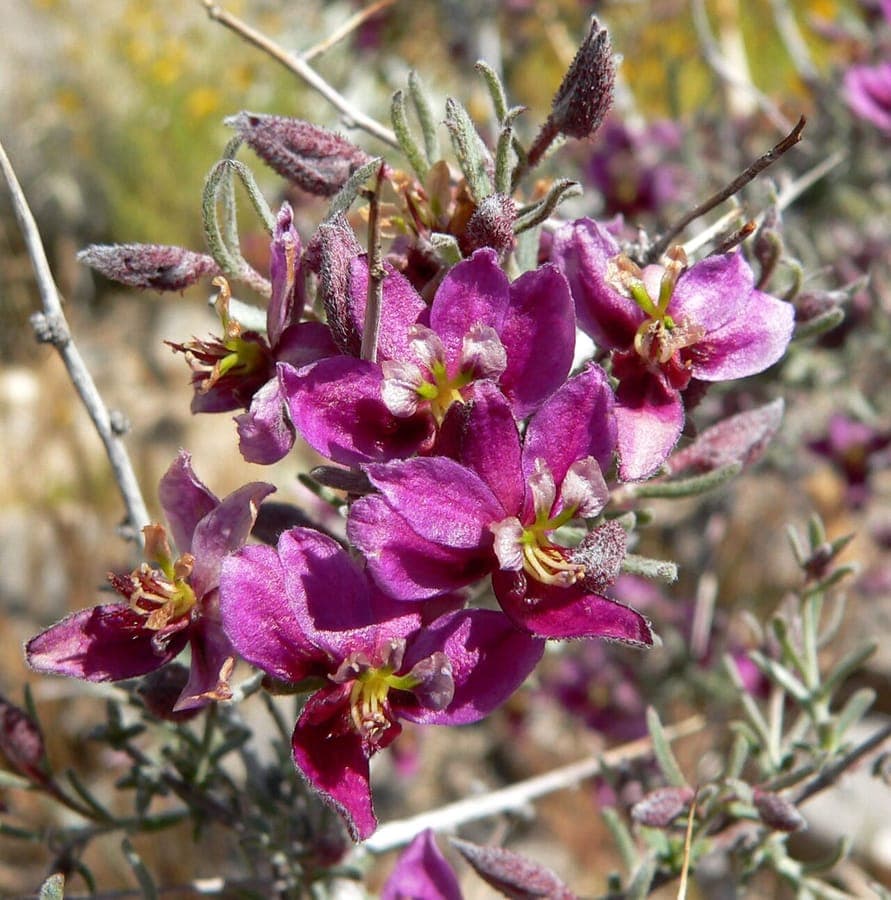
Stan Shebs / CC BY-SA 3.0, via Wikimedia Commons
Littleleaf ratany: complete guide
Krameria erecta
Want to see Littleleaf ratany: complete guide in your garden?
1 minute, no credit card
Overview
Krameria erecta, commonly known as littleleaf ratany or range ratany, is a compact perennial subshrub belonging to the family Krameriaceae. This distinctive plant family contains only the genus Krameria, comprising approximately eighteen species distributed exclusively in arid and semi-arid regions of North and South America. Krameria erecta itself is native to the dry regions of the southwestern United States - Arizona, California, Nevada, Texas and Utah - and into adjacent northern Mexico.
The common name 'littleleaf ratany' refers to its characteristically small, sparse leaves that are well adapted to extreme drought. In its natural habitat - the Sonoran Desert, the Chihuahuan Desert and related Mojave scrublands - the plant grows on rocky slopes, gravelly flats and limestone plateaux at elevations of 300 to 1,800 metres. It ranks among the most drought-tolerant shrubs in the southwestern United States.
For the gardener, Krameria erecta is attractive for its ornamental purple flowers, compact size and exceptional tolerance for heat, drought and poor soil. The plant is also hemiparasitic on the roots of neighbouring plants - a rare trait in the plant kingdom that makes it ecologically remarkable. On gardenworld.app you can view garden designs featuring drought-tolerant shrubs like Krameria in modern, water-saving front garden layouts.
The shrub typically reaches 30 to 60 cm in height with a spread of 60 to 120 cm. The branches are grey to silver-grey and clothed with tiny, strap-shaped leaves barely 5 to 15 mm long. Mature specimens develop a characteristic dense, rounded or hemispherical growth structure that holds up well even under extremely dry conditions.
Appearance & bloom cycle
Krameria erecta is a plant with a distinctively ornamental flowering that does not immediately suggest it survives in one of the harshest environments on earth. The flowers are small - averaging 1 to 1.5 cm across - but remarkably beautiful in colour: deep rose to magenta-purple, with five petals of which the upper three are narrower and the lower two are wing-like and fleshy. This distinctive flower structure is characteristic of the genus Krameria and makes the plant immediately recognisable.
The main flowering period falls from March to June, with a possible second flowering after summer monsoon rains in August to September. In garden conditions outside the plant's native range, the flowering period may vary depending on climate and position. The flowers are highly specialised for pollination by specific bee species - particularly oil-collecting bees of the genus Centris - which harvest oils from the petals as food for their larvae.
After flowering, Krameria erecta produces small, spherical fruits about 8 to 12 mm in diameter, covered with rigid, barbed spines. These spines ensure dispersal by animals and clothing. The fruits are not toxic but also not edible. The seed coat contains tannins that were traditionally used for leather tanning and medicinal purposes by indigenous peoples of the southwest.
The foliage of Krameria erecta is small and grey-green in colour with a soft indumentum that protects the plant from desiccation and excessive sunlight. Leaves are alternately arranged and remain on the plant year-round in mild temperatures; in severe frost some leaf drop may occur temporarily. The overall impression is open yet dense, grey-green with purple highlights during the flowering season.
Ideal location
Krameria erecta requires a fully sunny position with at least six to eight hours of direct sun per day. The plant cannot tolerate shade and produces virtually no flowers in partial shade. In European horticulture a south-facing or south-west-facing position is the best choice.
The plant is ideal for rock gardens, gravel gardens and xeriscaping projects - garden styles where water use is minimised. It thrives on dry slopes, alongside low stone walls and on well-drained ground where other plants fail. Krameria erecta can also function as a nurse plant helping other plants establish thanks to its root associations - however, be aware of its hemiparasitic nature, as it draws nutrients from neighbouring root systems.
The plant is heat-tolerant to temperatures rarely reached in European conditions - in its native range it survives summer maxima of 45 degrees Celsius and above. The combination of heat and drought poses no problem; it is prolonged cold and wetness that can cause damage.
In Dutch and Belgian gardens, Krameria erecta works best as a specimen plant in a sunny, well-drained border or in a gravel garden with a south-facing aspect. Do not plant it near valuable ornamental trees or plants that cannot withstand root competition from a hemiparasite.
Soil requirements
Krameria erecta is almost arrogant in its soil demands: it requires extremely well-draining, lean soil and refuses to thrive in wet or fertile ground. In its natural habitat the plant grows on coarse sand, gravel, crushed rock and limestone substrate with a pH of 7 to 8.5 - slightly alkaline to strongly alkaline.
For planting in typical European garden soil: mixing in at least 40 to 50 percent coarse grit, quartz sand or crushed stone is almost always necessary. In heavy clay soils most specimens do not survive their first wet winter. Good drainage starts with laying a drainage layer of at least 20 cm of coarse gravel under the planting zone.
Nutrients are barely needed. Do not fertilise Krameria erecta with nitrogen-rich fertilisers - this promotes lush but vulnerable growth and reduces flowering and winter hardiness. A single light application of potassium phosphate in spring is the maximum fertiliser input the plant can tolerate.
Soil pH may be higher than typical in European gardens. If needed, add a handful of garden lime or dolomite at planting time. Avoid acidic peat or compost that lowers pH. Krameria is a lime-lover accustomed to the alkaline conditions of rocky desert soil.
Free design
Want to see Littleleaf ratany: complete guide in your garden? Make a free design now.
Watering
Krameria erecta is among the most drought-tolerant plants that can be grown in a European garden. In its native range it inhabits zones receiving 150 to 400 mm of rainfall per year, concentrated in two seasons - winter rain and summer monsoon. Between those seasons the plant can survive for months without rain through its deep root system and low transpiration rate.
In the first year after planting some support during establishment is helpful: water once a week in dry, warm conditions during the first season. Always wait until the soil is completely dry to a depth of at least 10 cm before watering again. Overwatering is the most common cause of losses with this species in European gardens.
From the second season onward, supplemental irrigation is generally unnecessary in the Dutch or Belgian climate. Average annual rainfall of 600 to 800 mm in our region is more than adequate for an established Krameria erecta, provided drainage is excellent.
Watering in autumn and winter is strongly discouraged. The plant is more likely to survive a dry winter than a wet one. During prolonged summer drought - more than six weeks without rain - one thorough deep watering is permissible, followed by waiting again until the soil is completely dry.
Drip irrigation to root depth is preferred. Overhead sprinkler irrigation that wets the foliage increases the risk of fungal disease at lower temperatures.
Pruning
Krameria erecta requires little pruning and responds poorly to aggressive cutting back. The plant builds its own compact, rounded form without human intervention. Restraint is the key principle.
Once a year, in early spring, remove dead branches or branches damaged by frost. Cut always just above a live bud or branch junction. Use sharp, well-cleaned secateurs. Disinfect the tools before and after pruning with alcohol or a dilute bleach solution to prevent transmission of fungal diseases.
Light shaping in April or May is possible to encourage compactness or guide the plant in a desired direction. Never remove more than 20 to 25 percent of total volume in a single season. Hard cutting back - reducing the plant to just a few centimetres above the ground - is dangerous for Krameria erecta and can lead to dieback.
If you want to see the flowers - and you will - never prune during February to June, as this removes the developing flower buds. The best time to prune is after flowering in July, or in early autumn.
Leave the spent flowers and fruiting heads in autumn and winter - they not only provide food for seed-eating birds but give the plant an interesting winter structure as well.
Maintenance calendar
January and February: Full dormancy. Check drainage during prolonged rainfall. Ensure no water pools around the base of the plant. No pruning and no irrigation.
March: Inspect the plant for frost damage. Remove dead branches. Watch for the start of flowering. No fertilisation needed at this stage.
April: Peak of the spring flowering season. Enjoy the purple-pink flowers. Optionally apply a light dose of potassium phosphate if the plant appears low in vigour. No pruning during flowering.
May and June: Flowering winds down. Light shaping is possible after flowering. Check for damage spots and drought cracks in the soil. Begin reducing irrigation.
July and August: Possible second flowering period in areas with monsoon-like summer rainfall. Heat and drought are handled with ease. Stop irrigation unless extreme drought develops.
September: Summer rest. Fruits are ripening. Leave the spiny fruiting heads for birds. No pruning and no fertilisation.
October and November: Autumn. Light removal of damaged or crossing branches is possible. No irrigation in autumn.
December: Full rest. Leave the plant undisturbed. Check that drainage around the plant functions during heavy rainfall events.
Winter hardiness
Krameria erecta is generally rated as hardy to USDA zone 8, corresponding to minimum temperatures of approximately -12 degrees Celsius. This makes the plant suitable for the milder parts of the Netherlands, southern Belgium and Great Britain, but less reliable in colder inland or northern regions.
In practice, winter hardiness depends strongly on drainage. A plant standing in excellently drained, lightly alkaline soil can survive temperatures considerably lower than the official limit. A plant in wet or waterlogged soil may be killed by light frost of -5 degrees Celsius or even by prolonged cold above freezing.
In areas with winter temperatures below -10 degrees Celsius, consider mulching around the plant base with a thick layer of gravel or crushed stone. Avoid organic mulch such as bark or leaf compost directly around the stem, as this retains moisture and increases the risk of collar rot.
In cold and wet regions, growing Krameria erecta in a large, well-draining pot or terracotta container is a proven alternative. The pot can then be sheltered in an unheated, frost-free space during winter. Visit gardenworld.app for garden design examples showing how Mediterranean and desert plants can be incorporated into a European context.
Companion plants
Krameria erecta combines best with other drought-tolerant, sun-loving plants that share the same soil and water requirements. Avoid pairings with moisture-loving or nutrient-hungry plants that are incompatible with this desert shrub's growing conditions.
Suitable garden partners include:
- Encelia farinosa (brittlebush): similar habitat, yellow flowers that contrast beautifully against the purple-pink Krameria blooms. Both plants are natural neighbours in the Sonoran Desert.
- Larrea tridentata (creosote bush): robust desert shrub with yellow flowers and characteristic resinous scent. Tolerates the same extreme drought and heat.
- Agave americana (century plant): dramatic sculpture that complements the grey-green Krameria foliage with large, blue-grey rosettes.
- Salvia dorrii (purple desert sage): blue-purple flowers 30 to 60 cm tall, blooming at the same time or slightly ahead of Krameria and pairing perfectly with the purple-flowering shrub.
- Opuntia engelmannii (prickly pear): the spiny cactus creates an authentic Sonoran Desert habitat alongside Krameria.
- Nassella tenuissima (Mexican feather grass): the feathery, waving grass 40 to 60 cm tall adds movement and texture to the border without demanding much water.
Avoid planting beside deep-rooted ornamental trees or valuable garden plants whose roots could be affected by Krameria's hemiparasitic action. The parasitic effect is usually mild and not lethal to healthy mature plants, but in young or weakened specimens it can cause noticeable growth stagnation.
Closing
Krameria erecta is a botanically exceptional desert shrub with outstanding ornamental and ecological value. Its purple-pink flowers, compact habit and extreme drought tolerance make it a perfect choice for modern, water-saving front garden and rock garden designs.
It requires the most basic gardening care - a draining soil, full sun and almost no water - and rewards that minimal attention with seasonal flower colour that is extraordinary for a plant of such extreme origins. Visit gardenworld.app for more inspiration on low-water garden designs where unique drought specialists like Krameria erecta take centre stage.
Want to see Littleleaf ratany: complete guide in your garden? Make a free design now.
Upload a photo, pick a style, and get a photorealistic design with plant list in under a minute.
10,000+ gardens designed already
No credit card required


Similar plants
Acer pycnanthum: complete guide
Acer pycnanthum
Acer pycnanthum, the Japanese swamp maple, is a fast-growing tree with early red flowers and brilliant autumn color, ideal for damp garden settings.
Freeman maple: complete guide
Acer × freemanii
Everything about the Freeman maple (Acer x freemanii): a fast-growing shade tree with spectacular autumn colour for large gardens.
Silver vine: complete guide
Actinidia polygama
Discover silver vine (Actinidia polygama): a hardy climbing plant with silvery foliage, loved by gardeners and cats alike.