
Rror / CC BY-SA 3.0, via Wikimedia Commons
Shrimp plant: complete guide
Justicia brandegeeana
Want to see Shrimp plant: complete guide in your garden?
1 minute, no credit card
Overview
Justicia brandegeeana, commonly known as the shrimp plant, Mexican shrimp plant, false hop, or shrimp bush, is one of the most popular tender ornamental plants for use as a houseplant, patio plant, and container plant in temperate northern European climates. The species belongs to the Acanthaceae family and is native to Mexico and Central America - specifically the states of central and northeastern Mexico, Guatemala, Honduras, and El Salvador. In its natural habitat the shrimp plant grows as a low, multi-stemmed shrub at forest margins and in light shade beneath tropical trees.
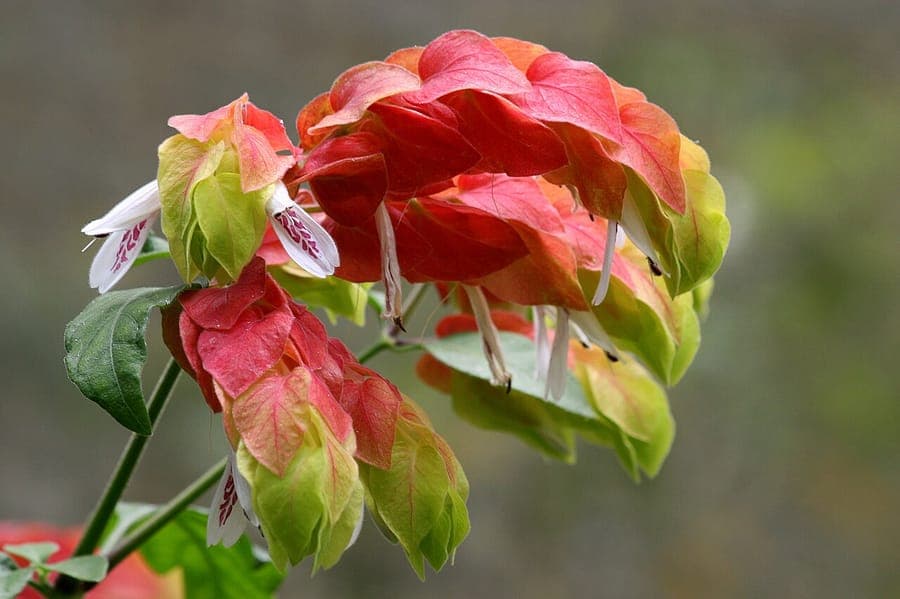
The common name 'shrimp plant' refers to the distinctive, arching flower spikes that resemble the curved body of a shrimp. The rust-brown, red, or salmon-orange bracts (modified leaves) envelop small, white tubular flowers spotted with purple on the lower lip. The botanical name honours the Californian plant collector Townshend Stith Brandegee (1843-1925), who described the species scientifically in the late nineteenth century. An earlier botanical name, Beloperone guttata, is still sometimes encountered in older references.
In Europe the shrimp plant became a popular houseplant and patio plant in the second half of the twentieth century. Its near-continuous, long-lasting flowering display, its relatively straightforward care requirements, and its exotic appearance make it a favourite among gardeners seeking colourful, distinctive plants for balconies and patios. At gardenworld.app you can explore how the shrimp plant can be incorporated into a patio or balcony planting scheme for a lasting, eye-catching colour effect.
The plant forms a compact, bushy shrub 60 to 90 cm tall (up to 150 cm in older specimens) and of similar spread. The stems are upright to slightly arching, lightly hairy, and become somewhat woody at the base with age. In good conditions the plant flowers virtually year-round - outdoors in the garden and on the patio from May to October, indoors throughout the year. The shrimp plant is not frost hardy and must be overwintered indoors or in a frost-free position.
Appearance & bloom cycle
The most striking feature of Justicia brandegeeana is its graceful, pendant flower spikes that genuinely resemble a curved shrimp. Each spike consists of a series of overlapping bracts arranged like roof tiles, enclosing small, two-lipped tubular flowers. It is the bracts that provide the decorative effect: they are 2 to 4 cm long, oval to kidney-shaped, and display a striking colour that varies from rust-brown through salmon-orange and red to yellow-green, depending on the cultivar. The most widely sold form has rust-brown to brick-red bracts; a yellow variant ('Yellow Queen') with olive-green bracts is also available.
The flowers themselves are small, white with purple spots on the lower lip, and protrude partway from between the bracts. They are visited by hummingbirds in the plant's native range, and in Europe by bees and bumblebees. Individual flowers are short-lived but the bracts - which create the ornamental effect - remain attractive for weeks to months.
The leaves are ovate to oblong, 5 to 8 cm long, mat to slightly glossy green, lightly hairy, with a clear midrib. They are arranged in opposite pairs on the stems and give the plant a full, lush appearance even when not in flower.
With adequate light and warmth, the shrimp plant flowers virtually year-round - a quality that sets it apart from many other ornamentals. Outdoors on the patio it flowers from May to October; as a houseplant throughout the year, with a slight dip in mid-winter when light intensity is lowest. After each flush of bloom, new shoots develop bearing fresh flower spikes.
Ideal location
Justicia brandegeeana thrives best in a bright position with indirect or filtered light. Full, unbroken midday sun can scorch the leaves and bleach the bracts. Indoors, the ideal position is directly in front of a bright east- or west-facing window, or at some distance from a south-facing window screened by net curtains or a blind. On a terrace or balcony: a position that catches morning sun and has light shade in the afternoon, or a sheltered position in indirect light.
In insufficient light - dark corners, far from a window - the plant will continue to grow but will produce little or no flower. The right position is essential for the best bloom. A dedicated plant light can support flowering indoors during the winter months.
Temperature: the shrimp plant thrives at normal indoor temperatures of 15 to 25 degrees Celsius. Temperatures above 28 to 30 degrees in full sun lead to leaf drop and decline. The minimum overwintering temperature is around 10 degrees Celsius: below this the plant becomes stressed, drops leaves, and may die back. Avoid cold draughts and direct air conditioning airflow.
Soil requirements
The shrimp plant has no demanding soil requirements but responds well to a well-draining, slightly acidic to neutral potting mix. Standard houseplant compost or a blend of houseplant compost and perlite in a 3:1 ratio is excellent. Drainage is essential: the plant cannot tolerate wet roots or standing water in the pot. Always use a pot with adequate drainage holes and never leave the pot sitting permanently in a saucer of water.
Repotting: repot the shrimp plant in spring (April-May) once the roots have filled the current container - check by sliding the plant out of the pot. Choose a pot only 2 to 3 cm larger than the previous one. Overly large pots hold excessive moisture and can encourage root problems.
Fertilising: feed the shrimp plant every two weeks from April to September with a complete liquid fertiliser for flowering plants (high in potassium and phosphorus, lower in nitrogen). Stop or significantly reduce feeding from October to March. Excess nitrogen fertiliser promotes leafy growth at the expense of flowers.
Repotting after winter: if the plant has become leggy or some stems have died back, prune first and then top-dress with fresh compost around the roots, or repot into fresh, well-structured potting mix.
Free design
Want to see Shrimp plant: complete guide in your garden? Make a free design now.
Watering
Watering is one of the most important aspects of shrimp plant care. The plant has moderate water requirements: the potting mix should remain lightly moist between waterings but must not remain waterlogged or dry out completely. A reliable rule of thumb: water when the top 2 to 3 cm of potting mix feels dry, water thoroughly until water runs from the drainage holes, then empty the saucer after 30 minutes.
In summer, at higher temperatures and in more sun, the plant may need watering two to three times per week. In winter, when the plant is in a cooler room and growing more slowly, once a week or less is sufficient. If the plant is overwatered - the potting mix remains constantly wet - yellowing leaves, root rot, and eventually plant death will result. If underwatered, leaves will droop and then drop.
Water quality: avoid hard, strongly alkaline tap water if it leads to white lime deposits on leaves. Rainwater or let-stand tap water is preferable. Water temperature: use water at room temperature or slightly warm - cold water causes stress.
Air humidity: the shrimp plant benefits from some atmospheric humidity. In dry indoor air during the heating season, mist the plant lightly once a week or stand it on a tray of wet pebbles to raise local humidity. This also promotes flowering and reduces the risk of red spider mite infestation.
Pruning
Pruning is crucial for maintaining a compact, free-flowering shrimp plant. Without pruning the stems become long, floppy, and sparsely branched, and flowering declines. Cutting back stimulates the formation of new, vigorous side shoots from which the new flower spikes develop.
Main prune in early spring (February-April): cut all stems back to one-third to one-half of their length, just above a leaf node. After pruning, new shoots appear rapidly. This is also the right time to remove any damaged, excessively weak, or completely bare stems.
The prunings make excellent cuttings: stem sections of 8 to 12 cm with two to three pairs of leaves can be inserted directly into moist cutting compost. Cover with clear plastic film or a plastic bag to maintain humidity. At room temperature the cuttings root in three to six weeks and make excellent gifts for fellow gardeners.
During the flowering period: remove spent flower spikes as the bracts fade and the flowers finish. This encourages the formation of new spikes and keeps the plant tidy. Small corrective cuts are acceptable throughout the year.
In autumn (September-October), when bringing the plant indoors for winter, the stems can be shortened to make the plant more manageable and to ease overwintering.
Maintenance calendar
January-February: Plant overwinters indoors at minimum 10-15 degrees Celsius with as much light as possible. Water sparingly. Do not feed. Check leaves for red spider mite.
March: Main prune: cut all stems back to one-third to one-half. Repot if necessary. Begin light feeding. Increase watering as new shoots appear.
April-May: Vigorous regrowth. Begin fortnightly feeding. After 15 May, move carefully outdoors to a sheltered, bright position.
June-July: Full flowering. Water regularly - more frequently in warm, sunny weather. Remove spent flower spikes. Feed fortnightly.
August: Peak flowering. Avoid heat stress and water stress. Lightly prune for better branching if desired.
September: Temperatures drop. Allow the plant to adjust gradually to cooler evenings. Bring indoors before the first night frost.
October: Plant is back indoors. Reduce watering. Stop feeding. Shorten stems if needed for overwintering.
November-December: Quiet overwintering period. Minimal care. Check regularly for pests and fungal issues.
Winter hardiness
Justicia brandegeeana is not frost hardy in northwest European climates. The plant tolerates brief temperatures down to about 5 degrees Celsius but prefers overwintering at a minimum of 10 degrees Celsius, ideally 12 to 15 degrees. Prolonged exposure to temperatures below 10 degrees leads to leaf drop, halted growth, and potential dieback of stems.
The correct approach for overwintering is: bring the plant indoors in September or early October, before the first night frost. A bright, cool room (12 to 15 degrees) is ideal. During overwintering, water sparingly - once a week or less, only when the top half of the potting mix feels dry - and do not feed. The plant may rest somewhat and lose some leaves in winter, but should not become completely bare.
In USDA zones 9 to 12 (the Mediterranean climate zone and warmer), Justicia brandegeeana can live outdoors year-round and is planted as a garden shrub. In the milder parts of southern Spain, Portugal, and Italy, the shrimp plant survives mild winters in the open with light protection.
For gardeners who prefer not to overwinter the plant each year: specialist nurseries and garden centres supply new plants each spring, and Justicia brandegeeana also roots easily from cuttings, allowing you to propagate a stock of young plants before winter and discard the parent if overwintering space is limited.
Companion plants
The shrimp plant is an excellent addition to any patio, balcony, or bright indoor space where tropical colour is desired. The distinctive rust-brown or red flower spikes combine well with the following plants:
- Fuchsia (fuchsia): the pendant, two-toned flowers of fuchsia complement the arching spikes of the shrimp plant. Together they create a rich, exotic combination for a lightly shaded position.
- Streptocarpus (cape primrose): the pastel tones of streptocarpus in pink, lilac, and white provide a calm contrast to the more intense colours of the shrimp plant.
- Begonia x hybrida (tuberous begonia): the lush, large flowers of the bedding begonia pair beautifully with the shrimp plant on a sheltered, bright patio.
- Impatiens walleriana (busy Lizzie): an easy-to-find, colourful addition that also thrives in light semi-shade.
- Plectranthus scutellarioides (coleus): the colourful, patterned foliage provides a lively underplanting beneath the flower spikes of the shrimp plant.
The shrimp plant is available at specialist nurseries and garden centres as a container plant for the patio or as a houseplant. At gardenworld.app you can request a garden design tailored to your patio or balcony dimensions and plant preferences for an optimal colour composition throughout the season.
Closing
Justicia brandegeeana, the shrimp plant, is justifiably one of the most popular tropical ornamentals for both indoors and outdoors in our climate. Its near-continuous flowering display, its straightforward care, and its striking, exotic appearance make it a plant that deserves a prominent place on any patio, balcony, or in any bright room. With proper overwintering the plant lasts for many years, becoming fuller and more magnificent with each passing season.
Interested in creating a colourful patio or balcony planting with special tropical plants like the shrimp plant? Visit gardenworld.app for professional bespoke garden design advice and inspiration for long-lasting, colourful planting schemes tailored to your outdoor space.
Want to see Shrimp plant: complete guide in your garden? Make a free design now.
Upload a photo, pick a style, and get a photorealistic design with plant list in under a minute.
10,000+ gardens designed already
No credit card required


Similar plants
Limestone wild petunia: complete guide
Ruellia strepens
Ruellia strepens is a long-blooming perennial native to central and eastern North America, with lavender trumpet flowers from June to September.
Caricature-plant: complete guide
Graptophyllum pictum
Grow the vibrant Caricature-plant with its striking patterned foliage. Care tips, cultivation, and pairing ideas for indoors and outdoors.
Hygrophila polysperma: complete guide
Hygrophila polysperma (Roxb.) T.Anderson
East Indian swampweed is ideal for aquariums and wet zones. Growing tips, care, propagation and comprehensive advice for all moisture-loving areas gardens.