
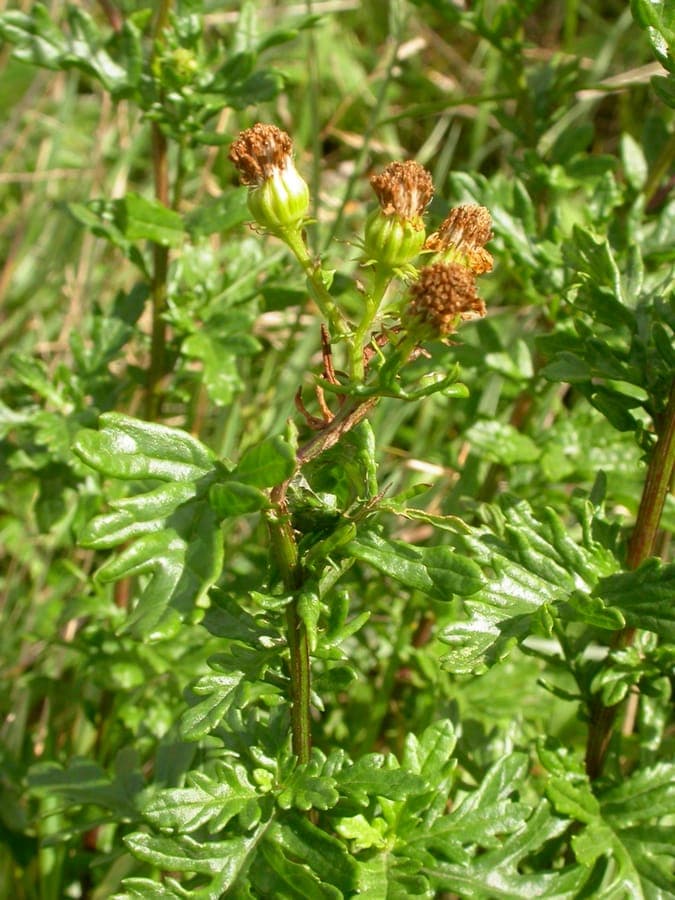
Pieter Pelser / CC BY 3.0, via Wikimedia Commons
Hoary ragwort: complete guide
Jacobaea erucifolia
Want to see Hoary ragwort: complete guide in your garden?
1 minute, no credit card
Overview
Hoary ragwort (Jacobaea erucifolia) is a native perennial wildflower in the daisy family (Asteraceae), distributed across Europe from the Atlantic coast eastward to Siberia and northern Iran. The plant's common name references its distinctive hoary (grey-white, downy) appearance: the stems, leaf undersides, and young shoots are covered in fine woolly hairs that give the whole plant a silvery-grey sheen in raking light. The specific epithet erucifolia refers to the deeply pinnate, rocket-shaped leaves.
For much of botanical history, hoary ragwort was classified as Senecio jacobaea subsp. erucifolius before being elevated to species rank as Jacobaea erucifolia. It is closely related to common ragwort (Jacobaea vulgaris) but clearly distinguished by its narrower, more finely divided leaf lobes and its later flowering season - August through September rather than June through August.
In the wild, hoary ragwort colonises dry, calcareous grasslands, railway embankments, chalk and limestone slopes, and rough roadside verges across its enormous native range. It thrives on nutrient-poor, free-draining soils and is superbly adapted to prolonged drought. Once established, it naturalises readily through prolific self-seeding, making it an ideal choice for naturalised and low-maintenance wildlife gardens.
For gardeners seeking to support pollinators, hoary ragwort is outstanding. Hoverflies, solitary bees, honey bees, and several butterfly species are frequent visitors. The plant is particularly valuable for late-summer pollinators when many other flowers have finished. Visit gardenworld.app to see how native wildflowers like hoary ragwort can fit into a beautifully designed garden layout.
Appearance & bloom cycle
Hoary ragwort is an upright, branching herb reaching 40–90 cm in height. The stems are stiff and woody at the base, well able to resist wind and light physical disturbance. The leaves are the plant's most distinctive feature: they are deeply pinnately divided into narrow, lance-shaped segments, with a pale, almost white woolly underside that contrasts with the grey-green upper surface. The uppermost stem leaves clasp the stem with rounded, ear-like bases.
Flowering occurs from August through September - the latest of all the commonly cultivated ragworts. The flower heads are 1.5–2 cm across, each with 12–15 bright yellow ray florets and a dense cluster of yellow disc florets at the centre. They are arranged in flat-topped corymbs at the tips of the branching stems, creating a bold, warm yellow display that lights up the late summer border.
After flowering, each head produces numerous achenes (one-seeded fruits) tipped with a white pappus of fine feathery bristles, dispersed readily by wind. This wind dispersal accounts for the plant's rapid spread in suitable habitats and its willingness to naturalise in the garden. The full cycle from seed to flowering takes two to three years; hoary ragwort behaves as a biennial to short-lived perennial.
The flower colour - a rich, saturated yellow - combines beautifully with purple, blue, and white flowered companions in late summer. The upright, airy structure of the branched stems adds vertical interest without overwhelming neighbouring plants.
Ideal location
Hoary ragwort requires a fully sunny, open position. The plant is adapted to open grassland habitats with maximum sun exposure; in shade, stems become lax and the flowering performance is markedly reduced. A light index of 7 in plant databases reflects this strong preference for sun.
Natural habitats include dry limestone and chalk grasslands, railway embankments, sand dunes, rocky slopes, and disturbed roadsides throughout Europe and into Asia. The plant tolerates strong wind, exposed positions, and lean, shallow soils with ease. It does not thrive on wet or poorly drained clay soils.
In the garden, hoary ragwort suits a wildflower meadow, a dry prairie-style border, a chalk garden, a large rock garden, or a wildlife hedge margin. It also works well in a dedicated native plant scheme or along a sunny boundary where it can self-seed freely. Plant at 40–60 cm spacing to allow for self-seeding and good air circulation around each plant.
Soil requirements
Hoary ragwort actively prefers poor, free-draining soils. On fertile, nitrogen-rich ground the plant becomes overly lush, less floriferous, and is quickly out-competed by more vigorous neighbours. The recorded soil pH preference of 7.5–8.0 confirms a clear preference for alkaline, calcareous soils, though the plant also tolerates neutral conditions.
The ideal soil is sandy to lightly loamy, with good drainage and low fertility. Gravel mulch (rather than organic mulch) keeps the root crown dry and reinforces the lean, dry conditions the plant favours. On heavy clay, improve individual planting holes with coarse grit and sharp sand, or better, position plants on a south-facing slope or raised bed to guarantee drainage.
No fertiliser should be applied at planting or subsequently. In established borders with rich garden soil, top-dressing with grit or coarse sand around each plant helps simulate the lean conditions the plant needs to perform at its best.
Free design
Want to see Hoary ragwort: complete guide in your garden? Make a free design now.
Watering
Hoary ragwort is highly drought-tolerant and requires very little supplemental watering once established. The plant's atmospheric humidity index of 4 out of 9 confirms its affinity for drier air conditions. After the first growing season, plants established in suitable free-draining soil can be left to rely entirely on rainfall in north-western European climates.
In the establishment year, water once every ten to fourteen days during extended dry spells to encourage root development. After the first season, irrigation is only justified after four to six consecutive weeks of drought, and even then a single thorough soaking at the root zone is sufficient.
Water at the base of the plant, never overhead. Persistent moisture on the foliage encourages powdery mildew and Botrytis. Drip irrigation is the ideal delivery method if supplemental water is occasionally needed. In a rain-poor summer, hoary ragwort typically flowers most prolifically - drought stress triggers more abundant and longer-lasting bloom.
Pruning
Hoary ragwort requires almost no pruning. The main intervention is the removal of spent flower stems after the main flowering period in September or October. This has two purposes: it gives the planting a tidier appearance and reduces self-seeding if you want to manage the spread of the plant. If abundant self-seeding is desired, leave the seed heads standing until midwinter, both for the decorative value of the feathery pappus and to provide shelter for overwintering insects.
In spring, old dead stems can be cut back to 10–15 cm above ground level before new growth emerges. This encourages a more compact, bushy habit in the second and subsequent years and can extend the life of individual plants. Hoary ragwort is naturally short-lived, however, so expect to rely on self-seeded replacement plants to maintain the colony over time.
No deadheading during the flowering season is necessary; removing individual spent heads is not practical given the quantity of flower heads each plant produces.
Maintenance calendar
March: Remove dead stems from the previous season; check for and relocate young self-seeded seedlings if needed.
April–May: New growth commences; top-dress around established plants with coarse grit if soil is too fertile. Do not fertilise.
June–July: Stem elongation and bud development; monitor for early aphid infestations. Natural predators usually keep populations in check.
August–September: Full flowering; enjoy the pollinator activity. Remove seed heads promptly if you wish to limit self-seeding.
October: Allow seed heads to stand for overwintering insects. Cut back spent stems if appearance matters.
November–February: No maintenance required; plants are fully hardy and need no winter protection.
Winter hardiness
Hoary ragwort is fully hardy to approximately -20 °C, corresponding to USDA hardiness zone 5 and warmer. This makes it completely trouble-free throughout the Netherlands, Belgium, Germany, France, and the British Isles. The plant's native range extends to Siberia, confirming its tolerance for harsh continental winters.
Snow cover is beneficial rather than harmful: it insulates the root crown and prevents freeze-thaw damage on exposed sites. On free-draining soils, the plant's crowns withstand hard frost without difficulty, provided water does not pool around the roots during thaw periods.
No winter mulching or covering is required or recommended. Young first-year plants can benefit from a thin layer of fallen leaves as a light insulating layer in the coldest regions, but this is rarely necessary in north-western Europe.
Companion plants
Hoary ragwort combines beautifully with other natives and near-natives that share its preference for dry, nutrient-poor, sunny conditions. The late August–September flowering window means it bridges the gap between summer and autumn bloomers.
Excellent companions include:
- Wild carrot (Daucus carota): white umbels in July–August alongside the yellow of hoary ragwort create a classic meadow palette.
- Purple loosestrife (Lythrum salicaria): the purple spires contrast vividly with the yellow flower heads, for slightly moister soils.
- Yarrow (Achillea millefolium): flat white or pink heads in June–July, followed by seed heads that add texture beside the later blooming ragwort.
- Greater knapweed (Centaurea scabiosa): blue-purple thistle-like heads make a striking colour companion.
- Marjoram (Origanum vulgare): aromatic, low-growing, attracting the same pollinator community.
- Sheep's fescue (Festuca ovina): a fine-leaved grass that reinforces the dry meadow character and provides a neutral foil.
Space plants 40–60 cm apart. A group of three to five hoary ragworts creates the most naturalistic effect. Explore more plant combination ideas for wildlife and native gardens at gardenworld.app.
Closing
Hoary ragwort is a rewarding choice for gardeners who want to support biodiversity and maintain a low-effort, high-impact late summer display. Its drought tolerance, alkaline soil preference, and exceptional pollinator value set it apart from most ornamental daisy-family plants available in garden centres. On chalk, limestone, or freely draining sandy soils it outperforms many commercially bred alternatives.
Seed is available from specialist native plant suppliers and wildlife gardening nurseries in the UK and continental Europe. The plant can also be grown from divisions taken in spring. Given its biennial to short-lived perennial nature, allow self-seeding to maintain the colony - and enjoy the gradual naturalisation of a true European native in your garden.
Want to see Hoary ragwort: complete guide in your garden? Make a free design now.
Upload a photo, pick a style, and get a photorealistic design with plant list in under a minute.
10,000+ gardens designed already
No credit card required


Similar plants
Calendula stellata: complete guide
Calendula stellata
Complete guide to Calendula stellata, the star-flowered marigold from Sicily: location, soil, watering and companion planting tips.
Korean chrysanthemum: complete guide
Chrysanthemum x rubellum
Chrysanthemum x rubellum is a hardy autumn perennial with single pink to copper flowers from August to November. Care and combinations.
Helianthus divaricatus: complete guide
Helianthus divaricatus
Helianthus divaricatus is a North American woodland sunflower with yellow summer blooms, ideal for naturalistic borders and shady edges.