
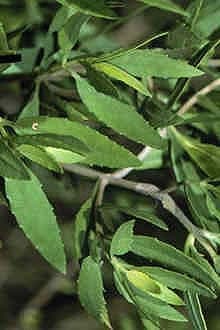
USDA-NRCS / Public domain, via Wikimedia Commons
Marsh-elder: complete guide
Iva frutescens
Want to see Marsh-elder: complete guide in your garden?
1 minute, no credit card
Overview
Iva frutescens, commonly known as marsh-elder, Jesuit's bark, or bigleaf marsh-elder, is a shrubby perennial subshrub in the daisy family (Asteraceae). Native to the Atlantic and Gulf coasts of North America, from Nova Scotia in Canada south through the eastern seaboard to Florida and west to Texas, this plant grows naturally in salt marshes, on beaches, along estuaries, and in other low-lying coastal habitats where the soil is regularly inundated with brackish or saline water.
The plant is little known in ornamental horticulture beyond its native range, but it possesses genuine garden value for specific applications: coastal gardens with salt-influenced soils, habitat gardens that mimic coastal ecosystems, and wildlife-focused plantings aimed at attracting seed-eating birds. The flowers are small and inconspicuous by conventional garden standards, but are produced in great quantities and provide valuable late-season nectar sources for pollinators preparing for winter. The seeds attract finches, sparrows, and other seed-eating birds through autumn and winter.
Iva frutescens is a perennial subshrub reaching 60 to 180 cm in height, with a multi-stemmed, somewhat open habit. The stems are woody at the base and become increasingly branched with age. The leaves are oblong to ovate-lanceolate, dark green, slightly rough, and pleasantly aromatic when crushed. The plant spreads by seed and by rhizome production, which can cause it to form sizeable colonies in favourable conditions.
In European gardens, Iva frutescens remains a rarity, but for gardeners seeking a salt-tolerant, ecologically valuable subshrub for challenging wet or saline sites, it offers a compelling option that few other ornamental plants can match. Its combination of salt tolerance, cold hardiness, and wildlife value makes it a remarkable specialist for coastal and estuary plantings.
Appearance & bloom cycle
Iva frutescens is an upright subshrub with multiple ascending stems emerging from a woody base. The stems are green to light grey, heavily branched in the upper portions, and lightly hairy or glabrous. The leaves are alternately arranged, oblong to lance-ovate, 3 to 8 cm long and 1 to 3 cm wide, dark green above and slightly lighter beneath with a fine texture.
The flowers are modest but ecologically significant. They are small, white-greenish, and disc-shaped, clustered into tiny flower heads of 3 to 5 mm diameter. They appear in dense racemes along the stems and bloom from August through October. The flowers are wind-pollinated but also attract a range of late-season insects, including small native bees and wasps. This makes Iva frutescens one of the few subshrubs providing late-season foraging resources when most other ornamental plants have finished blooming.
After flowering, the plants produce small, egg-shaped achenes of approximately 2 mm. These are eagerly consumed by seed-eating birds and represent a significant food source for migratory birds along the Atlantic flyway in late summer and autumn. The foliage remains green well into late autumn, after which the upper stems die back but the woody base remains intact to re-shoot the following spring.
Plants grow rapidly in their first year, reaching 80 to 120 cm. In subsequent years they become increasingly robust and branched. Mature specimens reach 120 to 180 cm in height with a similar spread, creating substantial, multi-stemmed clumps that provide strong structure in the landscape through all seasons.
Ideal location
Iva frutescens demands a sunny position: full sun is ideal, and the plant performs best with six or more hours of direct sunlight per day. In insufficient light the plant becomes elongated and less compact. In its natural habitat, it occupies open, light-rich coastal marshes and beaches, confirming its strong preference for bright conditions.
The plant is specifically suited to sites with saline or brackish soil, near salt water, along estuaries, and in wet low-lying coastal areas. It can also be grown in ordinary garden borders on moist to moderately dry soils, but its greatest strength lies in those challenging salt-affected and wet conditions where few other ornamental plants survive. In a coastal garden it works excellently as a structural element at the edge of wet and dry zones, as a windscreen, or as a living barrier in salt-transition habitats.
For planting as an informal hedge or dense border, space plants 90 to 120 cm apart. In naturalistic or ecological plantings, allow slightly wider spacing of 120 to 150 cm so each plant can develop its full multi-stemmed form. The plant tolerates flooding episodes that would kill most ornamentals, making it invaluable for flood-prone coastal margins.
Soil requirements
Iva frutescens is primarily a coastal plant that thrives on sandy, wet to moist soils along shorelines. The preferred soil pH is mildly acidic to neutral, between 5.0 and 5.7, which is relatively low compared to most garden plants. However, in saline soils with higher pH values up to around 7.5, it grows equally well thanks to its exceptional salt tolerance.
In non-saline garden soil, the plant can be cultivated on moderately moist, well-drained substrates. Heavy clay requires amendment with sand and organic matter to improve drainage and aeration. On light, freely draining sandy soil, incorporate compost to increase moisture retention. The plant has no need for rich soil: it grows naturally on lean coastal substrates and is not adapted to high nutrient concentrations. Over-fertilisation produces lush foliage at the expense of flowering.
An annual application of mature compost in spring provides sufficient nutrition. Mulching with seagrass clippings, shells, or compost from coastal plant material aligns well with the plant's natural habitat and helps maintain soil moisture through summer. In genuinely saline sites, no soil amendment is required: plant directly into the existing coastal soil.
Free design
Want to see Marsh-elder: complete guide in your garden? Make a free design now.
Watering
In its native habitat, Iva frutescens grows in moist to wet coastal areas and consequently has higher moisture requirements than the average drought-tolerant Mediterranean garden plant. In the garden context, however, established plants show reasonable tolerance of moderately dry periods, performing best when the soil does not remain completely dry for longer than one to two weeks.
In the first year after planting, regular watering is essential: water thoroughly once or twice per week, soaking the root zone to a depth of 20 to 30 cm. After the first year, established plants become more self-sufficient, but clearly benefit from weekly watering during dry summers. Apply water at the base of the plant rather than overhead to keep the foliage dry and reduce the risk of fungal disease. Drip irrigation is the most efficient method for this plant.
In genuinely saline coastal sites, supplemental watering is generally unnecessary, as the high water table combined with sea mist provides adequate moisture. In an ordinary inland garden, a moderate watering regime is most appropriate: avoid allowing the soil to remain completely dry, but avoid prolonged waterlogging at the crown as well. Good soil structure is the key to finding the right balance.
Pruning
Iva frutescens benefits from annual pruning that promotes compactness and abundant flowering. The best approach is to cut back the above-ground stems to 20 to 40 cm above ground level in early spring once hard frosts have passed. The plant then re-shoots vigorously from the woody base and develops a full, branched summer habit.
If you wish to allow a larger plant, reduce the stems by only one third in spring rather than cutting back hard. This retains height while encouraging more branching and a less leggy form. Summer tip-pruning of the longest stems stimulates additional branching. Remove dead or damaged stems immediately to keep the plant looking fresh.
As an informal hedge, Iva frutescens can be clipped one or two times during summer to maintain a uniform height. Always leave sufficient foliage for photosynthesis. The woody stems can be left standing through winter, providing structural interest and shelter for wildlife, before being cut back in early spring.
Maintenance calendar
February-March: Cut stems back to 20 to 40 cm above ground level (or reduce by one third for larger specimens). Apply annual compost dressing around the base. Check for winter damage.
April-May: New shoots begin to form. Remove competing weeds if necessary. Water during dry spells.
June-July: Strong growth phase. Selectively tip-prune excessively long stems for a more compact form. Water weekly during dry periods.
August-September: Peak flowering period. Small flowers form along the stems. Bird activity increases around ripening seeds. Continue regular watering.
October: Seeds ripen and are consumed by birds. Foliage begins to discolour. Reduce watering frequency.
November-January: Plant enters dormancy. Stems can be left standing for wildlife shelter and winter structure. No watering required.
Winter hardiness
Iva frutescens is cold-hardy in USDA zones 4 through 9, meaning the plant can survive temperatures as low as -30 °C provided the woody root crown is adequately protected. In practice, the plant is fully suited to gardens in the Netherlands, Belgium, northern France, and the UK, where winters rarely approach such extremes. It has adapted through its native Atlantic coast habitat to withstand cold, salty winters.
In extremely cold winters the above-ground stems may die back completely, but the plant re-shoots from the woody root crown as soon as spring temperatures rise. A mulch of 8 to 10 cm of bark chips or leaves around the base provides protection for the root crown at temperatures below -15 °C. In the mild oceanic climates of coastal western Europe, this precaution is rarely necessary.
Notably, the plant is also quite tolerant of saltwater spray from storm surges, which can rapidly defoliate most ornamentals. This makes it a uniquely valuable plant for coastal positions where sea spray is a regular occurrence. The combination of salt tolerance and cold hardiness makes Iva frutescens almost unrivalled among ornamental subshrubs for exposed coastal gardens.
Companion plants
Iva frutescens is best suited to combinations with other coastal and wetland plants that share its habitat preferences. Recommended companions include:
- Spartina alterniflora (smooth cordgrass): a low to medium height grass-like marsh plant that occupies the same saline shore habitat, providing textural contrast.
- Baccharis halimifolia (saltbush): a related species from the same coastal habitat with similar salt and moisture tolerance and silver-grey berries in autumn.
- Pluchea odorata (salt marsh fleabane): a warmth-loving coastal perennial with pink flowers in late summer.
- Phragmites australis (common reed): tall reed that lines coastal shores and can serve as a background planting behind Iva.
- Suaeda maritima (sea blite): low-growing coastal annual for the immediate waterline zone, providing contrasting fine texture.
In non-saline garden settings, Iva frutescens can be combined with other late-blooming perennials and subshrubs such as Aster, Eupatorium, and Solidago. The pairing with tall ornamental grasses such as Miscanthus or Panicum produces a naturalistic, prairie-like composition.
Visit gardenworld.app to plan a coastal habitat garden or a moist naturalistic planting that incorporates Iva frutescens alongside compatible companions. More inspiration for salt-tolerant plants and coastal planting design is available at gardenworld.app.
Closing
Iva frutescens is a specialist plant with a well-defined application: salt-affected and wet coastal locations, estuaries, and marsh margins. For gardeners seeking a tough, ecologically valuable subshrub for a challenging saline or moist site, it offers reliability and wildlife value that few other ornamentals can match. Low in maintenance requirements, it rewards the gardener annually with vigorous re-growth, late-season flowering for pollinators, and seed production for birds, making it an outstanding choice for ecologically oriented gardens at or near the coast.
Want to see Marsh-elder: complete guide in your garden? Make a free design now.
Upload a photo, pick a style, and get a photorealistic design with plant list in under a minute.
10,000+ gardens designed already
No credit card required


Similar plants
Calendula stellata: complete guide
Calendula stellata
Complete guide to Calendula stellata, the star-flowered marigold from Sicily: location, soil, watering and companion planting tips.
Korean chrysanthemum: complete guide
Chrysanthemum x rubellum
Chrysanthemum x rubellum is a hardy autumn perennial with single pink to copper flowers from August to November. Care and combinations.
Helianthus divaricatus: complete guide
Helianthus divaricatus
Helianthus divaricatus is a North American woodland sunflower with yellow summer blooms, ideal for naturalistic borders and shady edges.