
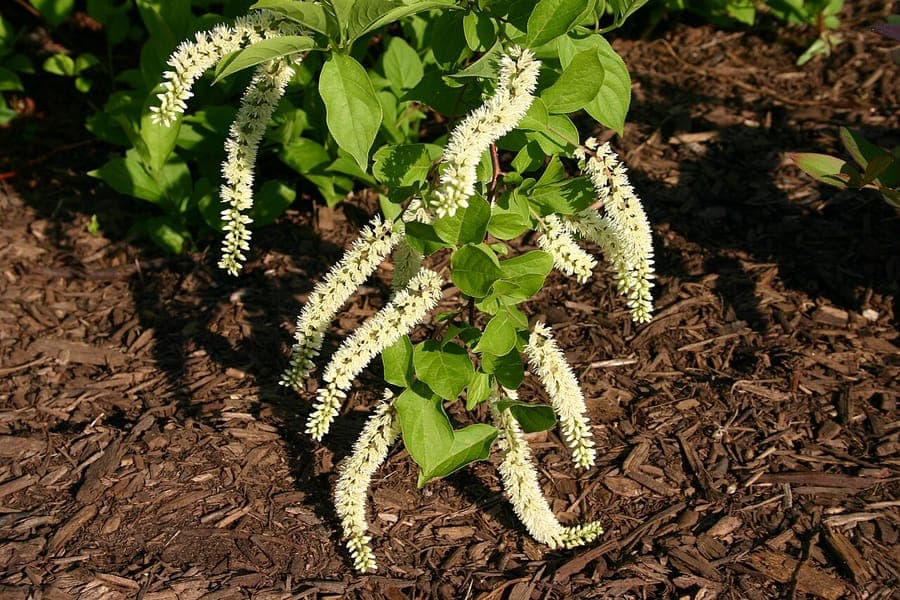
User:SB_Johnny / CC BY-SA 3.0, via Wikimedia Commons
Virginia sweetspire: complete guide
Itea virginica
Want to see Virginia sweetspire: complete guide in your garden?
1 minute, no credit card
Overview
Virginia sweetspire (Itea virginica) is one of the most undervalued flowering shrubs that North American flora has to offer European gardeners. First formally described by Carl Linnaeus in 1753 in his landmark Species Plantarum, the species belongs to the small family Iteaceae and is native to the central and eastern United States, growing naturally from New Jersey and Pennsylvania southward to Florida and westward to Missouri and Texas. In its native habitat, Virginia sweetspire favours the margins of streams and rivers, moist woodland edges, and low-lying areas where water collects - environments that give a clear indication of the conditions it prefers in the garden.
The common name 'sweetspire' refers to the graceful, fragrant white flower racemes that appear in summer. The plant also goes by the names virginia willow (for its willow-like leaves), virginia-tea, and tassel-white. In modern horticulture, the species is primarily offered in more compact, garden-selected cultivars such as 'Henry's Garnet' and 'Little Henry', which are widely appreciated for their outstanding autumn colour.
What makes Virginia sweetspire exceptional is the combination of three ornamental qualities that few other shrubs can match simultaneously. First, there are the white, lightly fragrant flower racemes produced in June and July - at a time when many other flowering shrubs have already finished blooming, filling an important gap in the garden's seasonal display. Second, the plant scores exceptionally well for autumn colour: leaves turn from scarlet red through orange to deep purple, a colour show that often persists for weeks. Third, Itea virginica is a remarkably adaptable plant, performing well in both full sun and partial shade, in both average-moisture and wet soils.
For gardens in north-west Europe, Virginia sweetspire is an excellent choice for shaded borders, pond margins, or as a freestanding ornamental shrub. Explore garden designs featuring Itea virginica in contemporary four-season borders at gardenworld.app.
Appearance & bloom cycle
Itea virginica is an upright to lightly arching shrub that typically reaches 90 to 180 cm in height in garden conditions, depending on the cultivar and growing environment. Growth is stoloniferous, meaning the plant produces underground runners that slowly widen the shrub's footprint over time, though this is strongly moderated in garden cultivars. The overall form is elegant, with multiple slender stems creating a fine winter branch structure.
Leaves are simple, alternately arranged, oval to elliptical in shape, 3 to 8 cm long, with a finely toothed margin. In summer they are fresh to dark green with a medium texture. The autumn colour is the plant's most spectacular feature: leaves begin colouring as early as September and often hold well into November. Colours range from scarlet and bright red through orange-red to deep purple, depending on cultivar and location. Shadier positions tend to produce more purple hues while sunny sites generate brighter reds.
Flowering occurs from June to August, with peak bloom in June and July. The inflorescences are elongated, slightly drooping to semi-erect racemes of 5 to 15 cm in length. Each raceme consists of dozens of small, white, star-shaped flowers approximately 6 mm across. They carry a light, sweet, honey-like fragrance that draws a steady stream of bees, bumble bees, and butterflies over a four-to-six-week flowering period - unusually long for a summer-blooming shrub.
After flowering, small brown seed capsules develop and persist on the plant into winter, adding modest textural interest.
Ideal location
Virginia sweetspire is one of the relatively rare flowering shrubs that performs genuinely well in both full sun and partial shade. This tolerance makes it particularly valuable in gardens where planting positions are not always ideal. In its native habitat, the plant grows both in open, sunny riverside situations and in the dappled shade of riparian woodland.
For the richest bloom production, a sunny to lightly shaded position is ideal. In full sun, flowering is more abundant and autumn colour is a brighter red. In partial shade - up to four hours of direct sun per day - flowering remains good but autumn colour tends toward purple. Deep shade with less than two hours of sun reduces blooming noticeably and limits autumn colour.
On the question of moisture, Virginia sweetspire is equally versatile. Growing naturally along moist, wet soils, it tolerates even temporary waterlogging. This makes it ideal for pond margins, for wet or difficult corners of the garden, and for areas where rainwater collects. At the same time, it performs well in average-moisture garden soil once established.
The plant suits mixed borders, as a freestanding specimen, in large containers on a terrace (with adequate moisture retention), or as an informal hedge in moist positions. Browse gardenworld.app for ideas on combining Virginia sweetspire in contemporary garden designs.
Soil requirements
Itea virginica is accustomed to moist, fertile soil along water margins and woodland edges, and this reflects its garden preferences. The plant performs best in humus-rich, moisture-retaining soil with a slightly to moderately acidic pH - ideally between 4.0 and 7.5, with optimal performance in the more acidic range.
The soil can be periodically quite wet, but well-drained garden soil is also suitable provided there is sufficient organic matter to retain moisture. Light sandy soil without organic content dries too quickly. Heavy clay soil is manageable if the plant receives adequate water, but improving it with compost improves air in the root zone and moderates waterlogging extremes.
At planting, work in generous amounts of well-composted material or leaf mould through the upper 30 cm to improve structure and water-holding capacity. After planting, mulch with a 5 to 8 cm layer of bark or leaf mulch around the plant to maintain soil moisture and suppress weeds. Renew the mulch layer each spring.
Nutrient-poor soil slows growth but does not seriously harm the plant over time. On very impoverished substrates, an annual application of well-composted organic matter or a small amount of balanced slow-release fertiliser is sufficient to maintain good growth.
Free design
Want to see Virginia sweetspire: complete guide in your garden? Make a free design now.
Watering
Virginia sweetspire has a higher moisture requirement than most garden shrubs, which reflects directly its origin in moist, riparian habitats. In the first and second years after planting, generous, regular watering is essential to allow the plant to establish itself in the new position.
During the first two years, water two to three times per week in dry, warm weather. Check soil moisture at 10 cm depth: the soil should be lightly moist but not waterlogged. Use a drip line or apply water gently at the base of the plant rather than over the foliage.
From the third year onward, drought tolerance increases as the plant develops a deeper root system. On normal, moisture-retaining garden soil, supplemental watering is rarely needed during most summers in the UK, Belgium, and the Netherlands. On lighter, faster-drying soils or during extended droughts of more than three weeks without rainfall above 25 degrees Celsius, weekly watering is advisable.
In wet positions - pond margins, low garden areas that retain water - Virginia sweetspire performs particularly well and rarely needs supplemental irrigation at all.
Pruning
Virginia sweetspire requires minimal pruning. The shrub has a naturally elegant habit that largely speaks for itself and needs attention only when growth becomes excessive or after a hard winter.
The main pruning operation takes place in early spring before bud break, in March or early April. At this point, remove all dead, frost-damaged, or crossing branches. If the plant has outgrown its allotted space, cut the oldest, thickest stems back to the base - this stimulates new young growth and keeps the plant compact. Remove no more than one third of all stems in a single operation; removing more interferes with the same-season bloom.
A hard renovation cut - reducing all stems to 20 to 30 cm above ground - is an option every five to seven years to rejuvenate a neglected or oversized plant. Bloom is reduced in the first year after such treatment but the plant recovers strongly in the second year.
Spent flower racemes do not need to be removed: the small brown seed capsules provide winter decoration and bird food. If a neater appearance is preferred, remove spent racemes after blooming, before autumn, by cutting back to the next healthy side shoot.
Maintenance calendar
February–March: Inspect the plant for winter damage. Remove dead or frost-damaged branches back to healthy wood. Apply a fresh mulch layer (5–8 cm of bark or leaf) around the plant. Add a small amount of composted material at the base if the soil is poor.
April–May: New leaves emerge. Check for any fungal issues or aphids on young growth. Keep the soil moist during dry spring conditions.
June–July: Full flowering period. Enjoy the fragrant white racemes. Water during prolonged dry spells of more than two weeks without rain.
August–September: Autumn colour begins to develop. Continue regular watering until leaves drop. September and October bring the most spectacular seasonal display.
October–November: Full autumn colour show in red, orange, and purple. Allow the plant to drop its leaves naturally. Do not prune at this stage.
December–January: Winter rest. The fine branching structure is decorative. No maintenance required. In severe frost check the mulch layer is intact over the root zone.
Winter hardiness
Itea virginica is reliably hardy for north-west European conditions. The plant is rated for USDA zones 5 to 9, tolerating winter temperatures as low as -26 degrees Celsius. In the practical context of gardens in the Netherlands, Belgium, and the UK - where winters rarely fall below -15 degrees Celsius - no winter protection whatsoever is needed.
In occasional very cold winters, the uppermost shoot tips may be damaged by frost, but the plant reshhoots readily from the base. This self-restoring quality is one of the great practical virtues of Itea virginica: even after a hard winter, it returns to full bloom by June of the same year.
The cultivar 'Henry's Garnet' - by far the most popular garden form - is in practice as cold-hardy as the species itself and retains its outstanding autumn colour even after cold winters. 'Little Henry' is a compact cultivar suitable for smaller gardens or container growing, provided the container is given some frost protection over winter.
Newly planted specimens in their first season are somewhat more vulnerable to hard frost. A light mulch of 10 cm dry leaves over the root zone provides useful additional protection in that first winter.
Companion plants
Virginia sweetspire combines particularly well with plants that share similar site requirements while offering complementary visual qualities:
- Hydrangea quercifolia (oakleaf hydrangea): large white flower heads in August, spectacular autumn colour in brown-red tones. Both favour moist, partially shaded positions.
- Fothergilla gardenii (dwarf fothergilla): creamy-white scented flowers in April-May before Itea blooms, plus superb autumn colour. A perfect combination for a four-season border.
- Clethra alnifolia (summersweet): lightly fragrant white flower racemes in August, overlapping with late Itea bloom. Shares the preference for moist, acidic soil.
- Ilex glabra (inkberry): evergreen leaves and glossy black berries as a structural counterpoint to Itea's seasonal flowering and autumn display.
- Physocarpus opulifolius 'Diabolo' (dark-leaved ninebark): deep burgundy foliage as a contrast to Itea's white summer flower spikes.
- Osmunda regalis (royal fern): a statement fern for moist, partially shaded sites; its bold fronds complement the shrubby habit of Itea beautifully.
Avoid pairing with drought-tolerant Mediterranean plants such as lavender, rosemary, or Cistus, whose watering requirements are fundamentally at odds with those of Virginia sweetspire.
Conclusion
Virginia sweetspire is the flowering shrub for gardeners who want the best of three worlds: fragrant summer blooms, spectacular autumn colour, and adaptability across a wide range of positions from sunny to partially shaded, from average to wet soils. Itea virginica asks little but gives generously - year after year, with minimal maintenance.
Curious to see how Virginia sweetspire would look in your own garden? Visit gardenworld.app for a personalised garden design where visually rich shrubs like Itea can play a starring role. You will also find more guides to outstanding ornamental shrubs for every position and garden style at gardenworld.app.
Want to see Virginia sweetspire: complete guide in your garden? Make a free design now.
Upload a photo, pick a style, and get a photorealistic design with plant list in under a minute.
10,000+ gardens designed already
No credit card required


Similar plants
Acer pycnanthum: complete guide
Acer pycnanthum
Acer pycnanthum, the Japanese swamp maple, is a fast-growing tree with early red flowers and brilliant autumn color, ideal for damp garden settings.
Freeman maple: complete guide
Acer × freemanii
Everything about the Freeman maple (Acer x freemanii): a fast-growing shade tree with spectacular autumn colour for large gardens.
Silver vine: complete guide
Actinidia polygama
Discover silver vine (Actinidia polygama): a hardy climbing plant with silvery foliage, loved by gardeners and cats alike.