
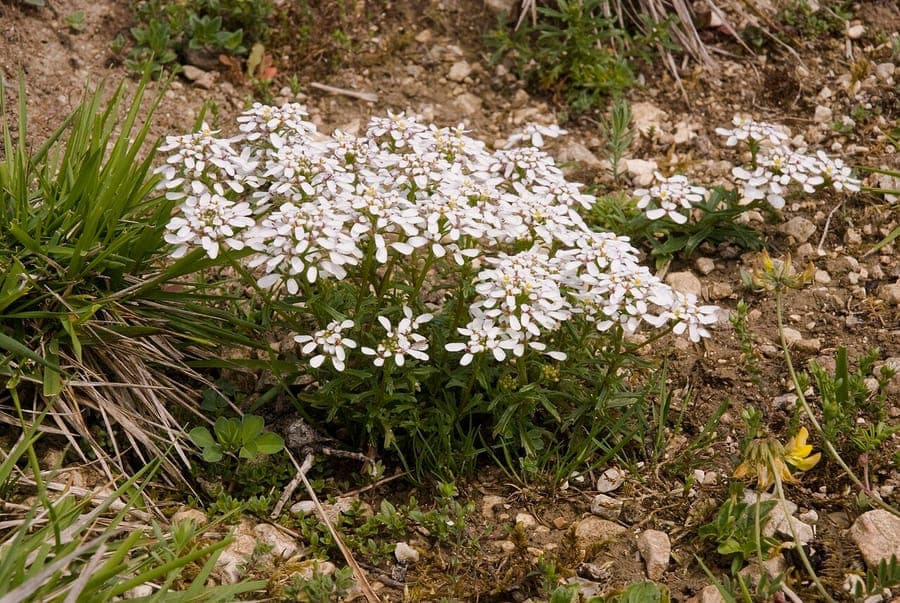
Olivier Pichard / CC BY-SA 3.0, via Wikimedia Commons
Bitter candytuft: complete guide
Iberis amara
Want to see Bitter candytuft: complete guide in your garden?
1 minute, no credit card
Overview
The Bitter candytuft (Iberis amara), also called Rocket candytuft or Wild candytuft, is a charming annual flower from the cabbage family. This plant grows easily from seed and produces attractive compact white flowers throughout the entire summer season.
Although technically an annual plant, bitter candytuft can sometimes be grown as a winter-flowering plant if you sow it in autumn. The plant reaches only 20 to 40 centimeters in height and works perfectly as a front-border flower, in rock crevices, or at the front of borders. This is a plant for everyone's garden.
Appearance and bloom
Bitter candytuft grows as a compact, upright bush with small, linear foliage. The leaves are green and narrow, providing little ornamental value, but are not unattractive.
The flowers are where this plant shines. Tiny, snow-white four-petaled flowers are gathered into upright plumes 2 to 4 centimeters long. This creates a compact, efficient flower structure. The flowers have an aromatic, slightly bitter scent (hence the name).
The blooming period extends from May to October, especially if you regularly deadhead. In warmer regions, this plant blooms even longer.
Ideal location
Bitter candytuft grows best in sunny locations receiving at least 6 hours of direct sunlight daily. Full sun promotes rich, dense blooming. In very hot climates, light afternoon shade can be beneficial.
Wind is usually not a problem for this compact plant. It withstands stronger wind conditions without issue.
For positioning, this plant works well in:
- Front of borders
- Rock gardens and gravel gardens
- Flower boxes and containers
- Front garden beds
Soil
Bitter candytuft is flexible regarding soil type. It grows in virtually all reasonably-drained soils, even somewhat drier, poor types.
Ideal soil composition:
- Garden soil or standard earth
- Some sand or gravel for better drainage
- Compost can be added but is not strictly necessary
The pH range can be broad (pH 6.0 to 8.0). This plant grows excellently in poor, mineral soils and requires minimal nutrition.
Over-fertilization can actually be undesirable - it can result in less compact growth and reduced blooming.
Free design
Want to see Bitter candytuft: complete guide in your garden? Make a free design now.
Watering
Bitter candytuft is a moderately drought-tolerant plant once established. During the growing period, keep soil lightly moist, but certainly not wet. It accepts regular watering but can also withstand dry periods.
Watering schedule:
- After sowing: water regularly until well-established (2-3 weeks)
- Growing period: keep lightly moist
- Hot summers: more frequent watering needed
- Ensure soil doesn't become waterlogged
Overwatering can lead to root rot and fungal diseases.
Pruning
Deadheading (removing spent flowers) is crucial for this plant. By continuously removing dead blooms, you encourage continuous flowering throughout the season. This is arguably the most important maintenance tip for bitter candytuft.
Remove withered flower clusters gently by pinching them off at the stem. This takes only a few minutes per week but results in much more abundant blooming.
Damaged or yellowed leaves can be removed, though this is rarely necessary.
Maintenance calendar
May-June: First blooms; begin deadheading July-September: Peak bloom season; regular deadheading critical October-November: Blooming slows; selective deadheading Winter: Plant dies back (annual) or overwinters (if sown in autumn)
Winter hardiness
Bitter candytuft is not winter-hardy in the classical sense. As an annual plant, it grows during one season and dies back after the first hard frost.
For winter blooming:
- Sow in August to September for winter-flowering plants
- This plant grows slowly over winter
- Blooms transition to spring blooms in early spring
- Plant dies back after spring blooming
In very mild regions of the Netherlands, self-sown seed sometimes overwinters and regrows spontaneously.
Companion plants
Bitter candytuft pairs nicely with:
- Lobelia: similar size and bloom time
- Alyssum: both compact, white or pink
- Pansies and violas: beautiful texture contrast
- Low shrubs: Hebe, Berberis
- Grasses: fine texture
Combine with plants of similar water and nutrient requirements.
Closing
Bitter candytuft is suitable for everyone - even beginners. Sow easily from seed, wait patiently, and then enjoy beautiful white flowers for months. This is no difficult plant, no diva. This is a reliable, simple flower that always performs.
Sow this plant in your garden design at gardenworld.app and discover how it brightens your front garden with its pure white flowers.
Check local garden centers for seed packets, or start your design on gardenworld.app for more advice.
Want to see Bitter candytuft: complete guide in your garden? Make a free design now.
Upload a photo, pick a style, and get a photorealistic design with plant list in under a minute.
No credit card required

