
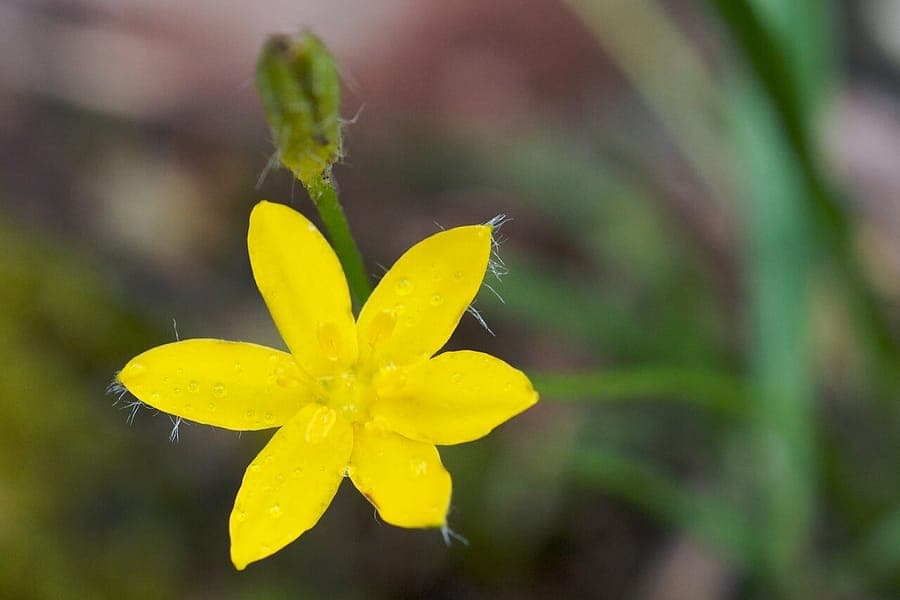
Eric in SF / CC BY-SA 3.0, via Wikimedia Commons
Yellow star-grass: complete guide
Hypoxis hirsuta
Want to see Yellow star-grass: complete guide in your garden?
1 minute, no credit card
Overview
Hypoxis hirsuta, commonly known as yellow star-grass or common goldstar, is a small but captivating cormous perennial belonging to the family Hypoxidaceae. Native to central and eastern North America, from southern Canada down through the eastern United States to northeastern Mexico, this plant thrives naturally in open prairies, woodland edges, and dry sunny slopes. Despite being relatively underused in ornamental horticulture, Hypoxis hirsuta rewards gardeners with cheerful starry yellow flowers and undemanding cultivation.
The botanical epithet 'hirsuta' refers to the plant's characteristic covering of soft white hairs on both the linear leaves and the flower stems. Plants typically grow 10 to 25 cm tall and gradually form dense tufts of grass-like foliage. The bright yellow, six-petalled, star-shaped flowers appear reliably each spring and attract native bees, sweat bees, and hoverflies. The plant stores energy in a compact corm, giving it remarkable drought tolerance and cold hardiness down to USDA zone 3.
In the garden, Hypoxis hirsuta fits beautifully into naturalistic plantings, prairie-style borders, rock gardens, and dry meadow compositions. Planted at 15 to 20 cm spacings, clumps fill in gradually to form a low, textured carpet that provides interest through both the flowering season and later in summer when the grass-like foliage adds subtle movement. Native plant enthusiasts and wildlife gardeners will find this species an indispensable companion for sunny, well-drained beds.
Appearance & bloom cycle
The leaves of Hypoxis hirsuta are linear, erect, and grass-like, reaching 20 to 30 cm in length and only 2 to 5 mm in width. They are densely covered with fine silvery hairs that catch the light beautifully, giving the foliage a soft shimmer in morning sun. The leaves emerge early in spring, often while the soil is still cool, and persist through summer before gradually yellowing and dying back in autumn.
Flowers appear from April through June, sometimes continuing into July during cool summers. Each flower stem carries three to seven individual blooms that open in succession, ensuring a prolonged display. The flowers are a clean, bright yellow, about 1 to 1.5 cm across, with six elliptical petals and a small cluster of yellow stamens at the centre. The outside of the petals is greenish, making the buds inconspicuous before they open. The flowers close in cloudy weather and at nightfall, a characteristic adaptation to maximise pollinator visits during the brightest parts of the day.
After flowering, small fleshy seed capsules develop, containing dark shiny seeds that can self-sow modestly in the surrounding soil. The corm, a compressed underground stem, grows slowly larger each year. Mature corms reach 1 to 2 cm in diameter and can be divided every three to five years to produce new plants. The corm is fully dormant and frost-hardy through winter, surviving soil temperatures well below freezing without protection.
Ideal location
Yellow star-grass performs best in full sun to light partial shade. Adequate sunlight, at least five to six hours of direct sun per day, promotes the richest flowering. In shadier positions the leaves elongate and flowering becomes sparse. In its native range the plant grows in open grasslands and at woodland margins where sunlight is abundant, which gives a clear indication of the conditions it prefers.
The site should be open, warm, and well-drained. Hypoxis hirsuta tolerates dry spells well once established, making it suitable for south-facing slopes, raised beds, or gravel gardens where drainage is excellent. Low-lying areas that collect standing water after rain are unsuitable, as prolonged waterlogging will rot the corm. A gently sloped aspect with morning sun is particularly effective at keeping the corm in the drier conditions it requires.
In formal gardens, plant Hypoxis hirsuta in the foreground of perennial borders where it creates a fine-textured, low edge. In a prairie or naturalistic garden it associates naturally with grasses and wildflowers. Spacing plants 15 to 20 cm apart gives them room to expand without crowding and creates a more natural-looking colony over time.
Soil requirements
Hypoxis hirsuta is an adaptable plant that tolerates a wide range of soils, provided drainage is good. It grows best in moderately fertile, well-drained loam, sandy loam, or sandy soil. The preferred soil pH range is 5.2 to 7.3, which encompasses most garden soils from slightly acidic to slightly alkaline. On naturally poor, sandy soils it performs very well without amendment.
On heavy clay soils, drainage improvement is essential before planting. Work a 10 to 15 cm layer of coarse sharp sand and mature compost into the top soil to open up the structure. Avoid over-enriching the soil: in rich, constantly moist conditions the plant tends to produce lush foliage at the expense of flowering. A lean soil regime that mimics the plant's native prairie habitat produces the best flowering results.
Apply a thin mulch of 3 to 5 cm of coarse grit, bark, or leaf mould around the plants in late autumn to moderate temperature fluctuations and suppress weeds. Do not pile mulch directly against the foliage base, as this can trap moisture and invite fungal problems. Annual top-dressing with a thin layer of mature compost in early spring provides sufficient nutrients for vigorous growth throughout the season.
Free design
Want to see Yellow star-grass: complete guide in your garden? Make a free design now.
Watering
Once established, yellow star-grass has modest water requirements. The corm acts as a water reservoir, enabling the plant to survive dry spells of two to three weeks without visible stress. During the spring flowering period, watering once a week is beneficial when natural rainfall is insufficient, helping to sustain bloom quality and duration. A thorough soaking that penetrates to 15 to 20 cm depth is more effective than frequent shallow watering.
In summer, once the main flowering flush is over, reduce watering frequency as the plant begins to slow its growth. Water deeply but infrequently, allowing the soil to partially dry between sessions. Avoid overhead watering: the hairy leaf surfaces trap moisture and can encourage fungal problems. Drip irrigation or watering at the base of the plant is preferable.
In autumn, as the foliage yellows, cease watering entirely and allow the corm to dry down naturally. During winter, no additional watering is needed. In areas with high winter rainfall, good drainage becomes the primary concern rather than supplemental irrigation.
Pruning
Hypoxis hirsuta requires minimal pruning. In early spring, once new shoots are emerging from the soil, remove the previous year's dead foliage by pulling it away gently by hand or cutting it at the base with scissors. This tidies the plant and allows full sunlight to reach the emerging growth.
Dead-head spent flower stems if you wish to prevent self-seeding, though self-sown seedlings are rarely a nuisance in most garden situations. If you want to encourage natural colonisation in a prairie or meadow planting, leave the seed capsules in place through late summer. Seeds germinate the following spring and develop into flowering plants within two to three years.
Every three to five years, when the corm cluster becomes large and blooming quality declines, divide the plant. Lift the clump carefully in autumn or very early spring before new growth begins, separate the individual corms by hand, and replant them at 15 to 20 cm spacings. This rejuvenates the planting and multiplies your stock at no cost.
Maintenance calendar
February-March: Remove dead foliage from the previous year. Apply a thin top-dressing of mature compost around the planting area. Check for any pest damage to the corms.
April: First flowers appear. No fertiliser needed at this stage. Water if the spring is dry and temperatures are already warm.
May-June: Peak flowering period. Water once weekly during dry spells. Remove spent stems if self-seeding is unwanted.
July-August: Foliage persists; flowering diminishes. Water during prolonged dry spells. Divide overcrowded clumps if needed.
September-October: Foliage yellows and dies back. Reduce watering. Divide and replant clumps if this was not done in spring.
November-January: Dormancy. No watering required. In gardens with cold, wet winters, check that drainage around the corms remains adequate.
Winter hardiness
Hypoxis hirsuta is exceptionally cold-hardy, rated for USDA zones 3 through 8. The corm tolerates soil temperatures well below freezing, surviving temperatures as low as -20 °C without damage. This makes it a reliable perennial across most of the UK, Germany, the Netherlands, Belgium, and northern France, where winter temperatures rarely approach those extremes.
No winter protection is required in temperate European gardens. The main winter risk is not cold but waterlogging: a corm sitting in frozen, saturated soil can rot. Ensuring good drainage before planting eliminates this risk. In areas with very heavy clay soils or persistently wet winters, raising the planting area by 10 to 15 cm with added grit and compost provides sufficient protection.
The plant re-emerges reliably every spring. Even after harsh winters with repeated freeze-thaw cycles, established clumps emerge without fail once soil temperatures rise above about 5 °C in late winter or early spring. This reliability makes Hypoxis hirsuta one of the most dependable low-maintenance perennials for a naturalistic planting.
Companion plants
Hypoxis hirsuta combines beautifully with other low-growing plants that share its preference for sunny, well-drained conditions. Recommended companions include:
- Penstemon hirsutus (hairy beardtongue): similar height and habitat preference, with contrasting blue-purple tubular flowers.
- Antennaria dioica (common pussytoes): a low-growing mat-former with silvery foliage that creates a calm understorey.
- Anemone patens (pasque flower): early-blooming crocus-like flowers in purple-blue that precede the Hypoxis blooms.
- Carex pensylvanica (Pennsylvania sedge): a low-growing sedge that echoes the grass-like foliage of Hypoxis.
- Viola pedata (bird's foot violet): deeply purple early flowers that pair well with the yellow of Hypoxis in a sunny, dry border.
Avoid planting alongside aggressive spreaders that would overwhelm this relatively modest plant. Low ornamental grasses such as Festuca ovina 'Blaufink' or Bouteloua gracilis make attractive neighbours without competition.
Visit gardenworld.app to design a prairie or naturalistic border that incorporates Hypoxis hirsuta alongside other sun-loving perennials. More plant combination ideas and garden design inspiration are available at gardenworld.app.
Closing
Hypoxis hirsuta is one of those quietly spectacular plants that reveal their true character when you get close enough to appreciate the individual flowers: perfectly formed golden stars rising from a tuft of silver-haired grass-like leaves. For gardeners who value native planting, wildlife-friendly design, and low-maintenance perennials, this modest plant delivers impressive year-on-year reliability.
From prairie borders to rock gardens and dry meadow edges, yellow star-grass earns its place through cheerful flowering, exceptional cold hardiness, and an undemanding nature that suits both novice and experienced gardeners. Plant it in groups of five to nine at 15 to 20 cm spacings for the best visual impact, and allow the colonies to develop naturally over the years.
Want to see Yellow star-grass: complete guide in your garden? Make a free design now.
Upload a photo, pick a style, and get a photorealistic design with plant list in under a minute.
10,000+ gardens designed already
No credit card required


Similar plants
Acer pycnanthum: complete guide
Acer pycnanthum
Acer pycnanthum, the Japanese swamp maple, is a fast-growing tree with early red flowers and brilliant autumn color, ideal for damp garden settings.
Freeman maple: complete guide
Acer × freemanii
Everything about the Freeman maple (Acer x freemanii): a fast-growing shade tree with spectacular autumn colour for large gardens.
Silver vine: complete guide
Actinidia polygama
Discover silver vine (Actinidia polygama): a hardy climbing plant with silvery foliage, loved by gardeners and cats alike.