
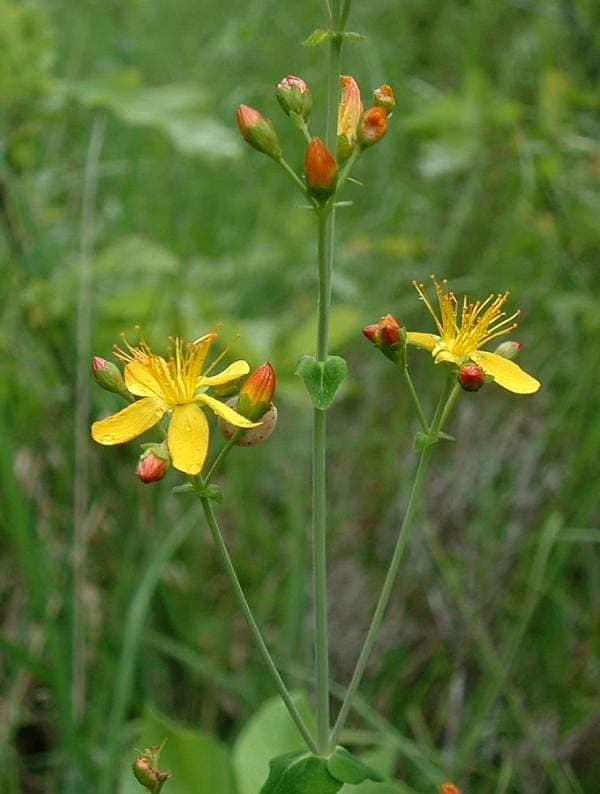
J.F. Gaffard Jeffdelonge at fr.wikipedia / CC BY-SA 3.0, via Wikimedia Commons
Slender St. John's-wort: complete guide
Hypericum pulchrum
Want to see Slender St. John's-wort: complete guide in your garden?
1 minute, no credit card
Overview
Slender St. John's-wort (Hypericum pulchrum), native to northwestern and western Europe through northern Croatia, is an elegant, refined perennial. Growing 30–60 cm tall, it thrives in USDA zones 6–8 and offers a more delicate appearance than many St. John's-wort species. The distinctive red flower buds that precede golden blooms add extra visual interest and make this species particularly valuable in bird-friendly gardens.
On gardenworld.app, slender St. John's-wort is ideal for partial-shade borders where you want refined texture. It pairs beautifully with other shade-tolerant perennials without overwhelming them.
Appearance & bloom cycle
The plant forms thin, upright stems with narrow, oval leaves 0.5–2 cm long. Foliage is dark green, sometimes with a reddish tint. What makes this species special are the distinctive red, bud-like structures that appear before flowering - these create striking contrast with the later yellow blooms. From June through September, numerous small, bright yellow flowers about 1.5–2 cm across appear. Like other Hypericum species, blooms feature characteristic long stamens with orange anthers.
Following flowers, small seed capsules develop. The plant remains compact and neat, never unruly.
Ideal location
Slender St. John's-wort thrives in partial to light shade (light level 6–7 out of 10). With 3–4 hours of direct sun daily, flowering remains good. In full sun during very hot summers, foliage may suffer scorching. This species is ideal for north-facing borders, under light deciduous trees, or along partially shaded pathways.
On gardenworld.app, use slender St. John's-wort as a transitional plant between shade-loving species and sun-demanding perennials.
Soil requirements
Slender St. John's-wort prefers moderately moist, well-drained soil with pH 5–7.5. Unlike many St. John's-wort species, this plant actually thrives on slightly moister soils. Amend with compost at planting. It dislikes pure sand or overly dry ground, but equally hates waterlogging.
On acidic, heathy soils, it excels. This is a plant for moist partial shade, not dry sun.
Free design
Want to see Slender St. John's-wort: complete guide in your garden? Make a free design now.
Watering
Regular watering is essential for slender St. John's-wort. Young plants must receive consistent moisture, especially during their first year. Even mature plants need watering during dry spells - this species is far less drought-tolerant than other St. John's-worts. A thin mulch layer helps retain moisture.
During very hot summers, you may need daily misting to prevent leaf scorch, especially in shadier locations where the plant receives less direct sun.
Pruning
Pruning is minimal. In early spring (late March), remove withered stems carefully. After flowering, trim flower clusters for a neater appearance if desired, though red seed capsules are ornamental. The plant grows naturally compact, so heavy pruning is unnecessary.
At season's end (October–November), remove dead stems.
Maintenance calendar
- January: Check moisture levels. Plant is dormant.
- February: No action unless very old stems visible.
- March: Gently remove dead stems.
- April: Monitor growth. Add compost if soil appears dry.
- May: Prepare for flowering. Ensure regular watering.
- June–July: Peak bloom. Maintain adequate moisture.
- August: Flowering subsides. Continue watering during dry spells.
- September: End of bloom. Leave seed capsules standing.
- October: Senescence begins. Clean up dead stems.
- November–December: Dormancy. Minimal care needed.
Winter hardiness
Slender St. John's-wort is hardy to USDA zone 6 (-20°C), making it reliably hardy in much of the UK and northern Europe, though severe winters may cause damage. In mild winters, substantial foliage persists. The plant appreciates shelter from harsh north winds, especially at higher elevations.
Companion plants
Combine with other partial-shade plants: Astilbe, fine ferns, Heuchera. Yellow flowers pair beautifully with blue species (Brunnera, Veronica). For contrast, incorporate silver-grey foliage (Lamium, Athyrium 'Pictum'). In woodland edges, associate with Helleborus, Polystichum, and light-coloured Hosta cultivars.
Avoid very dry competitors or overly aggressive species.
Closing
Slender St. John's-wort brings elegance and refined texture to partial-shade locations. With regular watering and suitable companions, it grows trouble-free. Plant in partial shade on moderately moist soil. Available from specialist garden centres. Use gardenworld.app to design combinations with Astilbe, ferns, and other shade-tolerant perennials for a natural, layered garden composition.
Want to see Slender St. John's-wort: complete guide in your garden? Make a free design now.
Upload a photo, pick a style, and get a photorealistic design with plant list in under a minute.
No credit card required


Similar plants
Hypericum coris: complete guide
Hypericum coris
Complete guide to Hypericum coris, the heath-leaved St John's wort from the Alps: location, soil, watering and rock gardens.
St. Peter's-wort: complete guide
Hypericum crux-andreae
St. Peter's-wort is a low-growing North American shrub with yellow flowers, ideal for acidic, damp soil and naturalistic borders.
Hypericum densiflorum: complete guide
Hypericum densiflorum
Hypericum densiflorum is a dense-flowering American shrub with bright yellow summer blooms, well suited to damp gardens, rain gardens, and pollinator borders.