
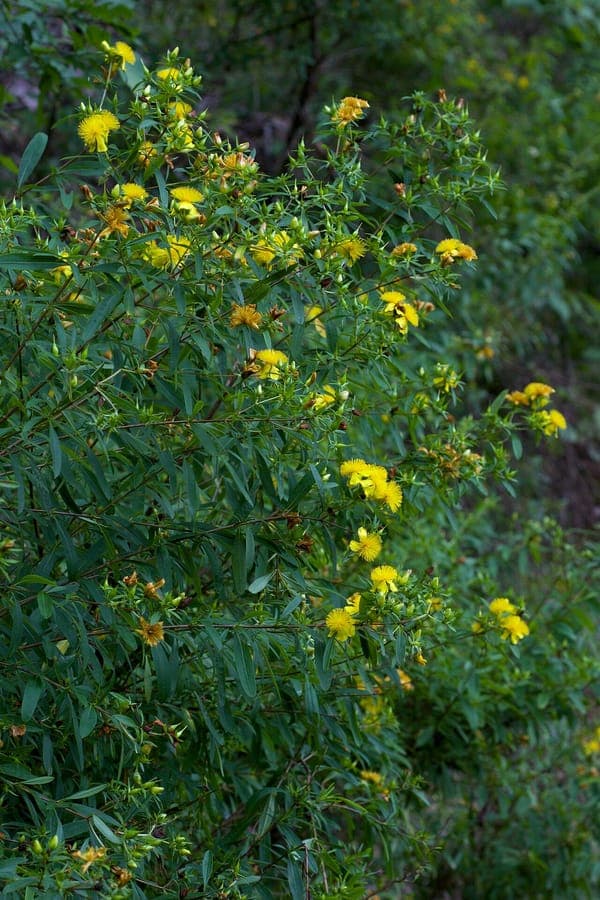
Eric Hunt / CC BY-SA 4.0, via Wikimedia Commons
Broombush: complete guide
Hypericum prolificum
Want to see Broombush: complete guide in your garden?
1 minute, no credit card
Overview
Hypericum prolificum, known by the common names broombush and shrubby St. John's-wort, is a compact, floriferous deciduous shrub in the Hypericaceae family. Native to the eastern and central United States and southern Ontario, it grows naturally from coastal New England west to Iowa and south to Georgia, Alabama, and Texas. This adaptable shrub occupies a range of open habitats including dry rocky slopes, sandy clearings, stream banks, and woodland edges.
The species name 'prolificum' (prolific, abundantly branching) aptly describes the plant's densely twiggy structure. The shrub typically grows 60 to 120 cm tall and at least as wide, forming a rounded, bushy mound of arching branches. The older bark exfoliates in papery reddish-brown strips, providing ornamental interest even when the plant is not in flower. This is a shrub with year-round appeal: clean foliage in summer, masses of bright yellow flowers from June to September, attractive seed capsules in autumn, and exfoliating bark in winter.
Compared with the more commonly grown European and Asian Hypericum selections - such as Hypericum calycinum, Hypericum 'Hidcote', or the widely planted Hypericum androsaemum - this North American native is notably more cold-hardy and arguably more generous in its flower production. It is an outstanding plant for low-maintenance gardens and for those wanting reliable summer colour without fuss.
Appearance & bloom cycle
The leaves of Hypericum prolificum are lance-shaped, 2 to 5 cm long, glossy dark green above and blue-green on the underside. They are densely arranged along the numerous lateral branchlets, giving the whole plant a full, lush appearance in the growing season. Lightly crushed, the leaves release a faint aromatic scent characteristic of the Hypericum genus.
Flowers are bright golden yellow, broadly cup-shaped with five petals 1 to 2 cm across. Each bloom carries a conspicuous central boss of stamens - a hallmark of the genus. The flowering season runs from June through September, peaking in July and August. Individual flowers last only two to three days, but the plant produces new buds continuously so the display is uninterrupted. Bees, bumblebees, and hoverflies visit regularly throughout the season.
After flowering, woody seed capsules 8 to 12 mm long develop, turning from green through red to dark brown. These persist on the plant into winter and, combined with the exfoliating reddish-brown bark on older stems, extend the ornamental season well beyond the last flowers of September.
Ideal location
Hypericum prolificum thrives in full sun to light shade. Full sun - at least six hours of direct sunlight daily - produces the most abundant flowering. In partial shade the plant blooms less freely but retains its attractive dark foliage. Avoid deep shade: the plant becomes leggy and flower production drops substantially.
This shrub tolerates urban conditions well, including air pollution, compacted soils, and drought along paved surfaces. These qualities make it an excellent choice for front gardens in built-up areas, along driveways, and as low hedging in informal settings. Its dense, twiggy habit also lends itself to low informal screening or mass planting beneath taller shrubs and small trees.
For design guidance on incorporating Hypericum prolificum into a sunny front garden scheme, visit gardenworld.app where planting plans are tailored to your specific site.
Soil requirements
Hypericum prolificum is an adaptable shrub that performs on a wide range of soils. Its pH tolerance of 4.6 to 7.2 covers moderately acidic to slightly alkaline conditions. On lean, sandy soils the plant grows more modestly but often flowers more prolifically; on rich, moisture-retentive soils growth is lush but the plant may be somewhat more susceptible to fungal problems.
Good drainage is the most critical soil requirement. Hypericum prolificum does not tolerate prolonged waterlogging: the roots are susceptible to crown rot in permanently wet conditions. On heavy clay, incorporate coarse grit and well-rotted compost into the top 30 cm before planting to improve drainage and structure. A mulch layer of bark or leaf compost, 5 to 8 cm deep, maintains soil moisture, suppresses weeds, and protects surface roots.
The plant shows good tolerance of mild salt levels, making it suitable for roadside plantings where winter salt spray or run-off may occur, provided drainage is adequate to dilute accumulated salts.
Watering
Once established, Hypericum prolificum is a notably drought-tolerant shrub. In the first year after planting, regular deep watering is important to establish a strong root system: water weekly, soaking the soil to a depth of 30 cm. After the first season the plant can largely sustain itself on rainfall in the northern European climate.
During exceptionally dry summers - several weeks without rain at high temperatures - the plant benefits from a supplementary deep watering every two weeks. Apply water at the base of the shrub rather than overhead sprinkling. Check soil moisture at 10 cm depth: the soil may feel dry but should not be bone dry. Container-grown specimens lose moisture faster than plants in the open ground and require more attentive watering throughout the season.
In winter no watering is needed unless an unusually dry frost-free period occurs. Container-grown plants should be checked periodically in winter to prevent the root ball drying out entirely.
Free design
Want to see Broombush: complete guide in your garden? Make a free design now.
Pruning
Hypericum prolificum flowers on new wood produced in the current growing season, which means an annual hard pruning in early spring promotes the best flowering. Cut all stems back to 10 to 20 cm from the ground, or just above a strong, swelling bud, in late February or March before growth begins. This vigorous pruning drives the production of strong new shoots and maximises the summer flower display.
A lighter pruning - cutting back by one-third to one-half - produces a larger, bushier plant but with somewhat fewer flowers. After the first flowering peak in June or July, remove spent flower heads to encourage continued production and maintain a tidy appearance.
Old, heavily woody specimens that have lost vigour can be rejuvenated by cutting back hard to 5 cm from the ground in early spring. Within a single season a dense new framework of branches is produced. This tolerance of hard cutting is one of the plant's most valuable practical traits.
Maintenance calendar
January-February: Plant dormant. Remove any frost-damaged or snow-broken branches.
March: Carry out the annual hard pruning once the worst frosts have passed. Cut back to 10-20 cm above ground or to a strong bud.
April-May: Strong new shoots emerge rapidly. Apply a light balanced feed on poor soils if desired.
June: First flowers open on the new growth. Regular flowering begins. Pollinators arrive in numbers.
July-August: Peak flowering. Plant at its best. Deep watering if extended drought occurs.
September: Flowering tapers off. Seed capsules ripen and colour red-brown.
October-November: Seed capsules and exfoliating bark provide autumn and winter interest. No pruning.
December: Plant dormant. Check and replenish mulch to 5-8 cm depth for winter protection.
Winter hardiness
Hypericum prolificum is outstandingly cold-hardy, rated for USDA hardiness zones 3 to 8. This corresponds to minimum temperatures down to -40 °C for zone 3, making it among the hardiest shrubs in its genus. Across the Netherlands, Belgium, northern France, Germany, and most of Scandinavia the plant overwinters completely reliably without any protection. This cold-hardiness, combined with its long flowering season, makes it a uniquely valuable shrub for northern European gardens.
The woody framework persists through winter. Only the youngest shoot tips may be damaged by very severe frost, and these are removed in any case during the spring pruning. On free-draining soils winter performance is better than on wet, heavy ground. In mild coastal winters the plant may retain much of its foliage well into December, giving a semi-evergreen character.
For gardeners in the cooler parts of the Netherlands or the higher-lying areas of the Belgian Ardennes, Hypericum prolificum is one of the most reliably hardy flowering shrubs available.
Companion plants
Hypericum prolificum combines beautifully with other summer-flowering shrubs and perennials in sunny borders:
- Caryopteris x clandonensis (blue spiraea): the blue-purple flowers in August and September provide a stunning contrast with the yellow of Hypericum in the same season.
- Spiraea japonica 'Anthony Waterer': pink summer flowers alongside yellow create vivid complementary contrasts; both respond well to the same pruning regime.
- Rudbeckia fulgida (orange coneflower): warm orange-yellow flowers repeat the palette and extend interest from August through October.
- Perovskia atriplicifolia (Russian sage): the lavender-blue spires alongside yellow Hypericum is a classic late-summer combination.
- Nepeta x faassenii (catmint): a low border companion with blue flowers that complement the yellow blooms and attract the same pollinators.
- Festuca glauca (blue fescue): blue-grey tufts planted in front of the shrub provide textural contrast and year-round interest.
For a complete front garden design with Hypericum prolificum as the anchor shrub in a summer border, explore the tools at gardenworld.app.
Closing
Hypericum prolificum is a shrub that earns its keep in every season: lush foliage in spring, a generous four-month flower display in summer, attractive capsules in autumn, and peeling bark in winter. Its outstanding cold-hardiness, drought tolerance once established, and generous response to pruning make it one of the most low-maintenance yet rewarding shrubs available for northern European gardens.
Whether you plant it as a specimen, in a mixed sunny border, or as a low informal hedge, Hypericum prolificum will deliver reliable performance year after year with minimal intervention.
Want to see Broombush: complete guide in your garden? Make a free design now.
Upload a photo, pick a style, and get a photorealistic design with plant list in under a minute.
10,000+ gardens designed already
No credit card required


Similar plants
Hypericum coris: complete guide
Hypericum coris
Complete guide to Hypericum coris, the heath-leaved St John's wort from the Alps: location, soil, watering and rock gardens.
St. Peter's-wort: complete guide
Hypericum crux-andreae
St. Peter's-wort is a low-growing North American shrub with yellow flowers, ideal for acidic, damp soil and naturalistic borders.
Hypericum densiflorum: complete guide
Hypericum densiflorum
Hypericum densiflorum is a dense-flowering American shrub with bright yellow summer blooms, well suited to damp gardens, rain gardens, and pollinator borders.