
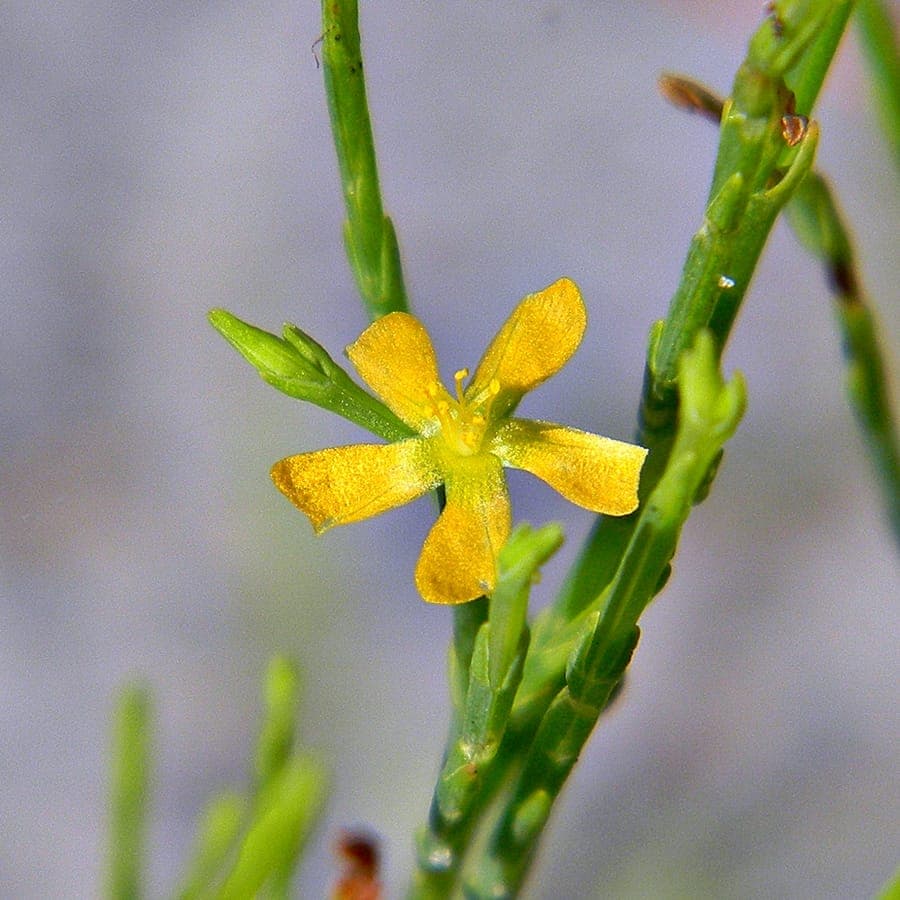
Bob Peterson from North Palm Beach, Florida, Planet Earth! / CC BY-SA 2.0, via Wikimedia Commons
Orangegrass: complete guide
Hypericum gentianoides
Want to see Orangegrass: complete guide in your garden?
1 minute, no credit card
Overview
Hypericum gentianoides, commonly called orangegrass or pineweed, is a slender, wiry herbaceous perennial in the Hypericaceae family. Native to eastern North America, it ranges from Nova Scotia and Ontario south to Florida, Texas, and Louisiana, where it colonises dry sandy fields, rocky outcrops, and open woodland edges. The common name 'orangegrass' refers to the orange-yellow tint of the dried stems in autumn, while 'pineweed' reflects the needle-like appearance of the tiny, closely spaced leaves.
The plant grows 15 to 50 cm tall, producing upright, much-branched stems that create a delicately wiry silhouette resembling a miniature conifer. This fine texture is its greatest ornamental asset: in a border or gravel garden it contributes a transparent, airy quality that few other plants can replicate. The cheerful yellow flowers appear in summer, drawing bees and hoverflies throughout the blooming season.
Unlike the woody Hypericum shrubs familiar in European gardens, such as the widely grown Hypericum calycinum and Hypericum 'Hidcote', this species is fully herbaceous and grows as an annual or short-lived perennial that regenerates freely from seed. This dynamic behaviour suits naturalistic planting designs, especially in dry, low-maintenance gardens where self-seeding can be harnessed creatively.
Appearance & bloom cycle
The stems of Hypericum gentianoides are green to reddish, upright, and covered in tiny, scale-like leaves just 2-5 mm long. The leaf arrangement is so dense and the leaves so small that from a short distance the stems look almost leafless or rush-like. This unusual foliage texture, combined with the erect, branching habit, gives the whole plant a character quite different from the broad-leaved Hypericums of the garden.
Flowers open from July through September. Each bloom is modest - bright yellow, five-petalled, about 5 mm across - but a mature plant produces hundreds of flowers simultaneously, creating a prolonged sparkle of golden yellow along every branchlet. After flowering, small reddish-brown seed capsules develop. These remain on the plant into autumn and turn a warm coppery-brown that extends the ornamental season well into October.
The plant commonly behaves as an annual, completing its cycle from seed germination in spring through flowering, seed set, and die-back by late autumn. On well-drained soils in sheltered positions, perennial root crowns can persist for several years.
Ideal location
Hypericum gentianoides demands full sun. In its native range it grows on the most exposed, open habitats - sandy roadsides, rocky outcrops, dry meadows - always in direct sun. The plant's light requirement is rated at 8 out of 10 on the standard scale, confirming that shaded positions simply will not work. Choose the sunniest available spot: a south-facing front garden bed, a raised gravel planter, or a dry sunny border.
The plant shows surprisingly good tolerance of high atmospheric humidity (rated 8 out of 10), meaning it performs well in coastal and lowland areas, provided the soil itself drains freely. In humid inland conditions, good soil drainage is the key factor that prevents the fungal root rots that might otherwise affect moisture-sensitive species.
A south-facing front garden with gravel or crushed stone mulch is an ideal setting. For design help creating a dry, sunny planting scheme with plants like Hypericum gentianoides, visit gardenworld.app.
Soil requirements
This species thrives on poor, dry, sandy soils. The pH tolerance of 4.6 to 7.0 spans from moderately acidic heathland soils through neutral garden ground. The key requirement is excellent drainage: Hypericum gentianoides will not tolerate waterlogged or nutrient-rich conditions. On fertile, moisture-retentive soils the plant tends to be floppy, soft, and short-lived.
To improve drainage on heavier soils, work coarse grit or horticultural sand generously into the top 20 cm before planting. Avoid adding compost or well-rotted manure in large quantities - this increases fertility beyond what the plant prefers. A surface mulch of coarse gravel or crushed stone keeps the root zone warm and dry, reflects light onto the lower stems, and suppresses competing weeds.
On suitable sandy or rocky soil, the plant often self-seeds reliably year to year, establishing a self-sustaining colony that requires no annual replanting. This self-seeding behaviour is one of its practical strengths in the low-maintenance dry garden.
Watering
Once established, Hypericum gentianoides is highly drought-tolerant and rarely needs supplementary watering. The root system is well adapted to extracting moisture from dry soil layers, and the plant is accustomed to periods of summer drought in its native habitat. Supplementary watering is most important in the first few weeks after planting, while the young plant is establishing its root system.
During prolonged summer drought - more than two weeks without rainfall - a deep weekly watering at the base of the plant will maintain good growth and flowering. Water at soil level, avoiding wetting the stems and leaves. In typical northern European summers with occasional rain, additional watering is not required for established plants.
In winter the plant is dormant or has died back fully above ground. No watering is needed. Avoid over-wet winter conditions: poor drainage in winter is more harmful to this plant than summer drought.
Free design
Want to see Orangegrass: complete guide in your garden? Make a free design now.
Pruning
Hypericum gentianoides is a herbaceous plant that dies back to the ground each autumn. Pruning requirements are therefore minimal. After the first frost, cut the dead stems to ground level or leave them standing through winter. The fine, reddish-brown stems and persistent seed capsules have real ornamental value in autumn and early winter light, and they provide a small but useful amount of shelter for overwintering insects.
In spring, cut back any remaining old growth before the new season's shoots emerge. This is also the time to remove unwanted self-sown seedlings if the plant is spreading beyond its intended area. On suitable soils, self-sown plants establish quickly and are often more vigorous than transplanted specimens.
For a second flush of flowers in late summer, you can cut back by half after the first flowering wave in July. This encourages fresh lateral branching and a second, often more prolific, flowering in August and September.
Maintenance calendar
January-February: Plant dormant or fully dead above ground. No action needed.
March: First new growth visible from established crowns. Seedlings may begin germinating from the seed bank. Keep the area clear of competitive weeds.
April-May: Rapid growth phase. Thin overcrowded seedlings if the stand is too dense. No feeding needed on poor soils.
June: Growth approaching full height. On very poor soils, a light low-nitrogen feed can extend the blooming season.
July-September: Full bloom. Hundreds of yellow flowers open daily. Water only during extended drought.
October: Reddish-brown seed capsules ornament the autumn stems. Plant begins to die back.
November: Cut back dead stems or leave for winter interest.
December: No maintenance required. Seeds overwinter in the soil.
Winter hardiness
Hypericum gentianoides is hardy to USDA zone 5, corresponding to minimum temperatures around -25 °C for short periods. Across the Netherlands, Belgium, northern France, and Germany the plant is generally reliably hardy, though in the coldest positions - northern Netherlands, higher elevations in the Ardennes or Vosges - severe winters may damage overwintering root crowns. On free-draining dry soils, winter hardiness is considerably greater than on wet or heavy ground.
The above-ground parts die back at the first frost, but roots and seeds in the soil survive dependably. New plants germinate in spring from the seed bank, and perennial roots resprout quickly. Recovery after cold winters is generally complete within a few weeks of warm spring weather.
In sheltered, dry positions such as a gravel bed in front of a south-facing wall, the plant overwinters reliably even in cold winters.
Companion plants
Hypericum gentianoides is best combined with other plants adapted to dry, nutrient-poor, sunny conditions:
- Sedum reflexum (reflexed stonecrop): a drought-tolerant ground cover that forms a low carpet beneath the upright Hypericum stems.
- Festuca glauca (blue fescue): the silvery-blue tufts provide a striking colour contrast with the yellow summer flowers.
- Thymus serpyllum (wild thyme): a ground-covering companion for the same dry, open conditions, blooming at the same time and attracting the same pollinators.
- Calluna vulgaris (heather): on acidic, nutrient-poor soils a natural associate; the pink or purple flowers contrast beautifully with yellow.
- Armeria maritima (sea thrift): compact cushions that give structure to a dry border or gravel garden.
- Erigeron karvinskianus (Mexican fleabane): a self-seeding companion for the same habitat that extends flowering into autumn.
For a tailored dry garden design incorporating Hypericum gentianoides alongside these companions, explore the planning tools at gardenworld.app.
Closing
Hypericum gentianoides is a specialist's plant: not showy in the conventional sense, but rewarding for gardeners who appreciate fine texture, ecological value, and the beauty of a plant perfectly matched to its conditions. Its airy wiry stems, prolific yellow midsummer flowers, and autumn seed-capsule interest make it a genuinely distinctive addition to dry gardens, gravel gardens, and naturalistic plantings.
The cultivation requirements are simple: full sun, poor and freely draining soil, and restraint in watering and feeding. Under those conditions, this plant will reward you with reliable flowers year after year, self-seeding modestly to maintain itself without intervention.
Want to see Orangegrass: complete guide in your garden? Make a free design now.
Upload a photo, pick a style, and get a photorealistic design with plant list in under a minute.
10,000+ gardens designed already
No credit card required


Similar plants
Hypericum coris: complete guide
Hypericum coris
Complete guide to Hypericum coris, the heath-leaved St John's wort from the Alps: location, soil, watering and rock gardens.
St. Peter's-wort: complete guide
Hypericum crux-andreae
St. Peter's-wort is a low-growing North American shrub with yellow flowers, ideal for acidic, damp soil and naturalistic borders.
Hypericum densiflorum: complete guide
Hypericum densiflorum
Hypericum densiflorum is a dense-flowering American shrub with bright yellow summer blooms, well suited to damp gardens, rain gardens, and pollinator borders.