
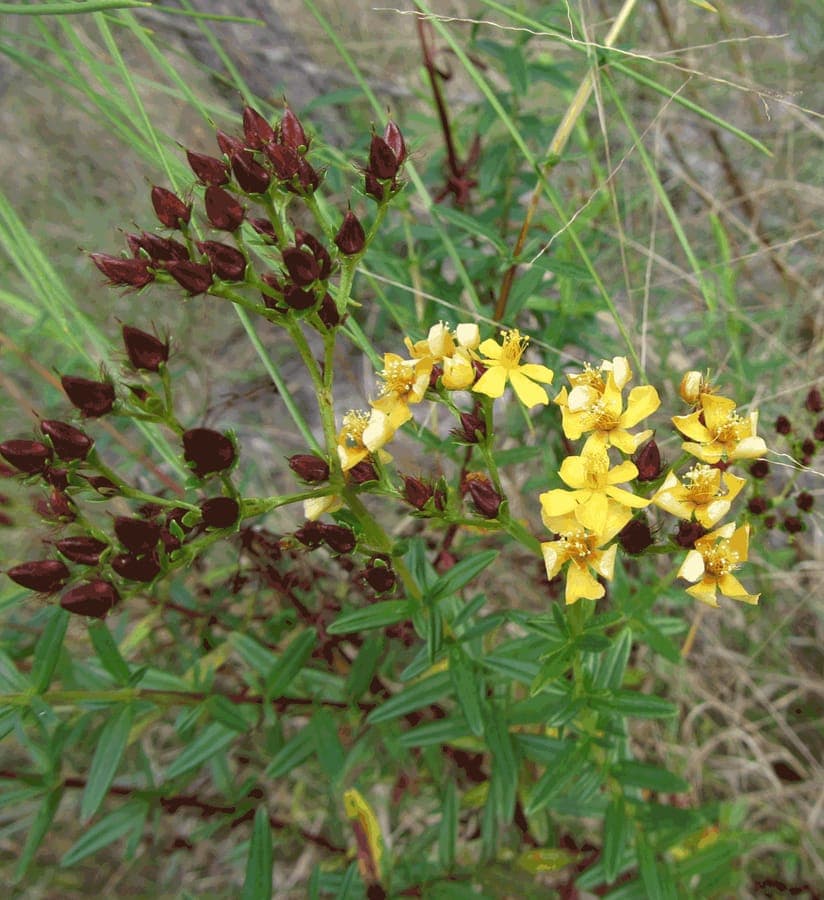
Homer Edward Price / CC BY 2.0, via Wikimedia Commons
Round-pod St. John's-wort: complete guide
Hypericum cistifolium
Want to see Round-pod St. John's-wort: complete guide in your garden?
1 minute, no credit card
Overview
Hypericum cistifolium, commonly called round-pod St. John's-wort or roundpod St. Johnswort, is a distinctive herbaceous to semi-woody perennial in the family Hypericaceae. Native to the southeastern United States - from North Carolina and South Carolina through Georgia, Alabama, Mississippi, Florida and Louisiana to eastern Texas - it grows on sandy open woodlands, damp grasslands, rocky streambanks and open forest margins. The species epithet 'cistifolium' refers to the resemblance of its leaves to those of Cistus, the rock rose: narrow, firm, and somewhat leathery.
The plant is classified as a stoloniferous forb, herb, or subshrub, meaning it spreads slowly over time by underground runners. This creeping habit makes it useful as a ground-covering perennial for warm, well-drained sites. The soil pH tolerance ranges from 4.6 to 7.0, spanning from moderately acid woodland soils to neutral garden ground, which gives it considerable flexibility across different garden settings.
In European gardens, Hypericum cistifolium is a rewarding choice for gardeners who want the classic yellow St. John's-wort flower in a more compact and orderly plant than some of the more vigorous stoloniferous species. At gardenworld.app you can have a personalised planting plan developed that includes drought-tolerant perennials like this one in a sunny front garden or border.
Appearance & bloom cycle
Hypericum cistifolium produces upright to slightly arching stems reaching 30 to 90 cm in height, depending on growing conditions. The stems are cylindrical, green to reddish, and clothed with numerous small, oval, sessile leaves - leaves that attach directly to the stem without a leaf stalk. Leaf colour ranges from grey-green to olive green; under drought conditions the leaves become slightly narrower and stiffer.
The flowers are bright yellow with five petals and a conspicuous central boss of many stamens, giving each flower a cheerful, airy appearance. Bloom time falls in high summer, from June through August in most garden settings, and the flowers are most profuse in full sun. Bees, bumblebees, and hoverflies visit the flowers readily throughout the blooming season.
The feature that gives this species its common name is the rounded to oval seed capsule that follows the flowers. The capsules start green and turn brown as they ripen, containing numerous small seeds. These round pods remain on the plant long into late summer and early autumn, providing a secondary ornamental interest after the main flowering period. The flowers are rated conspicuous in botanical records, while the fruits are less immediately striking but still add texture and interest.
Ideal location
Hypericum cistifolium performs best in full sun to light shade. In its native southeastern US range it occupies open sunny habitats but can also thrive in the dappled shade of open woodlands. In a northwest European garden climate, a south- or southwest-facing position is ideal: the plant flowers more freely in greater sun and is more robust with good light levels.
The plant tolerates heat well and copes with the dry, hot periods that are increasingly common in northern European summers. A south-facing front garden, a raised bed, or a gravelled border edge are all suitable settings. Avoid positions where water pools or drainage is slow: the roots are sensitive to prolonged wet conditions combined with cold temperatures.
In light shade - beneath an open-canopy tree or along an east-facing garden wall - the plant still flowers reasonably well, though less prolifically than in full sun. Deep shade does not suit Hypericum cistifolium.
Soil requirements
This species is undemanding about soil type but performs best on freely draining, slightly acid to neutral soil with a pH of 4.6 to 7.0. Sandy or sandy loam soils are preferable to heavy clay. On clay soils, work coarse grit or perlite into the top 20 cm to improve drainage.
Hypericum cistifolium does not need rich garden soil: too many nutrients lead to lush, floppy stems and fewer flowers. Do not add large amounts of compost or well-rotted manure to the planting site. A light soil with modest organic content is generally sufficient.
The stoloniferous habit means that over the years the plant will slowly spread via underground runners. On light sandy soils this happens more quickly than on heavier ground. Bear this in mind when planting in a formal border: contain the colony if needed with a root barrier or by planting in a buried container with its base removed.
Watering
Once established in the garden, Hypericum cistifolium needs little supplementary watering. The plant is accustomed from its native range to variable rainfall patterns and has developed a sound root system for bridging dry spells. Supplementary watering is most important in the first few weeks after planting, while the young plant is settling into its new position.
During extended summer drought - more than two weeks without significant rainfall - a thorough weekly watering at the base of the plant is recommended. Water directly at the root zone. Overhead watering onto the foliage is less effective and increases the risk of fungal problems in warm, humid weather.
In autumn and winter the plant needs little or no water. Winter waterlogging combined with frost is the greatest survival risk: on poorly drained soil, roots can rot under prolonged frozen wet conditions. Always choose a freely draining site to avoid this problem.
On a well-drained, lightly sandy soil in a typical western European summer, the established plant will rarely need supplementary watering beyond natural rainfall.
Free design
Want to see Round-pod St. John's-wort: complete guide in your garden? Make a free design now.
Pruning
Hypericum cistifolium is a subshrub that may remain partly persistent above ground in mild winters but typically dies back to near ground level in colder northern European winters. Pruning management is therefore straightforward.
In late spring, once the risk of hard frost has passed and new growth is clearly visible, cut back dead or damaged stems to the fresh shoots. Wait until you can clearly see where new buds are breaking before cutting: this prevents cutting back into live growth.
In mild winters or on sheltered sites where the plant remains partly intact above ground, cut the longest stems back by a third to a half in early spring to encourage a more compact, freely flowering plant. Remove any completely dead or bare branches at the base.
During the flowering season, cutting back spent flower stems by part of their length can encourage further flowering from side shoots. This is not strictly necessary but prolongs the ornamental period.
To keep the colony compact and limit spread by stolons, cut back or remove the outermost runners in autumn. Young stolons separate easily and can be potted up or given away.
Maintenance calendar
January-February: Plant dormant. On well-drained soil, roots and some stems survive. No active maintenance needed.
March: Check for winter damage. Cut back dead stems once new growth is clearly visible. Keep the area clear of competing weeds.
April-May: Growth accelerates. A light application of a general garden fertiliser on very poor soils may be given. Limited watering if spring drought occurs.
June: First flower buds appear. Blooming begins. Ensure the plant has space in the border; remove encroaching weeds.
July-August: Peak flowering. Yellow flowers above the compact mound. Bees and hoverflies visit daily. Water only during prolonged drought.
September: Flowering declines; round seed capsules become visible and colour from green to brown.
October: Above-ground dieback begins. Leave stems for winter structure and insect habitat.
November-December: Plant fully dormant. No maintenance required.
Winter hardiness
Hypericum cistifolium is native to the southeastern United States and is naturally suited to mild winters. The USDA hardiness zone for its native range runs from zone 7 to zone 9, corresponding to minimum temperatures of roughly -17 to -7 degrees Celsius. Most western European garden soils fall within USDA zones 7 to 8, making the plant potentially suitable across much of the Netherlands, Belgium, western and central Germany, and the northern French coast.
In colder regions - the inland Netherlands, inland Belgium and Germany, or higher elevations - caution is warranted. A sheltered position against a south-facing wall, a thick mulch of bark or straw at the plant's base, and freely draining soil all significantly improve winter survival.
In hard winters where temperatures remain below -10 degrees Celsius for several weeks, the above-ground parts may freeze completely. However, on well-drained soils the roots survive more often than expected, and the plant typically recovers from the root crown in spring.
In the mild coastal regions of the Netherlands, Belgium and northern France, the plant usually overwinters without problems. Inland and at higher elevations, winter protection is advisable.
Companion plants
Hypericum cistifolium combines best with other plants suited to sunny, freely draining, and relatively dry conditions:
- Sedum spectabile (ice plant): a drought-tolerant perennial with large flat flower heads in pink or red; the broad plate structure contrasts well with the more individual yellow flowers of Hypericum.
- Perovskia atriplicifolia (Russian sage): the lilac-blue flower spikes and silver-grey foliage provide a perfect colour complement to the yellow of St. John's-wort.
- Coreopsis verticillata (threadleaf coreopsis): fine, long-flowering yellow daisy blooms; together with Hypericum they create an extended golden-yellow summer display.
- Echinacea purpurea (purple coneflower): the purple to pink flowers alongside yellow Hypericum blooms form a classic pollinator-friendly colour pairing.
- Festuca glauca (blue fescue): the silvery-blue tufts provide structure and colour contrast in a dry border and complement the grey-green foliage of Hypericum cistifolium.
- Lavandula angustifolia (lavender): another sun-loving, drought-tolerant plant with contrasting flower form and fragrance; together they create a classic Mediterranean feel in the front garden.
For a tailored garden design using Hypericum cistifolium alongside suitable companions, the planning tools at gardenworld.app can help you bring together the right combination for your specific site conditions.
Closing
Hypericum cistifolium is a versatile, drought-tolerant perennial that deserves wider recognition in European gardens. Its compact spreading habit, rich yellow summer flowers, and the ornamental round seed capsules that follow them combine to make it a genuinely distinctive plant for the modern, water-wise garden.
Cultivation is straightforward: sun or light shade, freely draining soil, minimal watering once established, and very little feeding. Under those conditions this underused St. John's-wort will reward you with reliable summer colour, good pollinator value, and a low-maintenance habit that fits well into the busy contemporary garden.
Want to see Round-pod St. John's-wort: complete guide in your garden? Make a free design now.
Upload a photo, pick a style, and get a photorealistic design with plant list in under a minute.
10,000+ gardens designed already
No credit card required


Similar plants
Hypericum coris: complete guide
Hypericum coris
Complete guide to Hypericum coris, the heath-leaved St John's wort from the Alps: location, soil, watering and rock gardens.
St. Peter's-wort: complete guide
Hypericum crux-andreae
St. Peter's-wort is a low-growing North American shrub with yellow flowers, ideal for acidic, damp soil and naturalistic borders.
Hypericum densiflorum: complete guide
Hypericum densiflorum
Hypericum densiflorum is a dense-flowering American shrub with bright yellow summer blooms, well suited to damp gardens, rain gardens, and pollinator borders.