
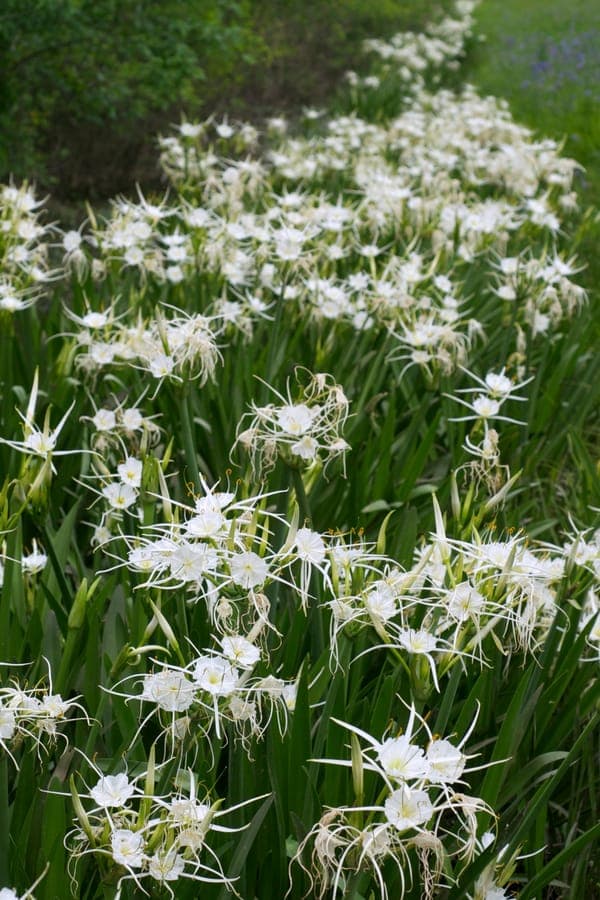
Eric Hunt / CC BY-SA 4.0, via Wikimedia Commons
Spring spiderlily: complete guide
Hymenocallis liriosme
Want to see Spring spiderlily: complete guide in your garden?
1 minute, no credit card
Overview
Spring spiderlily (Hymenocallis liriosme) is a striking bulbous perennial from the amaryllis family (Amaryllidaceae), native to the wet lowlands of the south-central United States. Its natural range covers Texas, Oklahoma, Louisiana, Mississippi, Arkansas, and Alabama, where it grows along the banks of ditches and rivers, in swamps, and on moist, sandy low-lying ground. The genus Hymenocallis encompasses around fifty species, all distinguished by those dramatic, spider-like flowers with long, slender perianth segments radiating from a central cup-shaped corona. The common name 'spring spiderlily' perfectly captures both the appearance and the bloom season. This is a plant for gardeners who want something genuinely unusual - exotic-looking blooms combined with a delicious fragrance. See how bulbs like this can be incorporated into a modern garden layout on gardenworld.app.
Appearance and bloom cycle
Spring spiderlily forms a clumping bulb that produces fans of dark green, strap-like leaves reaching 30 to 60 cm in length. The foliage is glossy, broad, and deeply coloured, arching slightly outward from the central crown. From the middle of the leaf rosette emerge stiff flower stems reaching 40 to 70 cm in height. Each stem carries an umbel of four to six individual flowers. Each flower consists of a narrow cylindrical white corona in the centre, from which six long, slender perianth segments radiate outward like the legs of a spider. The stamens are likewise long and projecting, reinforcing the spidery effect. Flowers are strongly fragrant, particularly in the evening, and appear from April through June in their native range. In cooler temperate gardens, flowering typically occurs in June and July. Green seed berries containing large seeds may follow the flowering period.
Ideal location
Spring spiderlily thrives in a sunny to lightly shaded position, requiring at least five to six hours of direct sunlight daily for good flowering. The crucial factor, however, is moisture: this plant grows naturally in swamps and along water edges. It is ideal for the margins of a pond, a wet ditch, or a stream bank. In drier gardens it can be grown in large containers filled with moisture-retentive compost so it still enjoys the conditions it needs. It also requires a warm, sheltered spot; cold winds and late frosts in May can seriously damage newly emerging leaves.
Soil
This plant has a strong preference for moist growing conditions. In nature it colonises wet, sandy or organically rich soils beside water. In the garden, a moist, well-fertilised, neutral to slightly acid soil is ideal, with a pH range of 5.5 to 9.0 being tolerated, though 6.5 to 7.5 is optimal. A soil that retains moisture but allows some drainage is preferred over permanently saturated ground. On sandy soils, incorporate generous amounts of organic matter: compost, coir fibre, or well-rotted leaf mould. At a pond edge, the bulb can be planted in shallow marginal soil, provided the root zone is not permanently submerged more than 5 cm deep. Specialised bulb composts available at garden centres work well when planting in containers.
Watering
This is a plant for the wet spots in your garden. Throughout the entire growing period - from when the leaves emerge in spring until they begin to yellow in late summer - it needs generous and consistent moisture. In dry summers, deep watering several times a week is necessary; never allow the soil to dry out completely while leaves are present and green. During the winter rest period, when the bulb is dormant, the soil may be considerably drier. For container growing: ensure the pot has large drainage holes and water regularly and generously during the growing months, but keep the plant quite dry during winter dormancy. Frequent moderate watering is better than infrequent heavy drenching.
Free design
Want to see Spring spiderlily: complete guide in your garden? Make a free design now.
Pruning
Spring spiderlily requires no conventional pruning. Remove spent flower stems at the base once all the blooms have faded; this improves the appearance and prevents the plant from directing energy into seed formation if that is not desired. However, the leaves must be left in place until they are completely yellow and withered: the green foliage photosynthesises and feeds the bulb for the following season. In late summer and autumn the leaves dry naturally; only then should they be removed. Never cut green leaves away prematurely as every green leaf represents stored energy the bulb needs to perform well the following year.
Maintenance calendar
March and April: bulbs begin to grow; provide warmth and adequate moisture. May and June: leaves and flower stems emerge; protect against late frosts. June and July: flowering period; enjoy the fragrant star-shaped blooms. August: leaves continue to feed the bulb; maintain watering. September and October: leaves wither; lift bulbs before hard frosts arrive. October and November: allow lifted bulbs to dry in a ventilated space for two weeks, then store dry and frost-free at 10 to 15 degrees Celsius. December to February: rest period; keep bulbs dry and cool in a frost-free location.
Winter hardiness
Spring spiderlily is rated for USDA hardiness zones 7 to 10, meaning it can survive light winters outdoors in the milder parts of western Europe (zone 8), but hard frosts below -10 to -12 degrees Celsius will kill the bulbs. The safest approach in cooler temperate climates is to lift the bulbs after the first autumn frost, allow them to dry for two weeks in a well-ventilated space, then store them dry and frost-free at 10 to 15 degrees Celsius until the end of April. In very warm, sheltered positions - such as beside a south-facing wall with a heavy mulch of 20 cm of straw over the root zone - the bulbs may survive mild winters in situ, but this is a gamble worth evaluating each season based on the weather forecast.
Companion plants
The white, star-shaped flowers of spring spiderlily look spectacular alongside other moisture-loving plants with strong structural forms. Good companions include yellow flag iris (Iris pseudacorus), purple loosestrife (Lythrum salicaria), water mint (Mentha aquatica), and marsh marigold (Caltha palustris). For a genuinely tropical effect, try combining it with cannas or ornamental water ferns. In a mixed summer border away from water, the spiderlily adds an unexpectedly elegant, airy note among heavier-blooming summer plants. White flowers combine beautifully with purple (Lythrum), yellow (Hemerocallis), and pale blue (Veronica longifolia).
Closing
Spring spiderlily (Hymenocallis liriosme) is a genuinely unique and elegant bulb for gardeners who appreciate unusual flower forms and fragrance. Its white star-shaped blooms with their long radiating perianth segments and projecting stamens are unmistakable and attract both admiring glances and butterflies. It asks for consistent moisture, protection from hard frost, and a little patience at lifting and storage time, but delivers a floral display that is difficult to match. Whether planted at a pond edge or grown in a generous container on a sunny terrace, it will always command attention. Visit gardenworld.app to discover how this and other distinctive bulbs can be woven into a well-planned garden design.
Want to see Spring spiderlily: complete guide in your garden? Make a free design now.
Upload a photo, pick a style, and get a photorealistic design with plant list in under a minute.
10,000+ gardens designed already
No credit card required

