
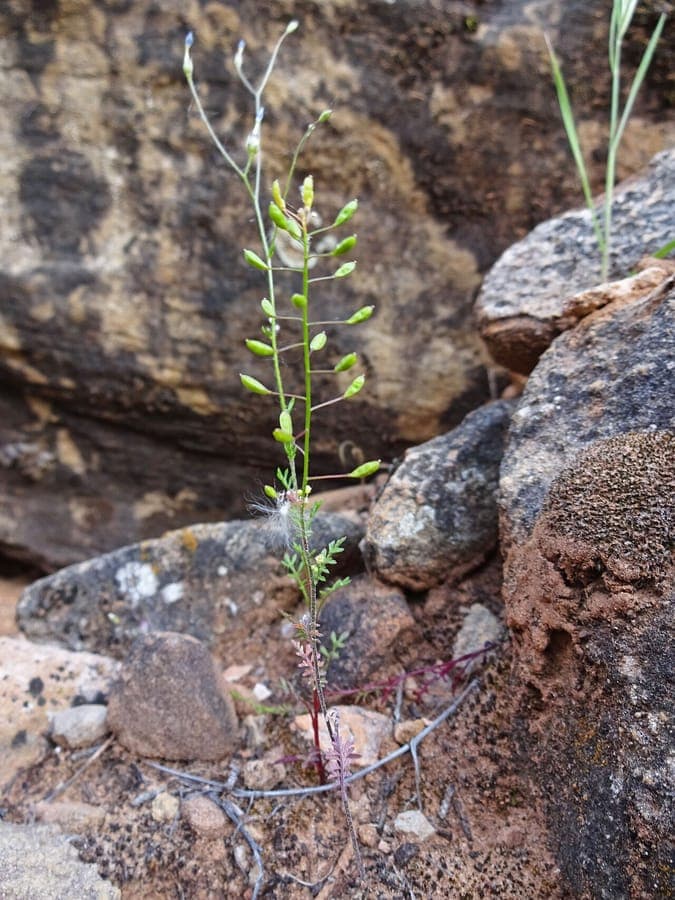
Andrey Zharkikh from Salt Lake City, USA / CC BY 2.0, via Wikimedia Commons
Hornungia procumbens: complete guide
Hornungia procumbens
Want to see Hornungia procumbens: complete guide in your garden?
1 minute, no credit card
Overview
Hornungia procumbens, also known as prostrate hutchinsia, spreading hutchinsia, or prostrate saltwort, is a compact herb from the Brassicaceae family. This small plant originates from the Mediterranean region to Xinjiang and Pakistan. The plant is renowned for its low, prostrate growth habit and small white flowers that bloom from April to June.
This plant is widely used in rock gardens, stone walls, and between stones because it can grow in difficult locations where many other plants cannot survive. It is particularly suited for calcareous, dry soils.
Appearance and Bloom
Hornungia procumbens forms a very compact, prostrate plant that spreads across the ground. The plant reaches only a few centimeters in height, making it perfect for rock gardens and stone walls. The leaves are small, green, and form compact rosettes at ground level.
The flowers are small, white, and appear in clusters above the foliage. They are only a few millimeters in diameter, but appear in great numbers, giving the plant a beautiful white tone. After blooming, small, round seed pods form that are characteristic of the Brassicaceae family.
Ideal Location
Hornungia procumbens thrives best in completely sunny locations. The plant requires at least 8-10 hours of sunlight daily. In full sun, the plant will remain compact and bloom well.
The plant is well-suited for rock gardens and can also grow well on steep, dry slopes. It can even grow on bare rocks and stone walls if there is minimal soil available.
Soil
Hornungia procumbens prefers well-draining, calcareous soils. The plant can very well grow on poor soils and actually requires little nutrition. A pH between 7.5 and 8.0 is ideal, although the plant can also grow on slightly more acidic soil.
Ensure the soil drains very well. For containers, use a mixture of sand and humus-rich soil. Very important: prevent water stagnation!
Free design
Want to see Hornungia procumbens: complete guide in your garden? Make a free design now.
Watering
Once established, Hornungia procumbens is very drought-tolerant. During the growing period, you can water carefully, but ensure the soil does not become wet. Actually, the plant prefers dry conditions.
In winter, water minimally. The plant can tolerate long dry periods. When growing in containers, water carefully so the soil does not become wet.
Pruning
Hornungia procumbens requires practically no pruning. The plant always grows compactly. Remove only dead leaves and flowers and gently pull back longer parts if you wish.
The plant is very self-sufficient and actually requires no special maintenance.
Maintenance Calendar
This plant requires very little maintenance. In spring, you can carefully apply a very small amount of fertilizer if desired, but this is not essential. Remove dead leaves occasionally.
The plant can actually survive completely without input.
Winter Hardiness
Hornungia procumbens is relatively winter-hardy in moderately cold climates. It can tolerate temperatures down to approximately -10 to -15 degrees Celsius, although prolonged frost is not favorable. In areas with very severe winters, the plant should receive some protection.
The plant survives winter moisture relatively well.
Companion Plants
Hornungia procumbens fits well in rock gardens with other rock garden plants. Combine it with other compact Mediterranean plants such as sedums, sempervirens, and alpine plants.
The plant works well alongside lavender, sage, and other salt-tolerant plants. In containers, it can be combined successfully with succulents.
Closing Thoughts
Hornungia procumbens is an ideal plant for rock gardens and rocky locations. With its very low growth, white flowers, and tolerance for dry, calcareous soil, it forms a perfect fill for difficult spots in the garden. Provide full sun, very well-draining soil, and minimal watering, and you will enjoy this small gem for many years.
For more plant inspiration, visit gardenworld.app.
Want to see Hornungia procumbens: complete guide in your garden? Make a free design now.
Upload a photo, pick a style, and get a photorealistic design with plant list in under a minute.
No credit card required


Similar plants
Brassica cretica: complete guide
Brassica cretica
Brassica cretica, the Cretan cabbage, grows wild on Aegean cliffs. Discover how to grow this drought-tolerant, yellow-flowered Mediterranean perennial.
Corsican cabbage: complete guide
Brassica insularis
Corsican cabbage is a rare Mediterranean rock cabbage with white flowers and blue-green leaves. Location, soil and winter protection.
Prostrate cabbage: complete guide
Brassica procumbens
Prostrate cabbage is a creeping North African cliff plant with yellow flowers. Discover location, soil type and winter protection.