
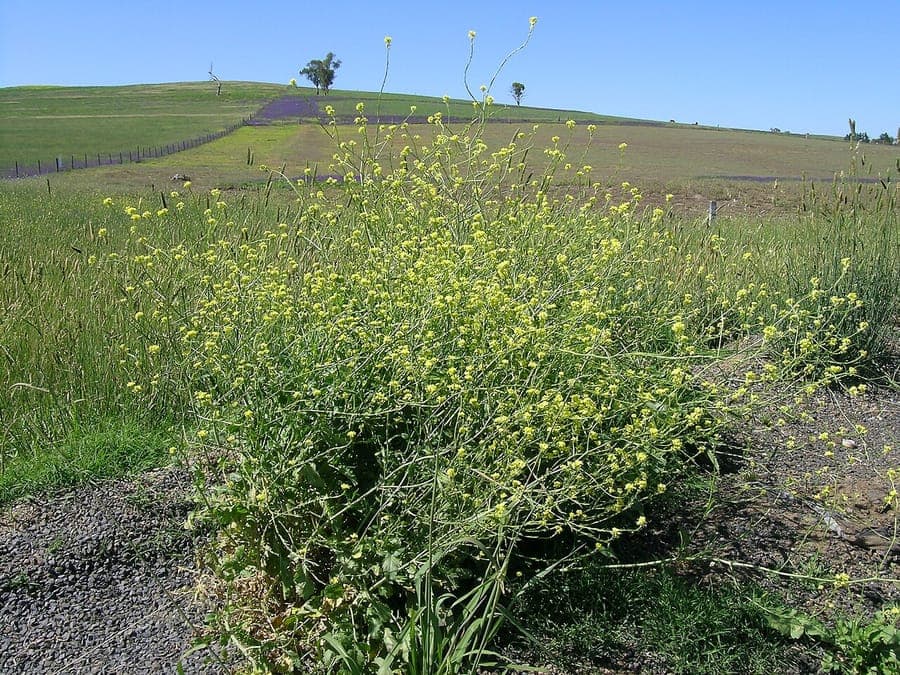
Harry Rose from South West Rocks, Australia / CC BY 2.0, via Wikimedia Commons
Hirschfeldia incana: complete guide
Hirschfeldia incana
Want to see Hirschfeldia incana: complete guide in your garden?
1 minute, no credit card
Overview
Hoary mustard (Hirschfeldia incana) is a robust, semi-woody annual to biennial plant from the Mediterranean region. This flowering plant grows 60-150 cm tall and is characterized by its gray-green foliage and bright yellow flowers. Hirschfeldia incana is extremely drought-tolerant, low-maintenance, and perfect for Mediterranean front garden designs on gardenworld.app.
Appearance and Bloom
Hirschfeldia incana has characteristic, finely hairy, gray-green leaves that are larger at the base and become narrower toward the top. The plant grows as an upright shrub to about 1-1.5 meters tall. The flowers are small, bright yellow and grow in dense, long flower spikes. The fruit stage (pods) is very decorative, with characteristic, distinctive vein patterns. Blooming period: April-August.
Ideal Location
Hoary mustard thrives best in full sun with well-draining soil. In your front garden design on gardenworld.app, a very sunny spot with at least 8 hours of direct sunlight daily is ideal. This plant tolerates partial shade but blooms most abundantly in full sun.
Soil
This plant prefers well-draining soil and even tolerates sterile sand. The plant grows well in stony, poor soils where many other species cannot grow. pH can range from acidic to alkaline (pH 5-8), but alkaline is preferred. No extra fertilizing needed - feeding can even cause excessive leaf growth and reduced flowering.
Watering
Once established, hoary mustard is extremely drought-tolerant. Water only in the first growing year. After establishment, no additional water is needed. Excessive moisture is harmful and can cause root rot.
Free design
Want to see Hirschfeldia incana: complete guide in your garden? Make a free design now.
Pruning and Maintenance
Prune as desired - this plant tolerates pruning well. Pruning can be done in May after first blooming. Remove dead stem remains in autumn. The plant can produce massive seed, so removing seed heads prevents self-seeding.
Maintenance Calendar
- March-April: Growth begins
- April-August: Long blooming period
- August-September: Seed formation, pruning optional
- October: Remove seed heads
- November-February: Minimal maintenance
Winter Hardiness
Hirschfeldia incana is half-hardy in mild winters (-5°C). In temperate regions, this is an annual to biennial crop. Plant in April-May and enjoy all-summer blooming. In mild years, plants can overwinter and flower as a biennial. USDA zone 8-9 for overwintering.
Companion Plants
Pairs well with:
- Lavender: purple tones provide color contrast
- Rosemary: similar drought requirements
- Sunflowers: related family
- Yellow sage: simultaneous blooming
- Silver-leaved plants (Senecio): foliage contrast
Closing Thoughts
Hoary mustard is a fascinating, underrated jewel for dry, Mediterranean front garden designs on gardenworld.app. With its silver-gray foliage, long-lasting yellow blooming, and extreme drought tolerance, this plant perfectly follows a water-conscious garden philosophy. Plant in full sun on well-draining soil, minimize water after the first season, and enjoy relentless blooming from April through August.
Want to design your front garden sustainably and drought-resistant? Visit gardenworld.app for personalized drought-tolerant garden advice.
Want to see Hirschfeldia incana: complete guide in your garden? Make a free design now.
Upload a photo, pick a style, and get a photorealistic design with plant list in under a minute.
No credit card required


Similar plants
Brassica cretica: complete guide
Brassica cretica
Brassica cretica, the Cretan cabbage, grows wild on Aegean cliffs. Discover how to grow this drought-tolerant, yellow-flowered Mediterranean perennial.
Corsican cabbage: complete guide
Brassica insularis
Corsican cabbage is a rare Mediterranean rock cabbage with white flowers and blue-green leaves. Location, soil and winter protection.
Prostrate cabbage: complete guide
Brassica procumbens
Prostrate cabbage is a creeping North African cliff plant with yellow flowers. Discover location, soil type and winter protection.