
Wikimedia Commons / Public domain, via Wikimedia Commons
Nuttall's sunflower: complete guide
Helianthus nuttallii
Want to see Nuttall's sunflower: complete guide in your garden?
1 minute, no credit card
Overview
Helianthus nuttallii, commonly known as Nuttall's sunflower or the clustered sunflower, is a robust rhizomatous perennial belonging to the Asteraceae family. Described in 1842 by Torrey and Gray, this North American native ranges from Alberta and British Columbia south through Montana, Wyoming, Colorado, and Utah to Arizona, New Mexico, and Oklahoma, occupying open prairies, dry hillsides, riverbanks, and mountain meadows at elevations up to 2,400 metres.
The plant is named after Thomas Nuttall, the nineteenth-century British-American botanist and ornithologist who was among the first systematic explorers of the North American interior flora. Nuttall's sunflower is closely related to the common swamp sunflower (Helianthus angustifolius) - indeed it was once classified as a subspecies thereof - but differs in its more upland, drought-tolerant habitat preference and somewhat smaller, more densely clustered flower heads.
In European gardens, Helianthus nuttallii is gaining recognition as a long-lived, low-maintenance alternative to annual sunflowers, returning reliably each spring from its spreading underground rhizomes. It belongs to a group of North American prairie perennials - alongside Echinacea, Rudbeckia, Liatris, and Agastache - that have transformed the naturalistic planting movement in the UK, Netherlands, and Germany over the past two decades. Plan your prairie-style planting with these species at gardenworld.app for a cohesive, ecologically valuable result.
Appearance & bloom cycle
Nuttall's sunflower forms multi-stemmed clumps that grow 80–150 cm tall in typical garden conditions, occasionally reaching 200 cm on rich, moist soils. Stems are stiffly erect, lightly hairy, and branch freely in the upper half, creating an open, airy structure rather than a single towering stalk.
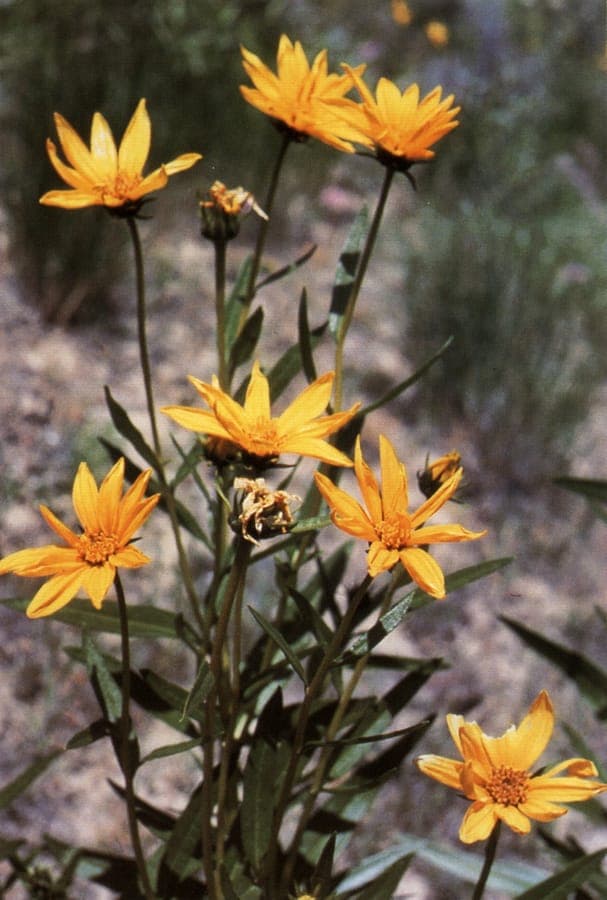
Leaves are lance-shaped to ovate-lanceolate, 8–15 cm long and 2–5 cm wide, with a slightly toothed margin. The upper surface is deep green and distinctly rough to the touch - characteristic of the genus - while the underside is paler and softly hairy. Upper leaves are nearly sessile, while lower leaves have short petioles.
Flower heads open from mid-July through September, each consisting of 10–20 bright lemon-yellow ray florets, 2–4 cm long, surrounding a dark brown to reddish-brown central disc 1–2 cm across. Individual plants carry dozens of heads simultaneously, making for a prolonged, spectacular display. The flowers are highly attractive to bees, bumblebees, butterflies, and hoverflies, making Nuttall's sunflower an excellent contribution to any pollinator garden.
After blooming, the small achene seeds ripen through September and October. These are popular with finches, titmice, and other seed-eating birds, extending the plant's ecological value well beyond the flowering season. The rhizomatous root system spreads at a moderate pace - creating a colony 60–100 cm across over five to ten years - without being aggressively invasive.
Ideal location
Nuttall's sunflower demands an open, sunny position receiving at least six hours of direct sunlight daily. It will not thrive in shade: plants grown in less than four hours of sun become leggy, weak-stemmed, and produce far fewer flowers.
In nature it occupies open grasslands and slopes exposed to full sun, often with strong prevailing winds. This gives it excellent wind tolerance, making it suitable for exposed positions where more delicate perennials would struggle. It performs well in large borders, meadow plantings, naturalistic gardens, and as a screening plant along boundaries.
For smaller front gardens, be aware of the rhizomatous habit: install a root barrier 30 cm deep around the planting area if you wish to confine it to a defined space. Without such a barrier, it will gradually colonise neighbouring areas - desirable in a meadow, potentially problematic in a formal bed.
Ideal aspect: south, southwest or southeast facing in the Northern Hemisphere. The plant handles reflected heat from walls and hard surfaces well, and can even thrive in gravel gardens where drainage is excellent.
Soil requirements
One of Nuttall's sunflower's greatest virtues is its tolerance of poor, dry soils. In its native prairie habitat it grows on thin, stony, often calcareous or slightly acidic substrates, and this tolerance makes it suitable for soils that defeat many other garden perennials.
Optimal soil pH is 5.9–7.5, covering a wide range from mildly acid to mildly alkaline. Sandy loam and light loam soils give the best results. Heavy clay that retains winter moisture is the main concern: waterlogged rhizomes can rot over winter on poorly drained clay. On clay soils, raise beds by 15–20 cm or incorporate coarse grit and gravel to a depth of 30–40 cm to improve drainage.
Organic matter can be incorporated at planting time - a layer of 5 cm of well-rotted compost or leafmould worked into the top 20 cm is beneficial on very sandy or impoverished soils. However, avoid rich composts or fresh manure, which produce lush, floppy vegetative growth at the expense of flowers. The plant performs at its best when pushed slightly lean.
Planting spacing: 50–70 cm between plants, in groups of three or more for the best visual impact. Individual plants take two to three years to reach full size and bloom potential.
Free design
Want to see Nuttall's sunflower: complete guide in your garden? Make a free design now.
Watering
Once established after the first growing season, Nuttall's sunflower is exceptionally drought tolerant and rarely needs supplemental irrigation in typical northern European summers. This makes it an excellent candidate for water-wise, low-maintenance garden schemes.
During the first year after planting, water regularly to help the roots establish. Water deeply once per week during dry, warm spells, applying 10–15 litres per plant at each session. Deep, infrequent watering is preferable to daily light irrigation, as it encourages deep root development that reinforces long-term drought resilience.
From the second year onwards, natural rainfall is usually sufficient. In prolonged droughts of three weeks or more, a single deep watering will help maintain vigour and flowering. Water at the base of the plant rather than overhead to minimise foliage wetting and potential foliar issues. Drip irrigation is the most efficient approach in large plantings.
Avoid keeping the root zone persistently wet in autumn and winter: this is the primary cause of rhizome rot, particularly on clay-heavy soils.
Pruning
Nuttall's sunflower responds well to a few carefully timed interventions that improve its habit and flowering without requiring constant attention.
In late spring, when new shoots reach 20–30 cm in height (typically late April to early May), cut back the tips by one-third. This "Chelsea chop" technique encourages lateral branching, resulting in more flowering stems, a sturdier, more compact habit, and reduced staking requirements. The technique can be repeated once more when regrowth reaches 15 cm.
After the main flowering period in autumn, cut stems back to 10–15 cm above ground level in October or November. However, leave a proportion of the spent flower heads standing through winter: the achene seeds are a valuable food source for seed-eating birds such as goldfinches, siskins, and great tits. Remove the remaining stems in late February or early March before new shoots appear.
Every second or third year, divide the clumps in early spring to prevent overcrowding and refresh the plant's vigour. Use a sharp spade to separate sections of rhizome, each with several growing points, and replant immediately at 50–70 cm spacing.
Maintenance calendar
March: Cut back remaining winter stems to ground level. Inspect rhizomes for any winter damage. Apply a thin layer (3 cm) of well-rotted compost as a spring top-dressing. This is also the best time to divide overcrowded clumps.
April–May: Monitor new growth. Carry out the Chelsea chop when shoots reach 20–30 cm. Complete any division and replanting from March if not yet done.
June: Apply a second pinch if growth is still very upright. Watch for slug damage on young shoots - young plants are most vulnerable.
July–August: Main flowering season. Deadhead selectively to extend the display, but leave some heads to set seed. Water only during prolonged drought.
September: Flowering continues into September. Seed heads develop for birds. Check for unwanted spread of rhizomes beyond designated areas.
October–November: Cut stems back to 10–15 cm after the first hard frost. Mulch lightly with 5–8 cm of leaves or straw on exposed or light soils.
December–February: No active care needed. The plant is dormant; rhizomes overwinter safely in the ground.
Winter hardiness
Nuttall's sunflower is extremely hardy, rated for USDA hardiness zones 3 through 9. This covers the entire Benelux, Germany, France, and the United Kingdom without any winter protection required in the vast majority of situations.
In continental climates the plant survives -25 °C or lower without difficulty. The above-ground stems die back after the first sharp autumn frost, but the rhizomes remain fully viable below ground throughout winter. New shoots emerge reliably in late February to early March depending on the season.
On well-drained soils in temperate maritime climates such as the Netherlands and Belgium, no mulching is needed. On heavier soils, a precautionary mulch of 5–8 cm of leaves or compost around the crown helps prevent frost penetrating deeply into the root zone.
Companion plants
Nuttall's sunflower is ideally suited to prairie-style and naturalistic planting schemes. The following companions share its preference for sun and good drainage while providing complementary colour and seasonal interest:
- Echinacea purpurea (purple coneflower, cultivars 'Magnus', 'White Swan', 'Sunrise'): pink-purple and white tones contrasting beautifully with the intense yellow of Helianthus; both bloom July through September.
- Rudbeckia fulgida ('Goldsturm'): warm golden-yellow with dark centres, flowering August to October and bridging the season as Helianthus begins to fade.
- Liatris spicata (blazing star): tall purple spikes in July–August, elegant vertical accent beside the broad flower heads of Helianthus.
- Sporobolus heterolepis (prairie dropseed): fine-textured, clump-forming grass with delicate airy plumes in late summer, providing textural contrast without spreading.
- Agastache foeniculum (anise hyssop): blue-purple spikes in July–September, attractive to bumblebees and butterflies; combines naturally with Helianthus in prairie settings.
- Verbena hastata (blue vervain): tall blue-purple candelabras in mid-summer, reaching similar height to Helianthus and thriving in the same open, sunny conditions.
For garden centres in the UK and Ireland, Helianthus nuttallii can be found at specialist perennial nurseries. Online sources across Europe often list it alongside other prairie perennials.
Conclusion
Nuttall's sunflower is a rewarding, long-lived perennial for any garden where a sunny, reasonably well-drained position is available. Its golden late-summer flowers, exceptional drought tolerance, and strong ecological value for pollinators and birds make it a standout choice in naturalistic and prairie-style plantings. Requiring minimal intervention once established, it delivers consistent seasonal spectacle year after year.
For a tailored planting plan incorporating Nuttall's sunflower alongside companion prairie species, visit gardenworld.app and design your ideal border or meadow scheme.
Want to see Nuttall's sunflower: complete guide in your garden? Make a free design now.
Upload a photo, pick a style, and get a photorealistic design with plant list in under a minute.
10,000+ gardens designed already
No credit card required


Similar plants
Calendula stellata: complete guide
Calendula stellata
Complete guide to Calendula stellata, the star-flowered marigold from Sicily: location, soil, watering and companion planting tips.
Korean chrysanthemum: complete guide
Chrysanthemum x rubellum
Chrysanthemum x rubellum is a hardy autumn perennial with single pink to copper flowers from August to November. Care and combinations.
Helianthus divaricatus: complete guide
Helianthus divaricatus
Helianthus divaricatus is a North American woodland sunflower with yellow summer blooms, ideal for naturalistic borders and shady edges.