
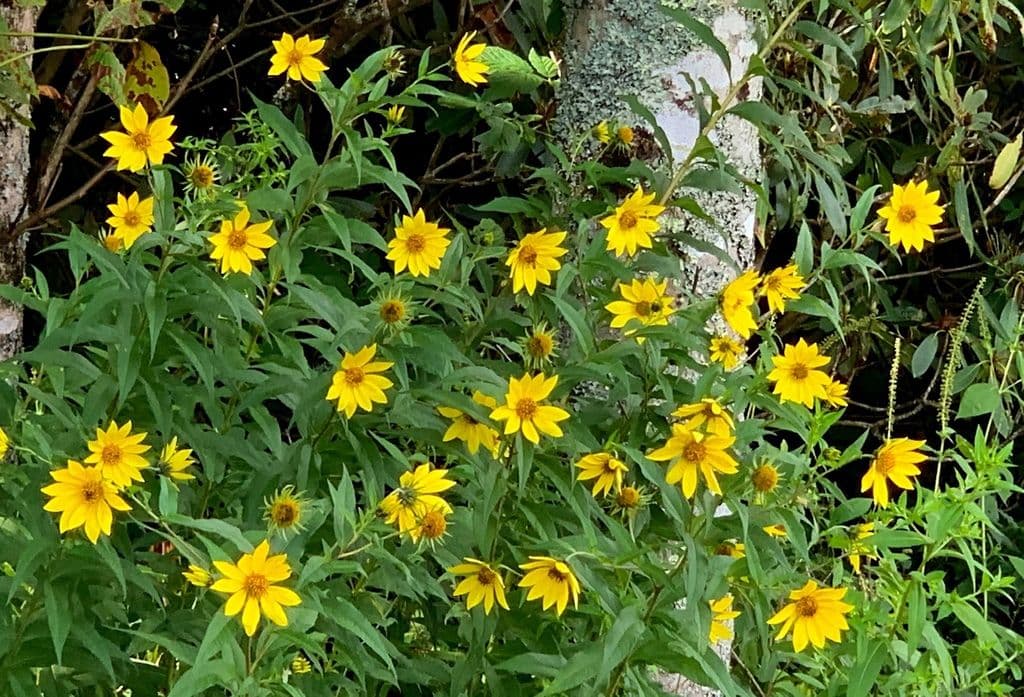
Helianthus grosseserratus: complete guide
Helianthus grosseserratus
Want to see Helianthus grosseserratus: complete guide in your garden?
1 minute, no credit card
Overview
Helianthus grosseserratus, commonly called the sawtooth sunflower, is an imposing perennial in the daisy family (Asteraceae), native from eastern Canada through the central and eastern United States. The species takes its name from the coarsely toothed, almost saw-like leaf margin, which together with its impressive height forms one of the most recognizable features of this prairie sunflower.
In garden design, Helianthus grosseserratus is mainly used as a backdrop plant in wide borders, prairie gardens, and naturalistic planting schemes, where its height and late flowering create a dramatic effect toward the end of summer. Because the species grows naturally on moist prairie ground and along riverbanks, it is also an excellent choice for damp parts of the garden where many other sun-loving perennials struggle. On gardenworld.app you can preview in advance how this substantial prairie plant relates to the rest of your border, important given its impressive mature height.
The plant spreads via rhizomes and can form a sturdy, broad clump after a few years, making it a striking focal point in a large border or along a fence line.
Appearance and bloom
Helianthus grosseserratus is one of the larger perennial Helianthus species and can reach 1.5 up to 3 meters in height under good conditions. Stems are sturdy, often reddish at the base, and bear elongated, lance-shaped leaves with a distinctly coarse, saw-toothed margin, the very feature referenced in the botanical name 'grosseserratus' (coarsely toothed).
Flowering typically begins in August and continues through October, later than many other perennial sunflowers. Flowerheads measure 5 to 8 cm across, with bright yellow ray florets surrounding a yellow to yellow-brown center. Each stem carries multiple flowerheads in a loose, branching arrangement, producing an airy, natural look rather than a dense flower cluster.
This late flowering period makes the species particularly valuable for gardens that want color and pollinator food well into autumn, a time when many other perennials have already finished blooming.
Ideal location
This sunflower prefers full sun, with at least 6 to 8 hours of direct light daily for the best flowering and sturdiest stems. In light shade the plant still grows, but less compactly and with a greater risk of lodging.
Helianthus grosseserratus is ideal for the back of wide borders, prairie gardens, riverside plantings, and damp meadow-like parts of the garden. Give the plant ample room, since its broad, spreading habit calls for at least 60 to 90 cm of spacing from neighboring planting.
Soil
The species grows best in moisture-retentive, moderately fertile soil with a pH between 6.0 and 7.5. In its natural habitat, the plant often grows on prairie ground and along riverbanks that are periodically moist to wet, setting this species apart from many other sun-loving perennials that actually prefer dry soil.
Ordinary garden soil with sufficient organic matter is suitable. Heavy clay is well tolerated as long as prolonged waterlogging does not occur. Extremely dry, lean sandy soil is less suitable unless supplemented with regular additional watering.
Watering
Helianthus grosseserratus prefers consistently moist soil and tolerates significantly more water than most other perennial sunflowers. Water the plant regularly during dry summers, particularly through the main growth and flowering period from July to September.
In gardens with naturally moist soil or near a pond or ditch, the plant often needs little supplemental water. On drier sites, weekly deep watering during dry spells is advisable to support the impressive height and full bloom.
Free design
Want to see Helianthus grosseserratus: complete guide in your garden? Make a free design now.
Pruning
Given its considerable height, it can be useful to cut the stems back to roughly two-thirds of their length in June, which encourages a more compact, sturdier growth habit and reduces the risk of lodging in wind or rain.
After autumn flowering, you can leave the spent stems standing until spring; the hollow stems and seedheads provide valuable overwintering shelter for insects and food for birds. Only cut the plant back in March, just before the new season begins.
Maintenance calendar
April to May: new shoots emerge from the rootstock; remove any remaining old stem debris. June: consider cutting back for a more compact, sturdier growth habit. July to August: vigorous growth; check for support at windy sites. August to October: main flowering period; enjoy the late yellow flowers and visiting pollinators. November to March: dormant period; leave spent stems standing for birds and cut back just before spring.
Winter hardiness
Helianthus grosseserratus is exceptionally hardy in USDA zones 3 to 8, comfortably exceeding the cold tolerance needed for the climate of northwestern Europe. The rhizomes overwinter without trouble, even in severe frost.
Because the species grows naturally on moist ground, winter waterlogging is less problematic than for many other prairie plants. Still, a reasonably drained location is preferable to permanently standing water around the crown.
Companion plants
Helianthus grosseserratus pairs beautifully with other tall, late-flowering prairie plants:
Aster novae-angliae (New England aster) extends the flowering season with purple and pink tones that contrast beautifully with the yellow.
Panicum virgatum (switchgrass) adds vertical grass structure that echoes the sunflower's height.
Eupatorium purpureum (Joe Pye weed) shares the preference for moist soil and flowers around the same period.
Vernonia (ironweed) offers a deep purple color as a counterpoint to the yellow flowerheads.
Rudbeckia laciniata (cutleaf coneflower) reinforces the yellow autumn palette within the same border.
For a naturalistic scheme, plant Helianthus grosseserratus at the back of the border in groups of three to five, spaced 60 to 90 cm apart, and let switchgrass and asters weave through the front. Because the sawtooth sunflower spreads slowly by rhizomes, leave at least 50 cm of open soil around young clumps in the first two seasons so neighbouring perennials are not crowded out before they establish. These combinations are well worth exploring on gardenworld.app, where you can visualize different prairie and autumn borders before you start planting.
Closing
Helianthus grosseserratus is an impressive, tall perennial that brings the strength and scale of the North American prairie to the back garden. Its late, bright yellow bloom, preference for moist soil, and simple care requirements make this sawtooth sunflower a valuable choice for anyone seeking a dramatic backdrop plant for late summer and autumn.
On gardenworld.app you can upload a photo of your garden and instantly see how Helianthus grosseserratus relates to the rest of your planting, so you know in advance whether this substantial prairie sunflower suits the scale of your border.
Want to see Helianthus grosseserratus: complete guide in your garden? Make a free design now.
Upload a photo, pick a style, and get a photorealistic design with plant list in under a minute.
No credit card required


Similar plants
Calendula stellata: complete guide
Calendula stellata
Complete guide to Calendula stellata, the star-flowered marigold from Sicily: location, soil, watering and companion planting tips.
Korean chrysanthemum: complete guide
Chrysanthemum x rubellum
Chrysanthemum x rubellum is a hardy autumn perennial with single pink to copper flowers from August to November. Care and combinations.
Helianthus divaricatus: complete guide
Helianthus divaricatus
Helianthus divaricatus is a North American woodland sunflower with yellow summer blooms, ideal for naturalistic borders and shady edges.