
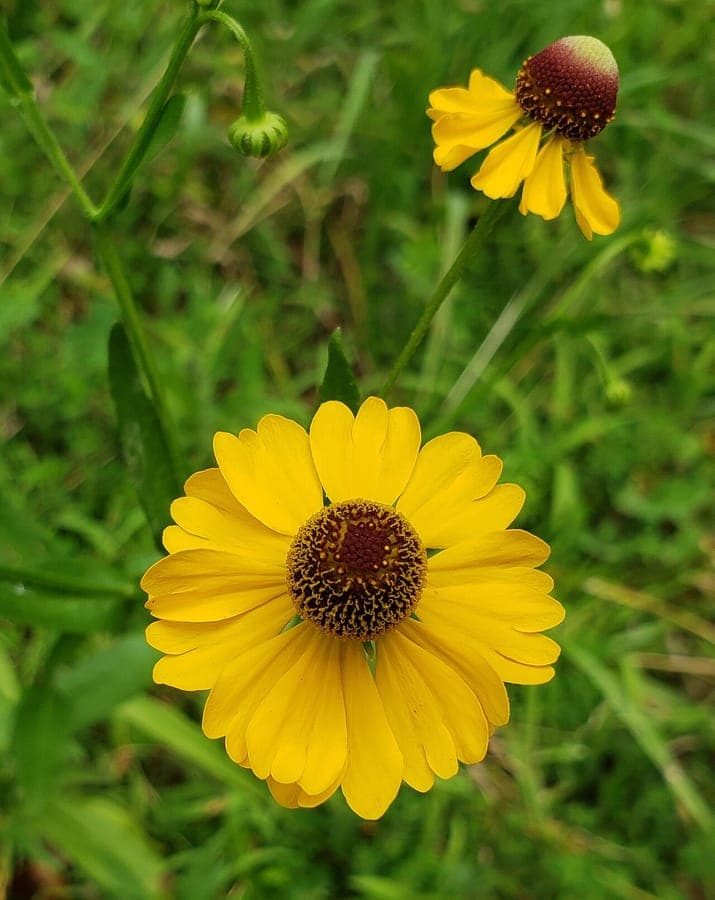
HoosierMan1816 / Public domain, via Wikimedia Commons
Purplehead sneezeweed: complete guide
Helenium flexuosum
Want to see Purplehead sneezeweed: complete guide in your garden?
1 minute, no credit card
Overview
Purplehead sneezeweed (Helenium flexuosum) is a vigorous, multi-stemmed perennial native to eastern and central North America, ranging from Nova Scotia and Quebec south to Florida and Texas. It belongs to the aster family (Asteraceae) and was formally described by Constantine Rafinesque in 1792 under the name Helenium flexuosum. In the wild it inhabits moist meadows, stream banks, wet prairies and open woodland edges, where it forms robust colonies and blooms from July through September.
The genus name Helenium is traditionally linked to Helen of Troy, reflecting the genus's ornamental beauty. The species epithet flexuosum refers to the subtly sinuous, flexing stems that distinguish this species from the closely related Helenium autumnale. In horticulture, purplehead sneezeweed is less well-known than its cultivated relatives ('Moerheim Beauty', 'Sahin's Early Flowerer', 'Rauchtopas') but is of genuine botanical interest and excellent value in naturalistic planting schemes.
The plant reaches 60 to 120 cm in height, forming a dense clump of upright, slightly winged stems. The 'winged' stem is a diagnostic feature: leaf tissue runs a short distance down the stem from the leaf base, creating a narrow flange. Flower heads are composite: a prominent, dome-shaped disc of tiny purple-brown to dark chocolate-brown florets is surrounded by 8 to 13 reflexed ray florets in warm golden-yellow to amber. This bold contrast between the dark dome and the backswept golden rays gives purplehead sneezeweed its distinctive, slightly drooping appearance.
For the mixed border, it is an ideal mid- to late-summer perennial, flowering reliably from July to September and attracting bumblebees, honeybees, butterflies and hoverflies in substantial numbers. Cut stems last well in a vase, making it useful as a cut flower too.
Appearance & bloom cycle
In spring, purplehead sneezeweed emerges as a basal rosette of lance-shaped, lightly hairy, mid-green leaves with toothed margins. Stems are erect, slightly winged (leaf tissue running down the stem) and branch in the upper third. In a fertile, moist soil, stems easily reach 100 to 120 cm; in drier, less fertile conditions they stay closer to 60 to 80 cm. The central stem is often the shortest; lateral branches arch slightly outward, contributing to the 'flexuosum' quality described by Rafinesque.
Flowering begins in July and continues through September, with peak display in August. Each flower head is 3 to 4 cm across. The disc - strongly domed, darker than in most other Helenium species - is an intense purple-brown to near-black, which is the feature giving the plant its common name 'purplehead'. The 8 to 13 ray florets are bright golden-yellow, strongly reflexed (pointing backward and downward), creating the characteristic nodding, shuttlecock-like silhouette.
A mature clump may carry dozens of flowering stems simultaneously, providing weeks of continuous colour. After flowering, the seed heads are small, dry and relatively ornamental through autumn. Self-seeding occurs but is not aggressive. The species propagates primarily by clump division.
Distinguishing features from Helenium autumnale: ray florets are three- to four-toothed at the tip (not entire); stems are more slender; disc colour is distinctly darker, with a pronounced purple-brown hue.
Ideal location
Purplehead sneezeweed thrives in full sun. A minimum of six hours of direct sunlight per day is needed for the best flowering, sturdiest stems and richest colour. In partial shade the plant will flower but produces fewer, taller and weaker stems prone to flopping. A sheltered site reduces the risk of wind damage to tall stems; alternatively, stake individual stems with bamboo canes or use grow-through supports installed in May.
The species is naturally adapted to moist habitats and tolerates brief waterlogging better than most border perennials. In the garden, it performs well beside a pond, in a rain garden or in low-lying border areas where rainwater occasionally pools. It also works well in a standard mixed border with normal, moisture-retentive soil, as long as extreme summer drought is avoided.
For bold visual impact, plant in groups of three to five at 40 to 50 cm spacing. A single plant looks somewhat sparse; a group creates a naturalistic sweep of colour that reads well from a distance. Plan your border design at gardenworld.app to see how purplehead sneezeweed fits into a complete planting scheme.
Soil requirements
Purplehead sneezeweed is broadly tolerant of soil types, accepting conditions from pH 4.5 to 7.5. It grows best in fertile, moisture-retentive but free-draining soil. Heavy clay that becomes waterlogged for extended periods can cause crown rot; very sandy, free-draining soils that dry out completely in summer cause early senescence and poor flowering.
Before planting, incorporate generous amounts of well-rotted compost - around 10 to 15 litres per square metre, worked into the top 30 cm. On light sandy soils this is especially important for improving moisture retention. On heavy clay, add coarse grit or perlite to open up the structure and improve drainage. The result should be a crumbly, workable tilth that holds moisture without compacting.
A 5 to 8 cm mulch layer of bark chip or leaf mould applied around (not over) the crowns helps maintain consistent soil moisture, suppresses weeds and moderates summer soil temperatures. Replenish mulch annually in early spring. Avoid placing fresh manure directly against the crowns, as it can cause ammonia scorching of young shoots.
Free design
Want to see Purplehead sneezeweed: complete guide in your garden? Make a free design now.
Watering
Consistent moisture is the key to thriving purplehead sneezeweed. The species is naturally a meadow and streamside plant and is poorly adapted to prolonged drought. During dry spells in summer, water once or twice a week, delivering enough water each time to moisten the soil to 25 cm depth. Drip irrigation is the most efficient method.
Water in the early morning where possible. This allows any inadvertent leaf wetting to dry off during the day, reducing the risk of powdery mildew, which can affect Helenium in warm, humid conditions. Avoid late evening watering, particularly during warm, still weather.
In a pond-side or rain garden setting, the naturally moist conditions usually eliminate the need for supplemental watering, making this an ideal low-maintenance choice for those wetter spots in the garden. In a standard border on lighter soil, mulching is essential to conserve moisture between watering sessions.
In autumn and winter, the above-ground growth dies back and water demand is minimal. The clump overwinters as a compact mass of roots and basal buds just below the soil surface.
Pruning
The main pruning task for purplehead sneezeweed is cutting back stems in autumn or early spring. After flowering, leaves yellow and stems gradually die back. You can choose to cut stems down to a few centimetres above soil level in November, or leave them standing until March for their winter silhouette, seed head interest and as overwintering habitat for beneficial insects.
The Chelsea Chop is a particularly useful technique with Helenium: cut all or half of the stems back by 50% in late May (around the time of the Chelsea Flower Show). This delays flowering by two to three weeks, produces shorter and sturdier stems less likely to flop, and extends the overall flowering period of the clump if only half the stems are cut at once. It removes the need for staking in most situations.
Deadhead spent flowers regularly to extend the display and limit self-seeding. Purplehead sneezeweed will self-seed in favourable conditions but is not invasive.
Divide the clump every three to four years in early spring. Use two garden forks back to back to pull the clump apart; select the outer, youngest sections for replanting and discard the woody centre. Replant immediately at the same depth, water well and mulch.
Maintenance calendar
January – February: leave standing stems for birds to eat seeds and for insect overwintering habitat; no active work needed; check that the crown is not sitting in standing water.
March: cut back old stems if not already done; assess clump size and divide if needed; replenish mulch layer; top-dress with mature compost.
April – May: new shoots grow quickly; apply Chelsea Chop (cut half the stems back by 50%) in late May for sturdier, better-timed flowering; apply slow-release organic fertiliser.
June: stems elongate; water during dry spells; check for aphids or caterpillars on young shoots; install grow-through support if Chelsea Chop was not applied.
July – August: main flowering period; water regularly; remove spent flower heads to prolong display; enjoy pollinator activity on the blooms.
September: late flowering continues; seed heads begin to form; reduce watering; leave seed heads for birds.
October – November: foliage dies back; leave dry stems for winter interest or cut back to a few centimetres; mulch in severe frost conditions.
December: crown dormant; no work required; ice crystals on seed heads create beautiful winter detail.
Winter hardiness
Purplehead sneezeweed is reliably cold-hardy across most of northern Europe. USDA hardiness zones 3 to 8 cover its full cultivated range, with the species tolerating temperatures as low as -35 °C. Across the British Isles, Belgium, the Netherlands and Germany (zones 6 to 8), it is fully hardy and needs no winter protection.
The main winter risk is not absolute cold but wet, waterlogged soil combined with frost, which can cause crown rot. On well-drained soils this is not a problem. On heavy clay, a light mulch applied in November provides insulation and helps prevent waterlogging around the crown.
In exceptionally harsh winters (prolonged temperatures below -20 °C), a covering of dry leaves or straw over the crown provides adequate protection. Remove this in March once the ground begins to thaw and the first green shoots appear.
The plant becomes more vigorous with age but benefits from division every three to four years to maintain flowering quality.
Companion plants
Purplehead sneezeweed is at its best in late-summer and autumn-themed borders alongside complementary perennials and ornamental grasses. Rudbeckia fulgida 'Goldsturm' (black-eyed Susan) is a classic pairing: the yellow ray florets and black disc of Rudbeckia echo the warm tones of Helenium, and they flower at exactly the same time. Echinacea purpurea (purple coneflower) and Persicaria amplexicaulis add cooler pink-red tones to balance the warm amber-gold palette.
Ornamental grasses are essential structural partners. Pennisetum alopecuroides, Miscanthus sinensis 'Gracillimus' and Panicum virgatum 'Shenandoah' all provide airy, backlit texture that contrasts beautifully with Helenium's solid, dome-headed flowers. Plant grasses at 50 to 60 cm from the Helenium clumps to allow both adequate space.
Veronicastrum virginicum (culver's root), Agastache foeniculum (anise hyssop), Monarda didyma (bergamot) and Lythrum salicaria (purple loosestrife) make excellent companions in a moist-soil border. For drier sunny borders, Echinacea, Verbena bonariensis and Salvia nemorosa partner well. For a full planting plan incorporating purplehead sneezeweed, visit gardenworld.app for personalised garden design ideas.
Conclusion
Purplehead sneezeweed rewards gardeners with a long, vibrant late-summer display, exceptional pollinator value and solid cold-hardiness. Whether you grow it at the waterside, in a meadow-style border or in a traditional mixed planting, Helenium flexuosum brings warm amber-gold tones and architectural interest at the time of year when many gardens begin to fade. Its combination of easy cultivation, reliable flowering and wildlife value makes it one of the most worthwhile native North American perennials for European gardens.
Want to see Purplehead sneezeweed: complete guide in your garden? Make a free design now.
Upload a photo, pick a style, and get a photorealistic design with plant list in under a minute.
10,000+ gardens designed already
No credit card required


Similar plants
Calendula stellata: complete guide
Calendula stellata
Complete guide to Calendula stellata, the star-flowered marigold from Sicily: location, soil, watering and companion planting tips.
Korean chrysanthemum: complete guide
Chrysanthemum x rubellum
Chrysanthemum x rubellum is a hardy autumn perennial with single pink to copper flowers from August to November. Care and combinations.
Helianthus divaricatus: complete guide
Helianthus divaricatus
Helianthus divaricatus is a North American woodland sunflower with yellow summer blooms, ideal for naturalistic borders and shady edges.