
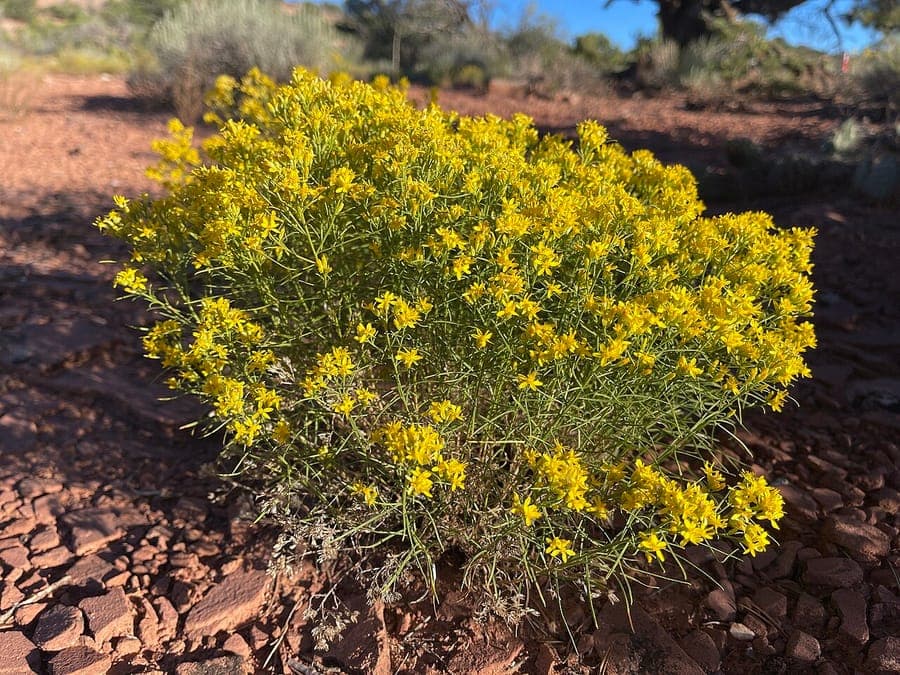
Robb Hannawacker https://www.inaturalist.org/people/hannawacker / CC0, via Wikimedia Commons
Broom snakeweed: complete guide to Gutierrezia sarothrae
Gutierrezia sarothrae
Want to see Broom snakeweed: complete guide to Gutierrezia sarothrae in your garden?
1 minute, no credit card
Overview
Gutierrezia sarothrae - broom snakeweed, broomweed, turpentine weed, matchbrush, kindlingweed - is a small resinous subshrub in the Asteraceae family, the same vast family that includes sunflowers, daisies, and chamomile. Native to western and central North America, its range extends from the Canadian provinces of Alberta and Saskatchewan south through the Great Plains and Rocky Mountain states to northern Mexico, and westward to California, Oregon, and Washington. The species was formally described in 1887 by Britton and Rusby, based on earlier collections made by Frederick Pursh.
The species name 'sarothrae' comes from the Greek word for broom (sarotron), a reference to the plant's densely branched, broom-like architecture. The folk names reveal centuries of close human relationship with this plant: 'broom snakeweed' because of the broom-shaped branches and its traditional use as a folk remedy for snakebite among Southwestern indigenous peoples; 'turpentine weed' and 'stinkweed' for the sharp, resinous scent of bruised foliage; 'kindlingweed' and 'matchbrush' because the dry stems were used as tinder.
In its native habitat, Gutierrezia sarothrae is a characteristic plant of dry grasslands, sagebrush steppe, and open prairie landscapes on poor, free-draining soils. It is a subshrub - technically a semi-woody plant where the basal stems become slightly woody while the upper stems remain herbaceous and die back in winter. It grows with sagebrush (Artemisia tridentata), blue grama grass, and other drought-adapted species of the American West.
For European gardens, broom snakeweed is an excellent choice for xeriscaping, gravel gardens, rock gardens, and drought-tolerant planting schemes that minimise water use. At gardenworld.app you will find professional design tools and visual inspiration for incorporating drought-adapted subshrubs as structural anchors in a cohesive, low-maintenance planting. The plant reaches 30-80 cm in height and similar width, with a compact, dome-shaped silhouette that provides year-round structure even outside the flowering season.
Appearance & bloom cycle
Gutierrezia sarothrae has a distinctive, densely branched silhouette - a compact mound of interlacing thin green stems that resembles a miniature broom or a tightly packed half-sphere. The lower stems are slightly woody and grey-green; the upper stems are fresh green, slender, and numerous. Height averages 30-60 cm, occasionally to 80 cm on favourable sites; width is equal to or slightly greater than height.
The leaves are narrow - linear to thread-like, 1-5 cm long and only 1-2 mm wide, slightly resinous and glossy, dark green. They are strongly aromatic when crushed, releasing the characteristic sharp, turpentine-like scent from the resinous oils in the leaf tissue. In dry conditions the leaves roll slightly along their margins, a neat drought-adaptation that reduces water loss.
The flowering display is the highlight of the season: from August through October, thousands of tiny yellow flower heads cover the entire upper surface of the plant, making it glow gold in the landscape. Each flower head is only 5-8 mm across, with 1-4 ray florets and 1-6 disc florets per head - miniature Asteraceae architecture in dense profusion. The flowers attract bees, hover flies, and butterflies in impressive numbers, making broom snakeweed a valuable late-season pollinator resource in the garden.
After flowering, small achene fruits develop with a pappus of small scales that assist wind dispersal. In winter the woody base persists and provides landscape structure; in the coldest positions the upper stems die back completely to the woody crown.
Ideal location
Gutierrezia sarothrae is a plant of open, sunny exposures that requires maximum direct sunlight. In its native range it grows on open flats, rocky slopes, dry stream banks, and degraded prairies where competition from taller vegetation is minimal. Full sun is not merely desirable but essential: in partial shade the plant becomes open and sparse, and flowering is greatly reduced.
In European gardens, choose the warmest, sunniest spot - a south-facing slope, a gravel bed against a stone wall that absorbs and radiates heat, a dry stony border, or a prairie-style planting in full sun. The plant thrives in Mediterranean-style corners of the garden where few other plants are comfortable.
Some protection from cold, wet north winds in winter is beneficial in the most northerly parts of the UK and the Low Countries. On sheltered, well-drained sites, however, hardiness is generally reliable. Avoid low-lying frost pockets where cold air stagnates and late frosts persist.
Soil requirements
The soil requirements of Gutierrezia sarothrae are, in contrast to its dramatic floral display, admirably undemanding. The plant thrives on poor, free-draining soils. Rich garden soil is more of a disadvantage than an advantage: on heavily fertilised ground the plant grows lush but loses its compact form and produces fewer flowers.
The preferred soil pH is 6-8 - slightly acid to slightly alkaline. The plant tolerates calcareous soils well, making it suitable for the chalky clay and marl soils found in many parts of northern Europe. Loamy soils are acceptable provided drainage is adequate.
Good drainage is the absolute requirement: Gutierrezia sarothrae is extremely sensitive to prolonged moisture around the crown, especially combined with cold. Waterlogging in winter is the most common cause of failure. On heavy ground, incorporate a 15-20 cm layer of coarse grit or gravel to improve drainage. Raised beds or sloping borders are ideal planting positions.
At planting time: excavate a hole one and a half times the width of the root ball, mix in up to 30% coarse sand or grit if the soil is heavy, add no fertiliser. Planting distance 40-60 cm for individual specimens; 30-40 cm for a dense mass planting.
Free design
Want to see Broom snakeweed: complete guide to Gutierrezia sarothrae in your garden? Make a free design now.
Watering
Gutierrezia sarothrae is a pronounced drought-tolerant plant that in its native range performs under annual rainfall totals of less than 300 mm. In European garden cultivation, supplemental watering is rarely needed after the establishment period in the first growing season.
In the first year: water regularly during dry spells to encourage good rooting. A weekly deep watering of 5-10 litres per plant during the growing season is a suitable guideline. After the first year: water only during extreme drought lasting more than four weeks. The plant signals water need clearly - leaves roll slightly and colour becomes slightly dull - at which point a deep, thorough watering is welcome.
Avoid frequent, shallow watering that encourages a shallow root system. One deep, infrequent watering is always preferable; it encourages the root system to penetrate deeper where the soil remains cooler and marginally moister. Drip irrigation at soil level is more effective than overhead watering.
In winter: do not water. The combination of cold and a wet crown is lethal. Keep the soil as dry as possible from November through March. On sites with imperfect drainage, a transparent cover of plastic sheeting or acrylic glass over the crown during prolonged wet winter weather is recommended.
Pruning
Gutierrezia sarothrae requires minimal pruning. The primary task is a light spring cut in March or early April, before new growth begins. Cut back dead or damaged upper stems to just above the living woody base - usually 10-20 cm above ground. This promotes compact new shoots and keeps the plant vigorous.
Never cut back hard into the wood of previous years - the plant recovers poorly from severe pruning of the woody framework. A gentle corrective trim in late spring (May) is possible to improve the shape after a hard winter.
No pruning is needed during the growing season. Removing spent flower heads after blooming is not essential but may tidy the plant; the seed heads provide food for seed-eating birds in autumn and are decorative in winter.
Do not attempt routine division: the woody crown is not easily divisible. Tip cuttings of soft upper stems taken in June to July (in a mix of sand and perlite) are the best means of vegetative propagation. Sowing seed in spring on a sunny, dry seedbed is also possible.
Maintenance calendar
January-February: Plant is dormant. Keep the crown as dry as possible. During prolonged thaw-and-refreeze cycles, protect the crown with a layer of dry coarse grit or bark.
March: Assess winter damage. Remove all dead upper stems. Cut back to just above the living woody base.
April: New shoots appear. No feeding. Remove weeds before they shade young growth. Apply a mulch of fine grit around the plant.
May: Growing season begins in earnest. Assess whether spacing and surroundings are adequate.
June-July: Strong vegetative growth. Opportunity to take soft stem cuttings for propagation.
August-September: Flowering season - the height of the year. Golden flower display. Pollinating insects visit abundantly.
October: Flower heads fade and seeds ripen. Leave plant standing for bird food and winter decoration.
November-December: Plant enters dormancy. No intervention; keep crown dry.
Winter hardiness
Gutierrezia sarothrae comes from areas with extreme continental winters: in Saskatchewan and Alberta, temperatures regularly drop to -30 or -40 degrees Celsius, and the species survives without damage. Documented cold hardiness corresponds to USDA zones 3-8, meaning the plant is fully hardy across all of temperate Europe with comfortable headroom.
For the Netherlands, Belgium, and the UK, hardiness is generally reliable - the weak point is not cold itself but wet, cold root conditions. On well-drained, lean soil, the plant survives European winters with ease. On heavy, moisture-retentive soil, losses are possible during prolonged freeze-thaw cycles.
Protection on critical sites: cover the crown in November with a 5-10 cm layer of dry coarse grit or coarse sand. Bark compost is less suitable as it retains moisture. On the wettest sites, a transparent cover over the crown will keep it dry. Remove protection in March once the risk of hard frost has passed.
Successful unprotected overwintering in Dutch and Belgian gardens on well-drained sandy soils and gravel beds has been widely reported. Once established and correctly sited, broom snakeweed is a durable, reliable long-lived perennial.
Companion plants
Gutierrezia sarothrae fits beautifully into drought-tolerant planting schemes, prairie designs, and gravel borders. The following companions, available from garden centres across the UK and Europe, create outstanding combinations:
- Salvia nemorosa (ornamental sage): the purple flower spikes and grey-green leaves are a classic partner for the yellow flowers of broom snakeweed, with overlapping bloom times and identical soil requirements.
- Perovskia atriplicifolia (Russian sage): the silver-grey stems and lavender-blue flowers complement the yellow broom snakeweed beautifully in height and texture.
- Echinacea purpurea (purple coneflower): the pink-purple flower heads on tall upright stems offer a fine contrast to the compact, yellow-flowering subshrub.
- Achillea millefolium (common yarrow): white- or yellow-flowered yarrow fills the lower gaps and shares the same preference for dry, lean soils.
- Lavandula angustifolia (English lavender): both in habitat requirements and aesthetics an excellent companion for a Mediterranean-style planting.
- Festuca glauca (blue fescue): the blue-grey foliage tufts provide textural contrast at the base of the border alongside broom snakeweed.
When designing a drought-tolerant border, use Gutierrezia sarothrae as a mid-height structural plant combined with lower groundcovers and taller species for height variation. Visit gardenworld.app for professional design tools to create a water-efficient garden that looks spectacular throughout the growing season.
Closing
Gutierrezia sarothrae is an unusual but highly rewarding subshrub for the drought-tolerant garden. Its spectacular golden flower mass in August and September, its compact broom-like form, its extreme drought tolerance, and its minimal care requirements make it an outstanding choice for gravel borders, rock gardens, and prairie-style plantings in the modern low-maintenance garden.
Curious about how drought-tolerant plants like broom snakeweed can be composed into a cohesive, beautiful garden design? Visit gardenworld.app for professional planting design tools tailored to your garden's specific conditions - from soil type to sun exposure and style preference.
Want to see Broom snakeweed: complete guide to Gutierrezia sarothrae in your garden? Make a free design now.
Upload a photo, pick a style, and get a photorealistic design with plant list in under a minute.
10,000+ gardens designed already
No credit card required


Similar plants
Calendula stellata: complete guide
Calendula stellata
Complete guide to Calendula stellata, the star-flowered marigold from Sicily: location, soil, watering and companion planting tips.
Korean chrysanthemum: complete guide
Chrysanthemum x rubellum
Chrysanthemum x rubellum is a hardy autumn perennial with single pink to copper flowers from August to November. Care and combinations.
Helianthus divaricatus: complete guide
Helianthus divaricatus
Helianthus divaricatus is a North American woodland sunflower with yellow summer blooms, ideal for naturalistic borders and shady edges.