
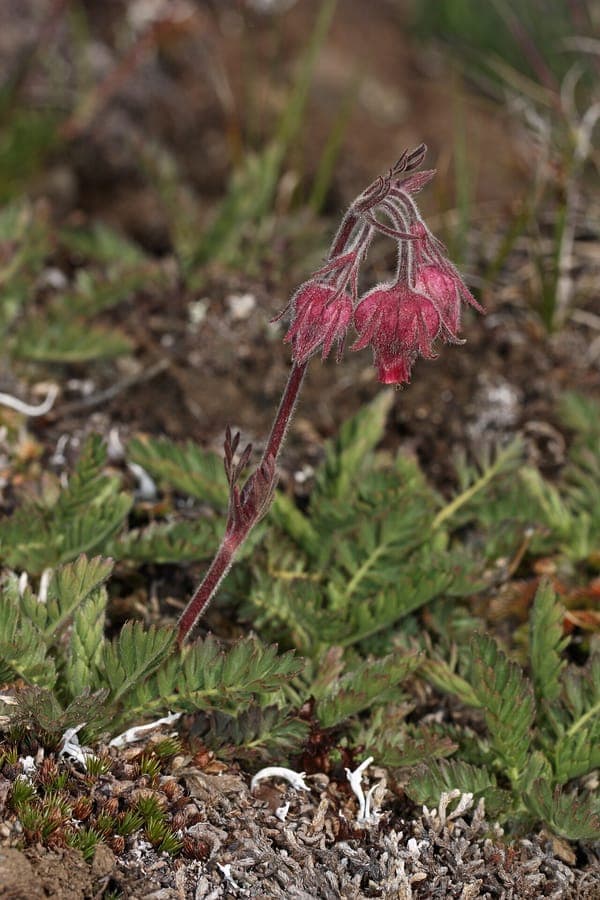
Walter Siegmund (talk) / CC BY-SA 3.0, via Wikimedia Commons
Geum triflorum: complete guide
Geum triflorum
Want to see Geum triflorum: complete guide in your garden?
1 minute, no credit card
Overview
Geum triflorum, widely known as prairie smoke or old man's whiskers, is one of North America's most distinctive native perennials. Described by botanist Frederick Pursh in 1814, this member of the rose family (Rosaceae) ranges from the subarctic territories of the Yukon and Northwest Territories south through the Great Plains and Rocky Mountains to Arizona, New Mexico and northern California. It grows on open grasslands, rocky slopes and dry meadows - conditions that tell you immediately what kind of garden conditions it will thrive in.
What sets Geum triflorum apart from the garden geums sold in most garden centres is its two-phase ornamental character. In late spring the plants produce nodding, urn-shaped flowers in deep dusky pink to burgundy-red, borne three to a stem (hence triflorum). Once pollinated, the flowers give way to feathery, thread-like styles that elongate into 3 to 5 cm plumes, turning the whole colony into a shimmering pink mist that drifts in the breeze - the effect that gave rise to the common name prairie smoke.
In the garden, Geum triflorum grows as a slow-spreading, rhizomatous perennial forming neat basal rosettes 10 to 15 cm tall. Flowering stems rise to 20 to 40 cm. Its moderate growth rate means it integrates well with neighbouring plants without crowding them out. For anyone designing a low-maintenance or pollinator-friendly garden, gardenworld.app offers design ideas that incorporate prairie smoke into naturalistic planting schemes that shine across multiple seasons.
Beyond its flowers and seed heads, the plant contributes autumnal interest: the deeply cut, pinnate leaves turn copper and bronze-red in October and November, often remaining partially evergreen through mild winters. Few perennials offer such a sustained decorative presence for so little effort.
Appearance and bloom cycle
The basal leaves of Geum triflorum are pinnately divided into numerous small leaflets, creating a fine-textured, ferny appearance at ground level. They are mid to dark green in summer and softly hairy on both surfaces, giving them a slightly silvery glint in bright light. Leaf rosettes spread slowly to form mats roughly 30 to 45 cm across after three to four years.
Flowering begins in mid to late May and continues through June, occasionally into early July in cooler seasons or at altitude. The flowering stems are slender and hairy, typically 25 to 35 cm tall, each carrying three nodding buds that open to reveal soft pink to mauve-pink petals - never fully opening but remaining cup-shaped and pendant. The sepals are conspicuously darker, almost wine-red, creating a rich bicolour effect. Bumblebees and specialist mining bees are the primary pollinators, drawn by the partially concealed, warm-coloured flowers.
After fertilisation the styles - the thread-like female parts of the flower - elongate dramatically to form feathery plumes 3 to 5 cm long. These plumes persist from June through August, catching morning dew and low-angle sunlight to produce the smoky, rose-coloured haze that gives the plant its name. Seed dispersal occurs gradually through late summer and into autumn as wind carries individual plumed seeds across the garden. Seedling establishment is slow, but occasional volunteers do appear in gritty, open soil.
By October the ferny foliage has turned copper-red and bronze, providing a warm understorey to later-blooming border plants. In mild winters much of the foliage persists until February.
Ideal location
Prairie smoke demands full sun. In its native range it grows on open, wind-exposed prairies and rocky meadows where sunlight is unobstructed for most of the day. In garden conditions, aim for at least six hours of direct sunlight; the plant tolerates partial shade but will flower less freely and the feathery seed heads will be less abundant.
The plant is well suited to exposed sites: it tolerates wind without staking or shelter and performs admirably in front gardens or on open terraces. Its compact stature - rarely exceeding 40 cm in flower - also makes it suitable for rock gardens, gravel gardens and low-maintenance dry borders. Avoid low-lying spots where cold air pools overnight or where rainwater sits after heavy showers; waterlogged soil in winter is the primary cause of plant failure.
Prairie smoke associates naturally with short grasses and low wildflowers, so it makes an excellent companion in a meadow-style planting or a naturalistic front border. Plant in groups of five or more for the best visual impact - isolated specimens are pleasant but miss the colony effect that gives the plant its characteristic smoky appearance. Spacing of 30 to 40 cm between plants allows individual rosettes to develop before they slowly merge into a ground-covering mat.
Soil requirements
Geum triflorum is highly adaptable in terms of soil type but insists on excellent drainage. In the wild it colonises thin, dry soils over limestone, gravelly alluvium and sandy loam - never heavy, moisture-retentive clay. In the garden, a well-drained loam or sandy loam with a pH of 6.0 to 7.5 is ideal. In heavier soils, improve drainage by incorporating 30 to 40 percent horticultural grit or coarse sand before planting, working the amendment to a depth of 30 cm.
Importantly, this plant does not require fertile soil and actively prefers lean conditions. Rich, nitrogen-heavy soil encourages lush leafy growth at the expense of flowers and makes plants floppy and vulnerable to fungal disease. No base fertiliser is needed at planting time; a very light top-dressing of a low-nitrogen, high-potassium fertiliser in early March each year is sufficient to maintain healthy plants.
For raised beds, gravel gardens or rock gardens, a mixture of two parts loam, one part horticultural grit and one part leaf mould produces excellent results. The leaf mould provides enough organic matter to retain a small amount of moisture through dry spells without compromising drainage. On naturally sandy soils - common near coastlines - prairie smoke will generally thrive without amendment.
Free design
Want to see Geum triflorum: complete guide in your garden? Make a free design now.
Watering
Once established, Geum triflorum is notably drought-tolerant, a quality that makes it increasingly valuable as summers grow hotter and drier. During the first growing season after planting, water two to three times a week in the absence of rain, aiming to keep the soil moist at 10 cm depth without allowing it to become waterlogged. A soaker hose or drip irrigation directed at the base of the plant keeps the foliage dry and reduces the risk of leaf disease.
From the second year onwards, established plants in most temperate garden situations cope well on rainfall alone. During prolonged dry spells - more than two to three weeks without meaningful rain - give a single deep watering rather than repeated shallow applications. Deep, infrequent irrigation encourages the plant to develop a deeper root system, which improves long-term resilience to drought.
In winter, no additional watering is required. The plants are dormant and the reduced evapotranspiration means natural precipitation is sufficient. The critical rule in winter is to ensure excess water drains away freely; standing water around the crown combined with frost is the most common cause of loss, particularly on heavy soils.
Pruning
Minimal pruning is one of the great virtues of Geum triflorum. After flowering, leave the feathery seed heads in place: they are ornamental until mid-autumn and provide seeds for birds and wind dispersal. In August or September, once the seed heads have dried and shed most of their seeds, cut the old flowering stems down to 5 cm above the crown. Leave the basal leaf rosette untouched - it remains photosynthetically active into late autumn and helps the plant build up energy reserves for the following spring.
In late winter or early spring (February-March), remove any winter-damaged or dead leaves from the rosette. New growth emerges quickly once soil temperatures rise above 5 degrees Celsius. This is also a good moment to check whether the colony has expanded beyond its intended space; if so, cut around the perimeter with a sharp spade and replant or compost the excess.
Every four to five years, consider lifting and dividing established clumps to rejuvenate them. Dig the entire clump, divide it into sections each containing three or more growing points, and replant the healthiest divisions. This process refreshes the vigour of older plants and is best carried out in early autumn (September) or early spring (March), avoiding the hottest and driest months.
Maintenance calendar
The following schedule covers all seasonal tasks for Geum triflorum in a temperate garden:
February-March: Remove dead or frost-damaged winter foliage. Apply a light top-dressing of a potassium-rich, low-nitrogen fertiliser (e.g. sulphate of potash at 20 g/m²). Lift and divide congested clumps if needed.
April-May: Keep the area around plants weed-free as new growth accelerates. Water regularly if spring is dry. Watch for the first flower buds emerging in late April to early May.
May-June: Flowering period. No deadheading needed - allow seed heads to develop. Water only during prolonged dry spells.
June-August: Feathery seed heads at their ornamental best. Admire and leave well alone. Light watering if a prolonged drought occurs.
September: Cut back old flowering stems. Consider dividing large clumps. Autumn leaf colour developing on the rosettes.
October-November: Foliage turning copper-red. No feeding required. Ensure drainage is functioning well before the wetter months.
December-January: Plants dormant. No action needed other than ensuring standing water does not accumulate.
Winter hardiness
Geum triflorum originates in some of the coldest regions of the North American continent - the prairies of Manitoba, Saskatchewan and the Northwest Territories - and is exceptionally frost-hardy. It is rated for USDA hardiness zones 3 to 7, meaning it survives minimum winter temperatures of -40 to -12 degrees Celsius without protection. For garden use across the United Kingdom, the Netherlands, Belgium and most of northern and central Europe, the plant is fully winter-hardy and requires no protective measures.
The basal rosette remains partially evergreen in mild winters and retreats to the rootstock in harsh ones, resprouting reliably in spring. Newly planted specimens in their first winter are slightly more vulnerable, particularly on heavy or poorly drained soils; a 5 cm mulch of bark or straw over the crown area after the first hard frost provides useful insurance. From the second year, no winter protection is needed.
The greatest threat is not cold but wetness combined with cold: waterlogged crowns freeze more severely and are more susceptible to crown rot. Excellent drainage is the single most important factor in overwinter survival on heavier soils.
Companion plants
Geum triflorum is a natural team player in prairie-inspired and naturalistic garden schemes. Its requirements - free-draining soil, full sun, lean fertility - align with a wide range of compatible perennials:
Pulsatilla vulgaris (Pasque flower): flowers slightly earlier, in March to April, with purple, pink or white nodding blooms followed by silky seed heads. The two plants together extend the feathery, windswept aesthetic from April into August.
Festuca glauca (Blue fescue): steel-blue evergreen grass clumps 20 to 30 cm high that form a striking contrast with the warm pink tones of Geum triflorum. Plant the two together at a ratio of three fescue to one Geum for a carpet-like effect.
Allium cernuum (Nodding onion): flowers in June and July with drooping umbels of pink to lilac on 30 to 40 cm stems, synchronising beautifully with the Geum seed head display. Both are native North American prairie plants.
Salvia nemorosa cultivars such as 'Caradonna' or 'Ostfriesland': deep violet-purple flower spikes 50 to 60 cm tall that contrast powerfully with the soft pinks of Geum triflorum. Space at 40 cm apart.
Dianthus deltoides (Maiden pink): low-growing, mat-forming perennial with bright pink or red flowers on 15 to 20 cm stems. Weaves attractively through and around Geum rosettes.
When planning your naturalistic border, gardenworld.app can help you visualise how these plants sit together in your actual garden space before you buy a single plant, saving both time and money.
Closing remarks
Geum triflorum is a rewarding perennial for any garden that can offer full sun and free-draining soil. Its dual ornamental phases - the early-summer flowers and the long-lasting feathery seed heads - give it one of the longest decorative seasons of any compact perennial. Add to that its drought tolerance, exceptional frost hardiness and ecological value for pollinators, and the case for including it in any sun-drenched border becomes compelling.
Plant in groups of five to seven at 30 to 40 cm spacing for the characteristic prairie smoke effect. Seek it out at specialist perennial nurseries or well-stocked garden centres, particularly those with a range of wildlife-friendly and prairie-native plants.
Want to see Geum triflorum: complete guide in your garden? Make a free design now.
Upload a photo, pick a style, and get a photorealistic design with plant list in under a minute.
10,000+ gardens designed already
No credit card required


Similar plants
Siberian crab apple: complete guide
Malus x robusta
Complete guide to the Siberian crab apple (Malus x robusta): location, soil, pruning, winter hardiness and the best companion plants for your garden.
Chinese flowering crabapple (Malus x spectabilis): complete guide
Malus x spectabilis
Meet the Chinese flowering crabapple (Malus x spectabilis): a classic spring bloomer with carmine buds and pink blossom.
Potentilla crassinervia: complete guide
Potentilla crassinervia
Potentilla crassinervia, the Corsican cinquefoil, grows wild on Corsica and Sardinia's peaks. Discover how to grow this hardy alpine rock garden gem.