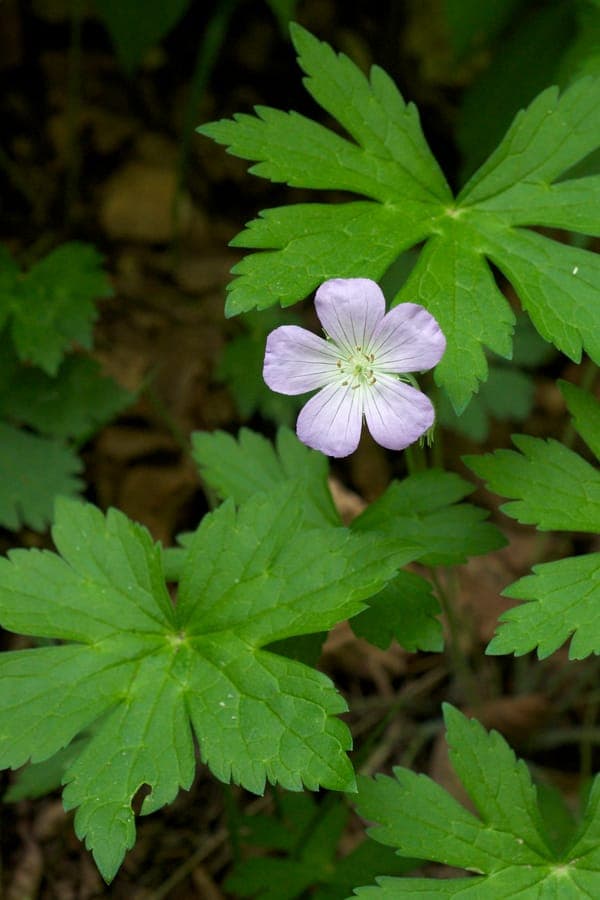
Eric in SF / CC BY-SA 3.0, via Wikimedia Commons
Geranium maculatum: complete guide
Geranium maculatum
Want to see Geranium maculatum: complete guide in your garden?
Full design in HD: €7.99
Look after your Geranium maculatum with the GardenWorld app
Identify plants with your camera and get a care calendar with reminders for this plant.


Overview
Geranium maculatum, known as spotted geranium or wild geranium, is a North American native plant with lavender-blue flowers marked with red veining. This versatile groundcover thrives naturally in woodland areas and is perfect for shaded gardens. The plant forms dense foliage and blooms abundantly from May through June.
Appearance & Bloom
The plant grows 30-60 cm tall and 45 cm wide with beautifully dissected foliage. The flowers are lavender to blue-purple with red-marked veining. They grow in loose clusters above the foliage. After blooming, the plant develops interesting seed capsules with long tails. Autumn foliage becomes red-orange.
Ideal Location
Geranium maculatum thrives best in partial to full shade, though it can function reasonably well in full sun on moist soil. Protection from intense midday sun is ideal. Perfect for woodland gardens, borders, and under shrubs. The plant provides a natural, wild appearance.
Soil
The plant is not fussy but prefers rich, moisture-retaining but well-draining soil. Add organic material before planting. The plant grows in acidic to neutral soil (pH 5.5-7.5). A natural groundcover requiring minimal feeding.
Watering
Water regularly during the first growing season until roots are established. Once established, mature plants tolerate drought reasonably well. However, during dry periods provide extra water for better appearance. Moisture-retaining soil helps maintain clean foliage.
Free preview
Want to see Geranium maculatum: complete guide in your garden? Make a free preview of your design.
Pruning
Routine pruning is not necessary, though you can deadhead faded flowers for a neater appearance. After blooming, allow the plant easy self-seeding, though this is controllable. Cut back dead plants in spring before new growth appears.
Maintenance Calendar
March: Remove dead foliage, clear space around plants. April-May: Growth and blooming, regular watering. June-July: Seed setting, light deadheading may stimulate additional bloom. August-September: Increased drought tolerance. October-February: Winter dormancy.
Winter Hardiness
Geranium maculatum is fully winter hardy throughout Europe and North America. The plant disappears in winter but returns each spring. No protection needed. The plant can thrive in the same location for many years.
Companion Plants
Perfect companions include moisture-loving groundcovers such as Helleborus, Heuchera, and Ajuga. Combine with other woodland plants like Astilbe, Helleborus, and Primula. The purple-blue flowers contrast beautifully with golden or variegated foliage.
Closing
Geranium maculatum is an easy, long-lived plant that enhances any shaded woodland or moist border. Ideal for wild-looking, natural garden designs. Available at major garden centers. Learn more at gardenworld.app/en and gardenworld.app/nl.
Frequently asked questions about Geranium maculatum
Is Geranium maculatum winter hardy?
Geranium maculatum is fully winter hardy throughout Europe and North America. The plant disappears in winter but returns each spring.
When and how do you prune Geranium maculatum?
Routine pruning is not necessary, though you can deadhead faded flowers for a neater appearance. After blooming, allow the plant easy self-seeding, though this is controllable.
How much water does Geranium maculatum need?
Water regularly during the first growing season until roots are established. Once established, mature plants tolerate drought reasonably well.
Where does Geranium maculatum grow best?
Geranium maculatum thrives best in partial to full shade, though it can function reasonably well in full sun on moist soil. Protection from intense midday sun is ideal.
What soil does Geranium maculatum need?
The plant is not fussy but prefers rich, moisture-retaining but well-draining soil. Add organic material before planting.

See it in your garden
See Geranium maculatum in your garden
One photo of your garden and a few questions. You see the result in about a minute.
Try it with a photoIdentify this plant in your own garden. Identify a plant
Similar plants
Geranium renardii: the velvet-leaved cranesbill
Geranium renardii
Geranium renardii is a compact cranesbill from the Caucasus with sage-green, velvety leaves and white flowers veined in violet. How to grow it in a dry, sunny spot.
Cambridge cranesbill (Geranium × cantabrigiense): guide
Geranium × cantabrigiense
Everything about Geranium × cantabrigiense, the low cranesbill for dry shade: cultivars such as 'Biokovo', position, pruning, division and companions.
Purple cranesbill: complete guide
Geranium × magnificum
Everything about purple cranesbill (Geranium × magnificum): violet-blue flowers in June, position, soil, cutting back after flowering and the best rose partners.
