
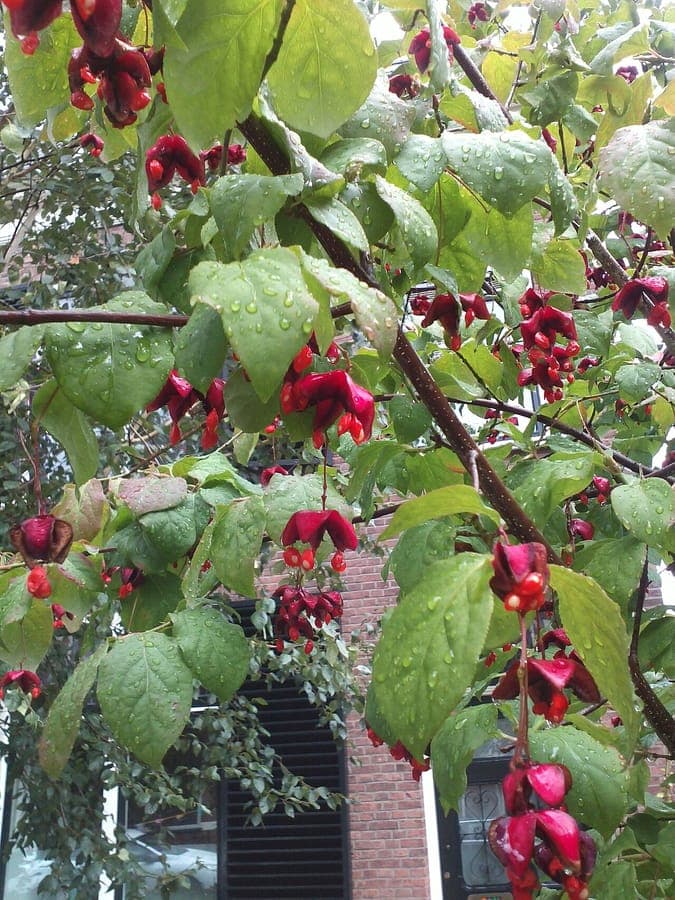
WeeJeeVee / CC BY-SA 4.0, via Wikimedia Commons
Euonymus sachalinensis: complete guide
Euonymus sachalinensis
Want to see Euonymus sachalinensis: complete guide in your garden?
1 minute, no credit card
Overview
Euonymus sachalinensis, known as the Sakhalin spindletree, is an elegant deciduous shrub from East Asia. The plant naturally grows in forested areas from the southern Russian Far East through Japan, Korea, and Sakhaline. It belongs to the Celastraceae family and is a favorite among gardeners for its attractive autumn foliage and striking red fruits that form in summer. This shrub brings color and structure to the fall garden and remains interesting when many other plants lose their appeal.
Appearance and Bloom
The Sakhalin spindletree grows as an upright, compact shrub reaching about 3 to 4 meters tall and 2 to 3 meters wide. The plant has a fine, elegant silhouette with thin, upright branches. The leaves are elliptical, dark green, and approximately 5 to 10 centimeters long. In spring, small, inconspicuous yellow-green flowers appear in clusters. While not spectacular, these flowers attract insects. The real highlight comes in summer and fall. Fruits form in July-August as distinctive red, four-lobed capsules that stand out beautifully against dark green foliage. These fruits remain visible for weeks and attract birds. In autumn, leaves develop stunning red to red-purple coloring before dropping.
Ideal Location
The Sakhalin spindletree grows well in full sun to part shade. At least 4 to 6 hours of direct daily sunlight ensures optimal growth and color development. Full sun locations produce the most intense fall coloring. The plant is fairly flexible regarding exposure and tolerates moderate shade. Ensure adequate air circulation to prevent disease.
Soil
The Sakhalin spindletree has moderate soil requirements. Well-draining, moderately rich soil is ideal. pH between 5.5 and 7.5 is acceptable. The plant tolerates both slightly acidic and neutral soils. Plant in autumn or spring. Heavy clay soils can be improved by adding sand and compost. Well-prepared soil with organic matter ensures better growth and foliage color.
Watering
Water regularly after planting until the plant becomes established (first year). Once established, the plant is fairly drought-tolerant. During dry summers, supplemental water benefits fruit and flower production. Ensure soil drains well; waterlogging can be harmful.
Free design
Want to see Euonymus sachalinensis: complete guide in your garden? Make a free design now.
Pruning
The Sakhalin spindletree naturally forms an attractive shape requiring minimal pruning. Light pruning maintains form or removes crossing branches. Spring or just after blooming is best for pruning. Avoid heavy pruning that disrupts natural growth. The plant recovers well from severe pruning but achieves its natural beauty better with light maintenance.
Maintenance Calendar
Spring (March-May): Begin regular feeding with slow-release fertilizer. Prune damaged branches. Plant new specimens.
Summer (June-August): Keep moist during dry periods. Enjoy red fruit development.
Autumn (September-November): The plant peaks with red fruits and beautiful foliage color. Provide extra feeding for strong fruit presentation.
Winter (December-February): Minimal care. No feeding needed. The plant is dormant.
Winter Hardiness
The Sakhalin spindletree is quite winter hardy. It tolerates temperatures down to about -20 degrees Celsius without damage. This makes it suitable for temperate and cool climates. It grows excellently in the Benelux. Only in very severe winters may young growth suffer frost damage, but this typically recovers in the following growing season.
Companion Plants
The Sakhalin spindletree combines beautifully with other autumn-fruiting plants. Associate it with viburnum, ilex (holly), and cornus (dogwood). For contrast, plant beside silver-foliaged plants like artemisia or red-leaved evergreens such as Photinia. In mixed borders, it grows well with Hydrangea and other shrubs offering fall color. The red fruits harmonize well with purple or yellow autumn tones of other plants.
Conclusion
Euonymus sachalinensis is a quiet star in the garden. With its elegant form, attractive foliage, and spectacular red fruits, it adds dignity and beauty to any garden. This is a plant that shows its worth both during the growing season and in fall. The Sakhalin spindletree is a reliable, hardy plant providing bird food and autumn color. For lovers of refined, Asian-inspired garden styles, this is an essential plant. Gardenworld.app provides everything needed for growing this beautiful shrub. Gardenworld.app also advises on integration into autumn garden compositions and bird attraction.
Want to see Euonymus sachalinensis: complete guide in your garden? Make a free design now.
Upload a photo, pick a style, and get a photorealistic design with plant list in under a minute.
10,000+ gardens designed already
No credit card required


Similar plants
Fringed grass of Parnassus: complete guide
Parnassia fimbriata
Everything about Fringed grass of Parnassus (Parnassia fimbriata): growing, soil, watering and care. A delicate mountain perennial with white fringed flowers.
Euonymus cornutus: complete guide
Euonymus cornutus
Horned spindle is an intriguing shrub from central China with distinctive winged seed capsules. Learn how to grow this unique plant.
Large-Winged Spindle: complete guide to this Far Eastern shrub
Euonymus macropterus Rupr.
Discover Large-Winged Spindle (Euonymus macropterus), an elegant Japanese shrub prized for spectacular winged fruits. Perfect for Asian gardens and woodland plantings.