
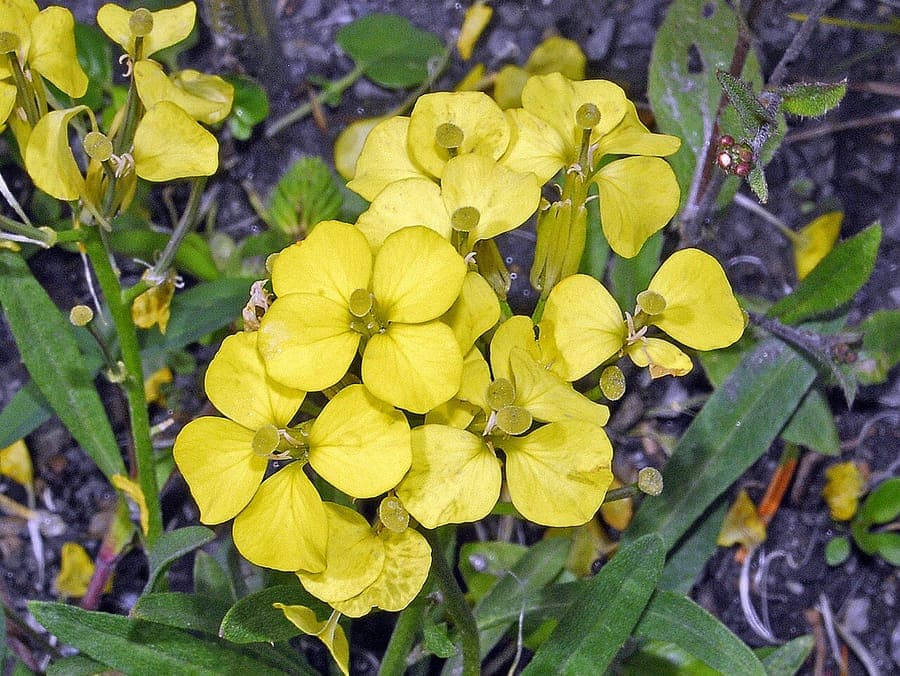
Hectonichus / CC BY-SA 4.0, via Wikimedia Commons
Erysimum jugicola: complete guide
Erysimum jugicola
Want to see Erysimum jugicola: complete guide in your garden?
1 minute, no credit card
Overview
Erysimum jugicola is a rare and distinctive alpine wallflower in the mustard family, Brassicaceae. Its natural distribution is restricted to the western Alps and the Ligurian Apennines, straddling the border between southern France and northwestern Italy. In the wild it inhabits stony mountain slopes, rocky cliffs, and calcareous alpine soils, typically above 1500 metres elevation.
The species epithet 'jugicola' derives from the Latin 'jugum' (mountain ridge) and 'cola' (inhabitant), perfectly describing where this plant makes its home. The species was formally described by the French botanist Alexis Jordan in 1864. Known synonyms include Erysimum parvulum and Erysimum brevicaule. French common names are Velar des sources and Velar nain; in German it is called Zwerg-Schotendotter.
In cultivation, Erysimum jugicola remains a specialist plant, beloved by enthusiasts of rock gardens and alpine plantings but little known outside those circles. This is undeserved obscurity: its compact habit, vivid yellow flowers, and adaptation to dry alkaline conditions make it genuinely useful for rock gardens, dry stone walls, and stony borders in small gardens where space and drainage challenges are the norm.
The species blooms in July and August, later than many alpine wallflowers, extending the season of interest in the rock garden well into high summer. Fragrant flowers attract bees, bumblebees, and butterflies, adding wildlife value to its ornamental qualities.
Appearance & bloom cycle
Erysimum jugicola is a compact, typically biennial or short-lived perennial herb reaching just 5-20 cm in height - a true dwarf among the Erysimum genus. It forms a tight rosette of narrow, lance-shaped leaves with a grey-green, slightly glaucous surface adapted to intense mountain ultraviolet radiation and periodic drought.
The four-petalled flowers are bright yellow with the characteristic cross-shaped arrangement typical of Brassicaceae. They appear in dense racemes above the leaf rosette from July through August, the classic bloom period for high-alpine plants that come into growth only after the snowmelt. Each flower is small but numerous and collectively create a cheerful, vivid display.
The flowers are mildly fragrant with a honey note attractive to pollinators. After flowering, the plant produces elongated seed pods (siliques) that turn brown and dry as they ripen. In suitable garden conditions - well-drained, slightly alkaline soil - Erysimum jugicola self-seeds reliably, maintaining a small colony from generation to generation.
As a short-lived species, individual plants typically persist for two to three years before setting seed and dying. Self-seeding ensures continuity if suitable bare soil patches are available.
Ideal location
Full sun is non-negotiable. In its mountain habitat, Erysimum jugicola is exposed to intense sunlight and strong winds; in the garden, reproduce these conditions with an open, south-facing position receiving uninterrupted sun for most of the day.
The plant excels in rock gardens, crevices in dry stone walls, between paving stones, and in stony raised beds. Altitude is irrelevant: it performs equally well at sea level provided drainage and light conditions are right. It is especially effective planted in wall crevices where its grey-green rosettes contrast beautifully with the stone.
Avoid rich, moist, or shaded positions. This species is adapted to harsh conditions and actually performs better in lean, dry spots where most garden plants struggle.
Soil
Erysimum jugicola is a calcicole: it requires alkaline to strongly alkaline soil with a pH between 7.5 and 8. This makes it ideal for limestone rock gardens, chalk gardens, and alkaline gravel borders. On acidic soils below pH 6, the plant declines and shows yellowing foliage (chlorosis).
Drainage must be excellent. Permanently wet or compacted soils cause rapid crown rot. A sandy or gritty substrate mixed with limestone chippings is ideal. The soil nutrient level recorded in data is low (nutriments score: 2), confirming that lean, poor substrates are preferred over rich garden soil.
Do not fertilize. High soil fertility encourages lush foliage at the expense of flowers and destroys the characteristic compact, tight growth habit that is so appealing in this plant.
Free design
Want to see Erysimum jugicola: complete guide in your garden? Make a free design now.
Watering
Once established, Erysimum jugicola is highly drought-tolerant and requires minimal supplementary irrigation. As an alpine plant adapted to seasonal drought, it manages well on natural rainfall in most temperate gardens.
During the establishment phase - the first few weeks after planting - water once weekly during dry spells to encourage rooting. Once the plant is settled in, reduce watering to zero in all but the most extreme drought conditions.
Avoid overwatering at all costs. Wet roots, especially in combination with summer warmth, are the primary cause of plant failure in this species. Allow the growing medium to dry completely between any watering events.
Pruning
After flowering in late August or September, cut back the spent flower stems and developing seed pods if you want to prevent self-seeding. This occasionally stimulates a modest second flush of bloom. If you wish to encourage self-seeding - the best strategy for long-term colonies - allow the siliques to ripen fully before removing the stems.
For biennial plants, the rosette will die naturally after seed set. Clear away the debris and allow any self-seeded seedlings in appropriate spots to grow on undisturbed: this is the most effective way to maintain a self-sustaining colony.
Do not cut back the leaf rosette itself on plants you want to overwinter: the rosette is the plant's energy reserve for next season's flowering. Remove only damaged or dead leaves.
Maintenance calendar
January-February: Dormant. Plant overwinters as a leaf rosette. No action needed. March-April: New leaf growth begins. Check for slug damage on young rosettes. Transplant seedlings to desired positions if needed. May-June: Rapid stem elongation. Check drainage after heavy rain episodes. July-August: Flowering. Enjoy yellow blooms and observe pollinator activity. Minimal work needed. September-October: Seed pods ripen. Cut spent stems or leave for self-seeding as preferred. November-December: Plant rests as rosette or dies after seed set. Remove dead plants and tidy the site.
Winter hardiness
As a high-alpine species from the western Alps, Erysimum jugicola is naturally adapted to severe winters. In garden conditions it tolerates temperatures down to approximately -15 degrees Celsius, corresponding to USDA zones 5-7. In most of temperate Western Europe (zones 7-8) it is fully reliable as a perennial or self-seeding biennial.
The primary winter risk is not cold but the combination of persistent wet and poor drainage at the crown. On freely draining soil in a rock garden or wall crevice, the plant comes through winter without difficulty. On heavier soils, place a collar of coarse grit around the neck of the plant to deflect moisture from the crown.
Container-grown plants overwinter outdoors in a sheltered, dry position, provided the pot drains freely. During prolonged wet autumn and winter periods, some protection from overhead rain - such as placing pots against a south-facing wall under a modest overhang - is beneficial.
Companion plants
Erysimum jugicola integrates naturally with other alpine and rock garden plants demanding similar conditions. Excellent companions include Aubrieta, Arabis caucasica, Iberis sempervirens, and Sedum species, all of which thrive in dry, alkaline, full-sun positions. Their complementary spring and early-summer bloom seasons bookend the later July-August flowering of Erysimum jugicola.
For a rock garden with continuous seasonal colour, combine with Alyssum montanum (yellow spring), Dianthus gratianopolitanus (pink early summer), then Erysimum jugicola (yellow high summer), and finally Sedum spectabile (pink autumn). This succession covers nearly the entire growing season.
Saxifraga species, Armeria maritima, and low-growing Campanula types are other natural partners. Browse rock garden design ideas and planting combinations at gardenworld.app to see how these compact alpine plants can create a compelling small-scale planting.
Closing
Erysimum jugicola is a genuine botanical rarity that deserves a far wider garden audience. Its compact rosettes, vivid yellow summer flowers, and remarkable adaptability to lean, alkaline, drought-prone conditions make it an ideal subject for rock gardens, dry stone walls, and challenging stony borders where conventional plants fail to thrive.
For personalized garden design advice on creating a rock garden or alpine border that works for your specific site and soil, visit gardenworld.app. The platform provides tailored planting plans showing exactly how specialist plants like Erysimum jugicola can anchor a small, low-maintenance planting with year-round character.
Want to see Erysimum jugicola: complete guide in your garden? Make a free design now.
Upload a photo, pick a style, and get a photorealistic design with plant list in under a minute.
10,000+ gardens designed already
No credit card required


Similar plants
Brassica cretica: complete guide
Brassica cretica
Brassica cretica, the Cretan cabbage, grows wild on Aegean cliffs. Discover how to grow this drought-tolerant, yellow-flowered Mediterranean perennial.
Corsican cabbage: complete guide
Brassica insularis
Corsican cabbage is a rare Mediterranean rock cabbage with white flowers and blue-green leaves. Location, soil and winter protection.
Prostrate cabbage: complete guide
Brassica procumbens
Prostrate cabbage is a creeping North African cliff plant with yellow flowers. Discover location, soil type and winter protection.