
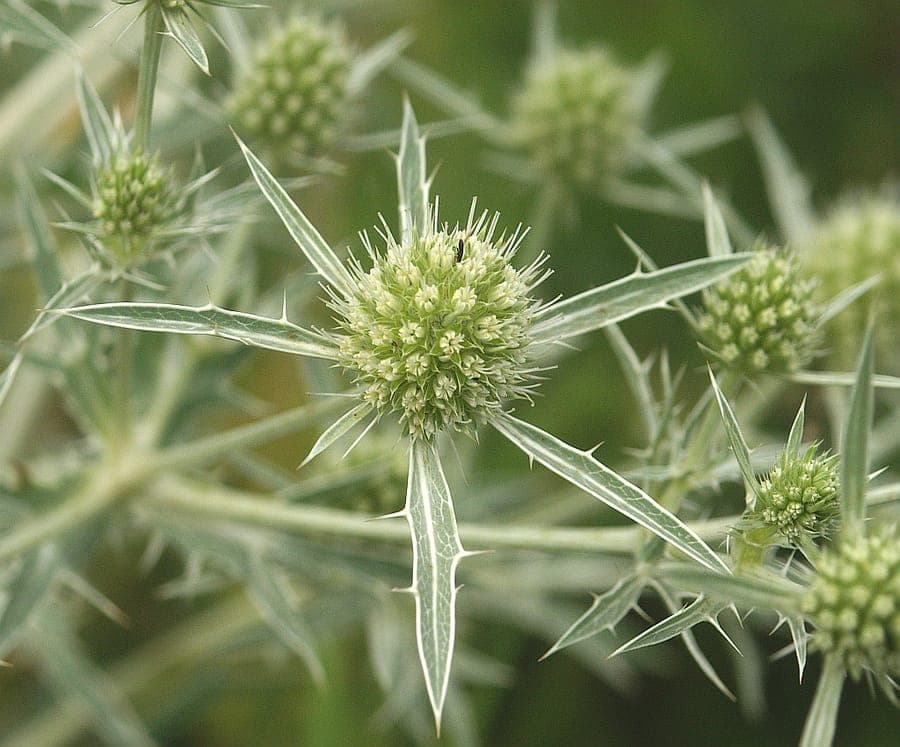
Bernd Haynold / CC BY-SA 2.5, via Wikimedia Commons
Field Eryngo: complete guide
Eryngium campestre
Want to see Field Eryngo: complete guide in your garden?
1 minute, no credit card
Overview
Field eryngo (Eryngium campestre) is a remarkable upright perennial from the carrot family (Apiaceae). This European wildflower stands out with its grey-silver branched stems and bluish seed-speckled flowers in spiky umbels. Reaching 30-60 cm tall, it creates an elegant skeleton in the landscape, thriving in lean, dry soils where other plants struggle.
The plant's deep tap roots ensure excellent drought tolerance and make it perfect for gardenworld.app gardens designed on lean, poor soils.
Appearance and Bloom
Field eryngo presents:
- Stems: Grey-silver-green, heavily branched, woody texture
- Leaves: Deeply lobed, almost spiny, blue-green tones
- Flowers: July through September, tiny grey-white flowers in bristly knots (5-8 mm diameter)
- Growth: 30-60 cm tall, 40 cm wide, open branching
Flower development is dynamic: grey-green initially, then whitish, finally reddish-brown coloration by autumn. They produce minimal nectar but abundant seeds.
Ideal Location
Field eryngo thrives in:
- Full sun exposure (6-8 hours direct light)
- Warm, sheltered spots away from north winds
- Elevated positions with no water pooling
- Excellent for rooftops, slopes, dry borders
- Perfect for contemporary design gardens (gardenworld.app positioning)
Soil
- Type: Well-draining, lean soil (USDA 6-8)
- pH: Neutral to alkaline (7.0-8.0)
- Nutrients: Poor soil is ideal; avoid heavy feeding
- Moisture: Dry to very dry; no waterlogging
- Preparation: Mix coarse sand/gravel into clay soil
Watering
- Growth period (April-May): Light watering until established
- Summer: Minimal; only in extreme heat
- Fall/Winter: Keep dry; no additional water
- Tip: Plant in raised beds to prevent root rot
Free design
Want to see Field Eryngo: complete guide in your garden? Make a free design now.
Pruning and Maintenance
- No pruning needed; plant grows elegantly on its own
- Spent stems can be removed in October for tidiness
- Seed heads scatter until late October; cut at base to prevent self-seeding
- Winter: Stems remain decorative until February, leave for wildlife
- Overall: Nine months of zero maintenance
Maintenance Calendar
| Month | Activity |
|---|---|
| Jan-Mar | Remove dead wood after frost |
| Apr-May | Growth care, monitor self-seeding |
| Jun-Aug | Drought management, water only if critical |
| Sep-Oct | Allow flowers to dry, seed heads persist |
| Nov-Dec | Stems provide visual interest and wildlife value |
Winter Hardiness
- USDA zone: 5b-9a (extremely hardy, down to -26°C)
- Preparation: None required; plant is fully winter-hardy in the UK and northern Europe
- Frost damage: Minimal; woody stems remain upright
- Snow cover: Harmless; plant pushes through
Companion Plants
Field eryngo works beautifully with:
- Dwarf spurge (Euphorbia cyparissias)
- Sedges and small grasses
- Rock roses (Helianthemum)
- Thyme (Thymus praecox)
- Blue fescue (Festuca glauca)
- Feather reed grass (Stipa)
Avoid pairing with water-lovers; this plant thrives in drought stress.
Final Thoughts
Field eryngo is the unsung hero of dry gardens. Its elegant form, minimal maintenance, and wildlife value create structure in contemporary borders designed with gardenworld.app principles. Plant in drifts of 3-5 for graphic impact, and you'll discover how autumn and winter reveal this plant's true grace. Expect subtle beauty rather than showy flowers - field eryngo works through minimalism and silhouette.
Want to see Field Eryngo: complete guide in your garden? Make a free design now.
Upload a photo, pick a style, and get a photorealistic design with plant list in under a minute.
No credit card required

