
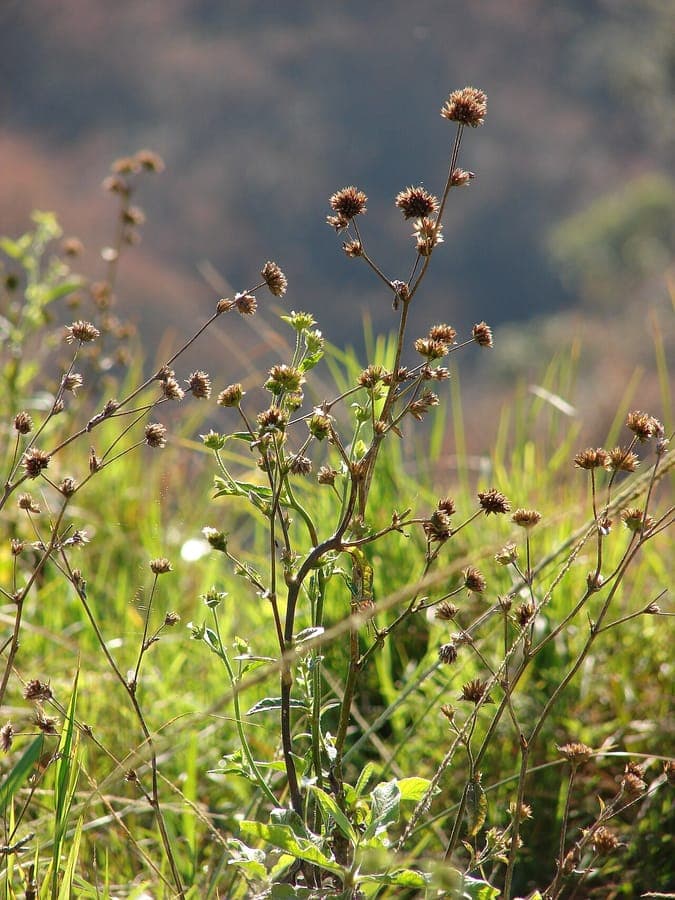
Forest & Kim Starr / CC BY 3.0, via Wikimedia Commons
Elephantopus mollis: complete guide
Elephantopus mollis
Want to see Elephantopus mollis: complete guide in your garden?
1 minute, no credit card
Overview
Elephantopus mollis, commonly known as false tobacco, tobacco-weed or soft elephant's-foot, is a herbaceous perennial in the daisy family (Asteraceae). The species epithet 'mollis' is Latin for soft, referring to the densely hairy, velvety texture of the leaves. It was described in 1818 by the botanist Carl Sigismund Kunth and is native to tropical and subtropical America - from Mexico and Central America throughout tropical South America to Uruguay and northern Argentina. Thanks to human activity it has become naturalised across large parts of tropical Africa, Southeast Asia, the Pacific Islands, Queensland in Australia and Hawaii.
Elephantopus mollis belongs to a genus of roughly twelve species distributed across tropical and warm-temperate regions worldwide. The genus name refers to the broad, flat leaf rosettes that sprawl at ground level like an elephant's foot - though in the case of E. mollis the plant grows more upright than prostrate. Related species such as Elephantopus scaber (rough elephant's-foot) have a long history of use in tropical folk medicine, and E. mollis shares similar properties. In Western gardens it is primarily an ornamental foliage plant grown for its bold, textural leaves.
The plant grows rapidly - described as having a rapid growth rate - and can reach a substantial size in a single growing season in warm conditions. In temperate Europe it is cultivated as a seasonal outdoor plant in summer or as a year-round houseplant or greenhouse specimen. For gardeners who enjoy tropical-themed borders, gardenworld.app can help you visualise how this species fits alongside other bold-leaved exotics such as cannas, colocasias and bananas.
Appearance and bloom cycle
Elephantopus mollis is an erect to spreading herbaceous plant growing 30 to 90 cm tall, depending on conditions. The overall growth form is single crown - it radiates from one central point without producing stolons or runners. The leaves are the plant's most striking feature: large, broadly elliptic to oblong, with a distinctly wrinkled surface and prominent veins. The upper surface is dark green; the lower surface is densely covered with soft white hairs, making it velvety to the touch - hence the name 'mollis'. Individual leaves can reach 15 to 30 cm in length and up to 10 cm wide, giving the plant a lush, tropical appearance.
The stems are erect or slightly curved, with smaller, clasping leaves towards the top. Flower heads are tiny by composite flower standards - only a few millimetres across - but are grouped into distinctive clusters enclosed by three triangular bracts. This three-bract structure is the hallmark of the Elephantopus genus and makes identification straightforward. The flowers are white to pale purple and appear during the warm growing months. In tropical climates flowering is nearly year-round; in temperate gardens it occurs in midsummer when temperatures are consistently warm. After pollination the achenes (seeds) are topped with rigid bristles that aid dispersal by catching on fur, feathers and clothing.
The foliage texture is described as coarse, and the plant's leaf retention is not evergreen in temperate conditions - it dies back in autumn and regrows from the rootstock in spring if successfully overwintered.
Ideal location
In its native range, Elephantopus mollis grows in semi-shaded to shaded environments - the edges and interiors of tropical forest, secondary woodland, roadsides under tree canopy, and disturbed ground with partial overhead cover. In temperate garden use, this translates to a preference for dappled or half-shade rather than full sun. Direct midday sun tends to scorch the large leaves and reduces the lush quality of the foliage.
For outdoor use in temperate regions, the plant can only go outside once night temperatures are reliably above 10°C, typically from mid-May onwards. Choose a sheltered position with morning or afternoon sun and protection from cold winds. An east- or west-facing wall is ideal. The plant also works well in large containers of at least 30 cm diameter on a sheltered terrace or balcony.
At up to 90 cm tall, Elephantopus mollis works as a bold background plant in a tropical-themed summer border or as a dramatic centrepiece in a large planter. In a mixed planting, allow at least 50 to 60 cm of space per plant to accommodate the spreading leaf canopy.
Soil requirements
Elephantopus mollis prefers a slightly acid to neutral soil with a pH between 5.0 and 7.2. In its native habitat it typically grows in moist, humus-rich forest soils that drain reasonably well. Heavy, waterlogged soils cause root rot; excessively dry, sandy soils lead to stunted growth and leaf scorch.
In containers, use a good-quality peat-free multipurpose compost mixed with 20 to 30% perlite to ensure drainage while retaining adequate moisture. In open ground, prepare planting beds by incorporating generous amounts of well-composted garden compost and a small proportion of coarse grit into the existing soil. A planting depth of 30 cm preparation is sufficient.
Fertility requirements are moderate to high for this fast-growing species. During the growing season, apply a balanced liquid fertiliser (10-10-10 NPK) monthly to support the vigorous leaf development. Yellowing, undersized leaves are usually a sign of nitrogen deficiency. Do not feed during the overwintering rest period.
Free design
Want to see Elephantopus mollis: complete guide in your garden? Make a free design now.
Watering
Elephantopus mollis needs consistent moisture during the growing season - it does not tolerate prolonged drought. The large leaf surface transpires water rapidly, meaning that in hot, dry weather the plant may need watering two to three times per week. Check the top 2 to 3 cm of compost: if dry, water thoroughly until it runs from the drainage holes, then allow to become barely moist before watering again.
Avoid wetting the foliage in bright sunshine, as water droplets can act as small magnifying lenses and cause scorch marks on the soft leaf surfaces. Overhead watering is fine in the evening when the sun is low or absent.
During winter dormancy - whether the plant is kept in a cool greenhouse, unheated sunroom, or warm windowsill - reduce watering dramatically. Water sparingly once every one to two weeks, enough to prevent the rootstock from completely desiccating. A plant kept at 10 to 12°C in winter uses very little water and should never sit in wet compost during this period.
Pruning
Pruning requirements are minimal. Remove damaged, yellowed or dead leaves regularly at their base to improve airflow and reduce the risk of fungal disease. This is especially important during summer when the dense leaf canopy can restrict air movement around the crown.
When bringing the plant indoors in autumn, cut it back to 10 to 15 cm above the crown. This reduces the overwintering volume and encourages vigorous fresh growth in spring. Use clean, sharp secateurs. In spring when the plant goes outside again, cut away any dead winter stems to the point of living tissue. New shoots emerge rapidly from the crown in warm conditions.
Do not attempt hard pruning during the growing season unless it is genuinely necessary - the large leaves are the main ornamental feature and removing them excessively defeats the purpose of growing the plant.
Maintenance calendar
February–March: Check overwintering plants for signs of drought stress or fungal problems. Water sparingly if the compost is fully dry. Do not fertilise yet.
April–May: Increase watering as days lengthen. Begin monthly feeding. Move outside in mid to late May when nights stay above 10°C, choosing a sheltered half-shade position.
June–July: Peak growth phase. Feed weekly with liquid fertiliser. Water generously when the top of the compost dries out. Remove yellowing leaves. Enjoy the lush tropical foliage.
August–September: Continued vigorous growth and possible flowering. Maintain regular watering and feeding. The plant is at its most impressive during this period.
October–November: Move inside once night temperatures drop below 10°C. Reduce watering significantly and stop feeding. Cut back to 10–15 cm if overwintering space is limited.
December–January: Cool, light resting period at 8–12°C. Water once every one to two weeks. No feeding required.
Winter hardiness
Elephantopus mollis is frost-tender and cannot survive outdoors in temperate climates. Below 5°C the plant shows serious cold damage; frost kills it outright. In USDA hardiness zones 9b and above it can be grown as a true perennial outdoors, but in northern and central Europe it must be treated as a seasonal annual or brought indoors for winter.
Overwintering indoors is straightforward. Ideal temperatures are 8 to 15°C, with reasonable light levels - a cool but frost-free greenhouse, conservatory or bright windowsill all work well. In centrally-heated rooms with low humidity, spider mite can become a problem; maintain adequate humidity by misting the surroundings or placing water-filled trays near the plant. Inspect new growth regularly in spring before placing the plant outside.
For garden centre customers in the UK, Elephantopus mollis is occasionally available from specialist tropical plant nurseries in spring and early summer. Online suppliers focusing on unusual and exotic plants are the most reliable source.
Companion plants
Elephantopus mollis works beautifully in a tropical-themed summer planting scheme alongside other moisture-loving, shade-tolerant foliage plants. Excellent companions include Caladium bicolor (angel wings) with its spectacularly patterned leaves, Begonia rex cultivars for their metallic and coloured foliage, Strobilanthes dyerianus (Persian shield) for its iridescent purple-blue leaves, and low-growing Impatiens walleriana (busy lizzie) as a colourful understorey filler.
For a more dramatic effect in a large greenhouse or winter garden setting, pair Elephantopus mollis with tall-growing tropicals such as Ensete ventricosum (Ethiopian banana) or Canna 'Tropicanna', whose broad orange-striped leaves create a spectacular contrast with Elephantopus's dark green. The result is a layered tropical composition full of textural variety.
In an outdoor summer border, the combination of Elephantopus mollis with Colocasia esculenta (taro) and Hedychium gardnerianum (Kahili ginger) creates a convincing tropical atmosphere. The gardenworld.app platform makes it easy to experiment with such exotic combinations and see how they interact in terms of scale, colour and light requirements before you invest in the plants.
Closing thoughts
Elephantopus mollis is a striking, fast-growing tropical plant that rewards careful cultivation with lush, bold foliage from late spring through autumn. Though not hardy in temperate climates, it is an excellent seasonal performer in sheltered summer borders and a rewarding greenhouse or conservatory plant throughout the year. Its unfussy soil requirements, tolerance of partial shade and impressive size make it a genuine statement plant in any exotic or tropical garden scheme. With regular watering, monthly feeding and a warm, frost-free winter home, this soft elephant's-foot will return year after year to fill its appointed space with tropical vigour.
Want to see Elephantopus mollis: complete guide in your garden? Make a free design now.
Upload a photo, pick a style, and get a photorealistic design with plant list in under a minute.
10,000+ gardens designed already
No credit card required


Similar plants
Calendula stellata: complete guide
Calendula stellata
Complete guide to Calendula stellata, the star-flowered marigold from Sicily: location, soil, watering and companion planting tips.
Korean chrysanthemum: complete guide
Chrysanthemum x rubellum
Chrysanthemum x rubellum is a hardy autumn perennial with single pink to copper flowers from August to November. Care and combinations.
Helianthus divaricatus: complete guide
Helianthus divaricatus
Helianthus divaricatus is a North American woodland sunflower with yellow summer blooms, ideal for naturalistic borders and shady edges.