
Robert H. Mohlenbrock / Public domain, via Wikimedia Commons
Beaked spikerush: complete guide
Eleocharis rostellata
Want to see Beaked spikerush: complete guide in your garden?
1 minute, no credit card
Overview
Eleocharis rostellata, commonly called beaked spikerush or walking sedge, is a perennial wetland plant in the sedge family (Cyperaceae). The species was first formally described by Torrey in 1843 based on material from New York. Its native range is extensive: from Canada (Ontario, Nova Scotia, British Columbia) through the eastern and western United States, Mexico, Central America, the Caribbean and south to north-west Argentina. It is not native to Europe but is available as a garden plant for wet conditions.
The common name "walking sedge" captures the plant's most distinctive behaviour: the longest, arching stems bend outward from the clump, touch the ground at their tips, and root there to form new daughter plants - a vegetative spreading mechanism analogous to the runners of a strawberry. This gives the species a slow, steady colonising ability on suitable wet substrates.
In its natural habitat, Eleocharis rostellata occupies calcareous fens, brackish coastal marshes, wet prairies overlying limestone and freshwater lake shores. It is ecologically important as cover for waterfowl, amphibians and invertebrates. On gardenworld.app you can find complete design inspiration for wildlife ponds and bog gardens where this unusual spikerush fits naturally.
Appearance and bloom cycle
Mature plants form dense tufts of upright to gently arching stems, typically 20 to 60 cm tall. The stems are slender, round in cross-section and a bright green to mid-green. The outer stems of a mature clump arch outward and, when they contact moist soil, produce adventitious roots and small plantlets - giving the colony a sprawling, mat-like periphery.
Like all Eleocharis species, there are no true leaves; photosynthesis takes place entirely in the green stems. Brown papery sheaths wrap the base of each stem.
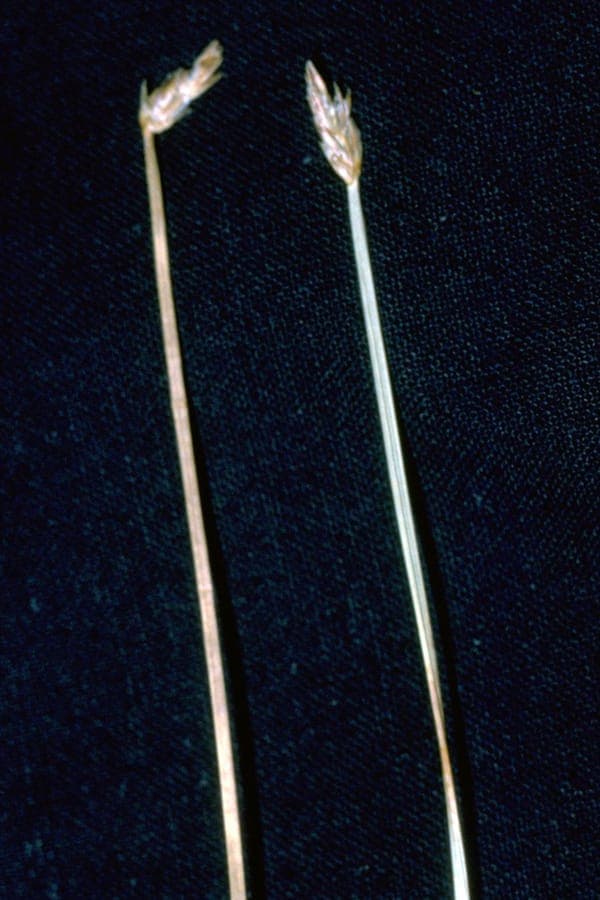
At the tip of each stem sits a single ovoid to oblong spikelet, 5 to 20 mm long, bearing small green to brownish flowers. The defining fruit character is a small, beak-like tubercle (the "rostellum" from which the species takes its Latin name) at the apex of each achene. Flowering: May to August. Fruit ripening: July to September. Seeds are distributed by water and wind.
Ideal location
Full sun to light partial shade is best. A permanently wet to saturated substrate is essential. The species shows a preference for calcareous substrates - limestone-influenced fens, coastal seeps with hard water, wet meadows over chalk - but it also grows well on neutral to slightly alkaline substrates (pH 6.0 to 8.0).
The plant thrives in the shallow margin of a pond (water depth 0 to 10 cm), in constructed wetland basins, along ditch banks and in wet prairie beds. It tolerates mild brackishness, making it suitable for coastal gardens in brackish-water transition zones. Brief flooding is no problem; prolonged drought causes die-back.
USDA hardiness zones 4 to 9 cover the full range of the species, making it highly adaptable to temperate European gardens.
Soil
Calcareous to neutral, permanently wet substrates are preferred. The pH range of 6.0 to 8.0 reflects the species' origin in calcareous fens. Loamy clay and calcareous marl are ideal growing media. Pure peat with a very low pH is less suitable than for acid-bog plants.
For pond basket cultivation, fill with heavy loam or pond clay mixed with coarse sand, and set the basket at 0 to 10 cm water depth. Moderate nutrient levels are best - excessive fertilisation promotes lush but floppy stems. In a marsh bed, plant directly into wet soil and allow the rhizomes to spread naturally.
The rhizomatous and stoloniferous growth habit makes this species an excellent choice for gradual shoreline revegetation projects, as it binds sediment and creates dense, stable mats.
Free design
Want to see Beaked spikerush: complete guide in your garden? Make a free design now.
Watering
Consistent moisture is the key requirement. In a pond or marsh setting, no supplemental irrigation is needed. In a container or planting basket, the substrate must never dry out; top up with water regularly.
When using the plant in a pond with fluctuating water levels, position the basket in the zone that never fully dries out. The arching stems need contact with moist soil to produce their adventitious roots and daughter plants. In dry summers when the pond margin risks drying, supplement with several litres of water per plant per week.
Pruning
Very little management is required. During the growing season (May to September), no cutting is needed; allow the stems to arch and colonise freely. In early spring (February to March), cut all old dead stems back to ground level to make way for fresh growth. This is also the right time to detach established daughter plants (those that have already rooted from arching stems) and transplant them to new locations.
When removing arching stems, check which tips have already rooted before cutting; these rooted plantlets can be carefully lifted and potted or replanted elsewhere as new specimens.
Maintenance calendar
January - February: Dormancy. Leave stems standing as shelter for aquatic invertebrates and amphibians.
March - April: Remove old stems. Monitor new shoots. Detach and transplant rooted daughter plantlets. Consult gardenworld.app for companion plant ideas that work alongside beaked spikerush.
May - July: Flowering period. Spikelets are inconspicuous but ecologically important for invertebrates. No intervention needed.
August - September: Seeds ripening. Check if the plant is spreading into unwanted areas; confine with a basket or physical barrier if necessary.
October - November: Stems yellowing. Leave in place for winter structure and wildlife value.
December: Full dormancy. Move baskets indoors in frost-prone climates if needed.
Winter hardiness
Eleocharis rostellata is rated hardy in USDA zones 4 to 9, making it one of the more widely adaptable spikerush species. In temperate European gardens (zones 7 to 9), plants overwinter without protection in the soil or in shallow ponds. In colder zones (4 to 6), the above-ground stems die back at the first hard frost but the rhizomes survive in the wet sediment and produce new growth the following spring once soil temperature rises above 8 degrees Celsius.
In very cold winters (below -15 degrees Celsius) or in ponds at risk of freezing solid, move planting baskets to a frost-free space or cover the root zone with 10 to 15 cm of dry straw. Seeds remain viable in the soil after cold winters.
Companion plants
Beaked spikerush combines well with other calcareous fen and pond-margin plants. Excellent companions include yellow flag iris (Iris pseudacorus), water forget-me-not (Myosotis scorpioides), water mint (Mentha aquatica), arrowhead (Sagittaria sagittifolia), marsh marigold (Caltha palustris) and lesser cattail (Typha angustifolia).
For structural variety, pair the fine stems of Eleocharis rostellata with the bolder foliage of flowering rush (Butomus umbellatus) or greater spearwort (Ranunculus lingua). Low ground-covering associates such as marshwort (Apium inundatum) or water-purslane (Lythrum portula) fill the shallow water nicely.
Ecologically, the dense clumps provide cover and spawning habitat for frogs, toads and newts, while the seeds attract dabbling ducks, snipe and other wetland birds. Visit gardenworld.app to design your pond planting scheme with the right mix of marginal and submerged species.
Closing
Eleocharis rostellata is a versatile, ecologically outstanding marginal plant with the unusual ability to colonise new ground through its arching, rooting stems. It is reliably hardy, low-maintenance and suited to a wide range of wet habitats from freshwater pond margins to mildly brackish coastal wetlands.
The plant is available from specialist water plant nurseries and online retailers; it is rarely stocked at mainstream garden centres. With the right wet site, a calcareous to neutral substrate and full sun, beaked spikerush will reward you with natural, living architecture and genuine wildlife value that keeps on giving through every season.
Want to see Beaked spikerush: complete guide in your garden? Make a free design now.
Upload a photo, pick a style, and get a photorealistic design with plant list in under a minute.
10,000+ gardens designed already
No credit card required


Similar plants
Flatstem spikerush: complete guide
Eleocharis compressa
Full guide to Eleocharis compressa: origin, appearance, ideal site, soil, watering, pruning and pond garden care tips.
Walter's barnyard grass: complete guide
Echinochloa walteri
Full guide to Echinochloa walteri: origin, appearance, ideal site, soil, watering, pruning and care in the pond garden.