
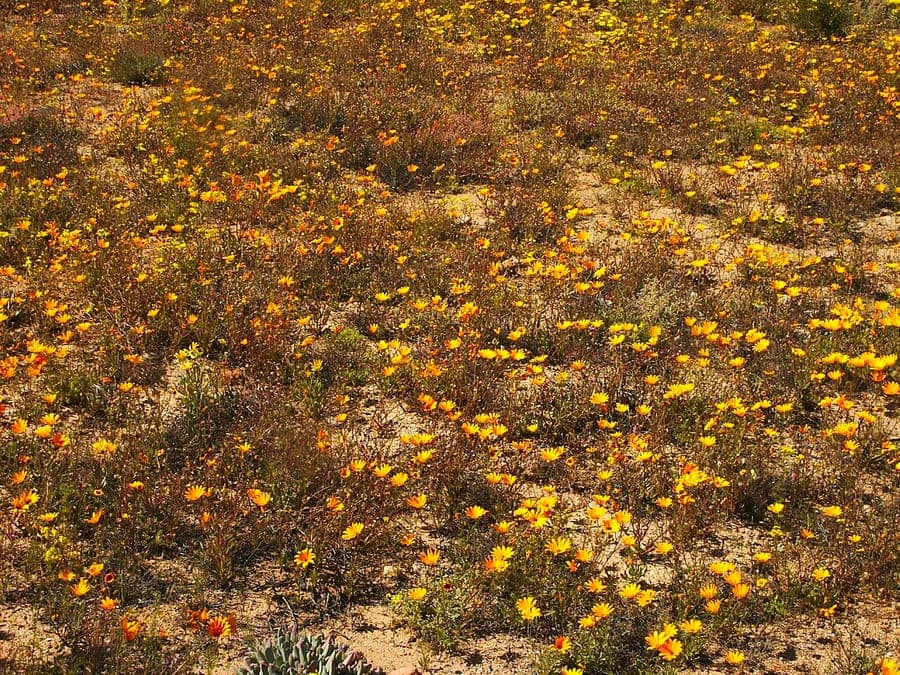
Winfried Bruenken (Amrum) / CC BY-SA 2.5, via Wikimedia Commons
Dimorphotheca sinuata: complete guide
Dimorphotheca sinuata
Want to see Dimorphotheca sinuata: complete guide in your garden?
1 minute, no credit card
Overview
Dimorphotheca sinuata, the Namaqualand daisy, is a cheerful, sun-loving plant from the Asteraceae family. Hailing from Namibia and South Africa, this compact flowering plant produces prolonged, brilliant yellow-orange blooms. With its preference for sunlight and dry conditions, it is ideal for sunny borders, containers, and drought-tolerant gardens.
Appearance and bloom
Growing 30-60 cm tall and forming compact clumps with finely lobed foliage, this plant produces radiant golden to orange flowers from March through October. Dark purple disc florets in the center create striking contrast. Flowers close at night and open during the day.
Ideal location
Choose a sunny location with at least eight hours of direct sunlight daily. Namaqualand daisy cannot thrive without full sun and warm environments. Perfect for sunny borders, containers, groupings, or dry garden screens.
Soil
This plant thrives in well-draining, sandy or light clay soil. Prefers neutral pH. Avoid heavy, wet soils. Poor soil is fine; no extra fertilization needed.
Free design
Want to see Dimorphotheca sinuata: complete guide in your garden? Make a free design now.
Watering
This is a drought lover. Water at planting, then minimal care needed. In extreme drought, water lightly, but overwatering is harmful. Keep plant base dry.
Pruning
Regularly removing spent flowers encourages continuous blooming throughout the season. Cut away frost-damaged parts after severe frost.
Maintenance calendar
Spring: sow seed and place plants; Summer: deadhead and water minimally; Autumn: enjoy continuous bloom; Winter: provide protection in cold regions.
Winter hardiness
Namaqualand daisy is frost-tender. Treat as an annual in colder climates. Protect against severe frost.
Companion plants
Pair with other drought-lovers such as Helichrysum, Gazania, and other sun-seekers. Beautiful planted in large masses for bold color impact.
Closing
Namaqualand daisy brings continuous sunny color to dry, hot gardens. Ideal for water-wise and low-maintenance landscapes. Available at garden centers. Explore more planting designs at gardenworld.app and browse our full plant catalog at gardenworld.app/en.
Want to see Dimorphotheca sinuata: complete guide in your garden? Make a free design now.
Upload a photo, pick a style, and get a photorealistic design with plant list in under a minute.
No credit card required


Similar plants
Calendula stellata: complete guide
Calendula stellata
Complete guide to Calendula stellata, the star-flowered marigold from Sicily: location, soil, watering and companion planting tips.
Korean chrysanthemum: complete guide
Chrysanthemum x rubellum
Chrysanthemum x rubellum is a hardy autumn perennial with single pink to copper flowers from August to November. Care and combinations.
Helianthus divaricatus: complete guide
Helianthus divaricatus
Helianthus divaricatus is a North American woodland sunflower with yellow summer blooms, ideal for naturalistic borders and shady edges.