
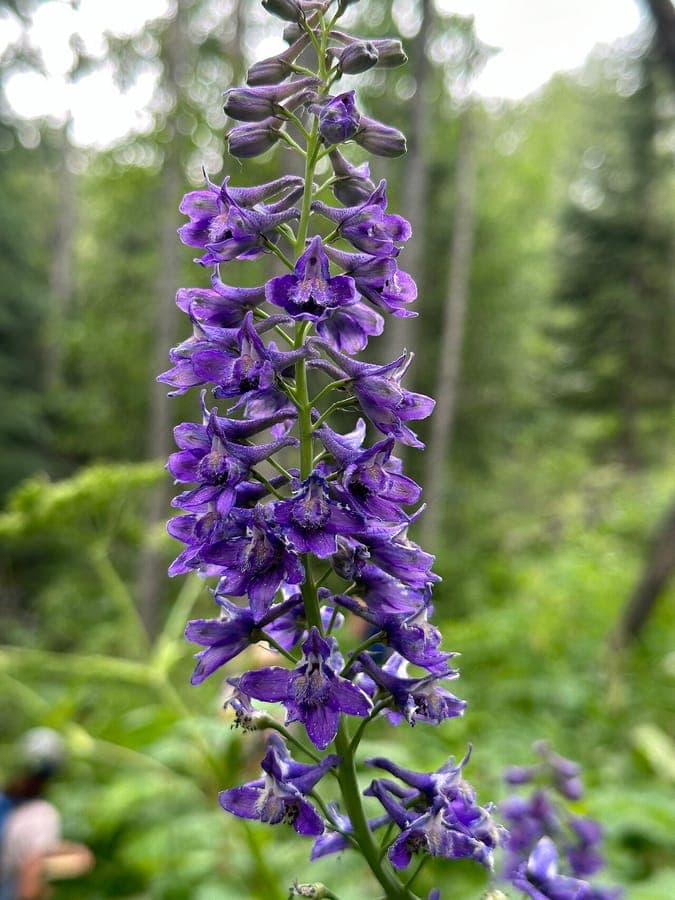
Kallum McDonald / CC0, via Wikimedia Commons
Tall larkspur: complete guide
Delphinium glaucum
Want to see Tall larkspur: complete guide in your garden?
1 minute, no credit card
Overview
Tall larkspur (Delphinium glaucum) is one of the most striking perennials that western North America has given to horticulture. Native from Alaska and the Canadian Rockies south through Montana, Wyoming, Idaho, Colorado, Utah, Nevada, and California, it colonises moist mountain meadows, stream banks, and subalpine clearings, often reaching 150 to 200 cm in a single season. Its common English names - tall larkspur, mountain larkspur, sierra larkspur, and tower larkspur - all capture aspects of its character: great height, mountain origin, and the soaring spike of purple-blue flowers.
The plant belongs to the genus Delphinium in the family Ranunculaceae, a group that also includes garden hybrids such as the 'Pacific Giant' series, the compact 'Magic Fountains', and the graceful 'Belladonna' cultivars. Among the species, Delphinium glaucum stands apart for its blue-grey (glaucous) foliage, its exceptional cold tolerance, and the speed with which it establishes from seed or division. It is also one of the tallest species in cultivation, which makes it indispensable as a back-of-border accent wherever height and dramatic colour are required.
Gardeners who want to explore how tall larkspur can fit into a planned border composition can use gardenworld.app to generate a personalised garden layout before buying a single plant.
Appearance & bloom cycle
Delphinium glaucum produces thick, hollow, erect stems from a fleshy crown. Mature plants in rich, moist soil regularly achieve 150 to 200 cm, and exceptional specimens in streamside conditions have been recorded at 250 cm. The stems are pale green, faintly glaucous, and slightly hairy at the nodes. The leaves are large - up to 15 cm across - palmately divided into five to seven lobes, each lobe further toothed or cut. The leaf surfaces carry the same blue-grey waxy bloom that distinguishes the species from its green-leaved relatives.
Flowering begins in June in lowland gardens and continues into July; in mountain provenance plants or cool-summer climates it may extend into August. The inflorescence is a dense, elongated raceme carrying 20 to 60 individual flowers. Each flower is 4 to 6 cm across, bright violet-purple to deep blue-purple, with a distinctive white or cream central eye formed by modified inner petals. The backward-pointing spur, 1 to 2 cm long, is characteristic of the genus and gives larkspurs their English name - the spur resembles the hind toe (spur) of a lark.
After flowering, conspicuous black seed pods develop. Ripe seed is viable and germinates freely. If the spent flower stems are cut back to 30 cm in late July and the plant is watered and fed, a second, smaller flush of blooms often follows in September. Selected cultivars and seed strains selected for especially deep colour or vigorous growth are available from specialist nurseries.
Ideal location
Tall larkspur thrives in full sun to light partial shade. In British and northern European gardens, a south- or west-facing position receiving at least six hours of direct sunlight daily gives the best results: stocky, wind-resistant stems and the richest flower colour. In regions with very hot summers, such as southern France or the Mediterranean fringe, light afternoon shade prevents heat stress and extends the flowering period.
Wind protection is critical. The tall, hollow stems snap easily in strong gusts, particularly once laden with flowers. Site the plant against a wall, fence, or tall hedge, or surround it with robust shrubs that act as a windbreak. Staking is nearly always necessary: insert bamboo canes or metal grow-through rings when stems reach 50 cm, and add additional support at 100 cm for the tallest specimens.
A slightly raised bed or sloped position aids drainage around the crown, reducing the risk of crown rot in wet winters. Avoid planting in low-lying areas where rainwater pools after storms.
Soil requirements
Delphinium glaucum demands deep, moisture-retentive but well-drained soil with a pH of 5.6 to 7.0. It will not thrive in waterlogged conditions, compact subsoil, or highly alkaline ground. The ideal texture is a deep, humus-rich loam - the sort of soil found on productive vegetable plots or established cottage gardens.
On heavy clay, incorporate sharp grit and well-rotted garden compost before planting: work in one bucket of grit and two buckets of compost per square metre to a depth of 40 cm. On free-draining sandy soil, add 5 to 10 litres of compost per square metre to improve moisture retention. Both amendments help maintain the consistently moist root zone that tall larkspur requires throughout the growing season.
At planting, mix a slow-release fertiliser (such as bone meal or a balanced granular feed at NPK 8-4-8) into the planting hole. Top-dress with 5 cm of well-rotted compost each spring to replenish organic matter and introduce beneficial soil organisms.
Watering
Consistent moisture is the single most important requirement of tall larkspur. In its natural habitat along mountain streams and in snowmelt-fed meadows, the plant enjoys generous water throughout the growing season. In the garden, aim to keep the top 30 cm of soil evenly moist from April through July - the period of rapid stem elongation and flowering.
Drip irrigation is the ideal delivery method: it keeps foliage dry, which dramatically reduces the risk of powdery mildew and Botrytis (grey mould), two of the most common diseases in this genus. If overhead watering is unavoidable, water in the early morning so that leaves dry before nightfall. Evening watering on damp leaves is a direct invitation to fungal infection.
After the first flowering flush in July, gradually reduce irrigation as the plant transitions to dormancy. In autumn and winter, natural rainfall is usually sufficient except in prolonged dry spells. Applying a 5 to 8 cm mulch of bark chippings or straw after cutting back in autumn conserves soil moisture and moderates soil temperature.
Free design
Want to see Tall larkspur: complete guide in your garden? Make a free design now.
Pruning
Pruning tall larkspur involves two distinct operations. The first is post-flowering deadheading and cut-back: once the flowers on the main spike have faded - typically in late July - cut the entire stem down to 30 to 40 cm above ground level. Immediately apply a potassium-rich liquid fertiliser (tomato feed works well) and water the plant deeply. Within two to four weeks, new side shoots emerge from the base, and these often produce a second, more modest flower display in September.
The second operation is the autumn cutback. Once the foliage has been blackened by the first hard frost - usually October or November - cut all stems down to 5 to 10 cm above ground level. Remove all dead material promptly; leaving it in place creates ideal conditions for fungal pathogens and overwinter slug populations that attack the crown. Dispose of the cut material by burning or hot composting.
In spring, when the new shoots are 15 to 20 cm tall, thin them to the three to five strongest per crown. This ensures thick, robust stems that are more wind-resistant than a crowded mass of thin ones. Insert support stakes or grow-through grids at this point to avoid disturbing the roots later.
Maintenance calendar
March: Remove remaining dead stems from the previous year; top-dress with 5 cm of well-rotted compost; apply slug prevention measures (pellets, copper tape, or physical barriers) around emerging shoots.
April: Thin shoots to three to five per crown; place support stakes when stems reach 50 cm; begin regular watering if rainfall is below 20 mm per week.
May – June: Water two to three times weekly; apply a nitrogen-rich liquid feed weekly; check stems for aphid colonies and treat with insecticidal soap if necessary.
July: Enjoy the main flowering display; cut back spent spikes to 30 cm after bloom; apply potassium-rich fertiliser to encourage regrowth.
August – September: Enjoy any second flowering; gradually reduce watering; harvest seed if required for propagation.
October – November: Cut all stems to 5 cm after first frost; mulch the crown with 5 to 8 cm of bark or straw.
December – February: Minimal attention; check mulch is intact after thaw; no watering unless soil is completely dry.
Winter hardiness
Few perennials can match the cold tolerance of Delphinium glaucum. Native to Alaska, the Yukon, and the Canadian Rockies, it naturally endures temperatures well below -30 °C. In horticultural terms it is rated USDA zones 3 to 7, covering the entire Benelux, Germany, northern France, and the United Kingdom without protection. Even in USDA zone 3 climates (minimum winter temperatures of around -40 °C) the dormant crowns survive beneath frozen ground.
The key to winter survival is good drainage. Wet, waterlogged soil in combination with freezing temperatures is far more lethal to the fleshy crown than dry cold. Ensure the planting site drains freely and mulch the crown with dry material (bark or straw) before hard frosts arrive. In mild, wet maritime climates, a raised bed or sloped position provides sufficient drainage without additional intervention.
Division every three to four years in early spring reinvigorates old clumps, improves drainage around individual crowns, and is the most reliable method of propagation.
Companion plants
Tall larkspur's combination of great height and violet-purple flowers makes it an invaluable anchor for any mixed or herbaceous border. The most effective companions are those that contrast in colour, form, or texture without competing directly for the same visual space:
- Achillea millefolium 'Paprika' - flat-headed, warm-red yarrow at 60 cm provides a striking complementary contrast to the vertical blue spires; plant 50 cm apart.
- Leucanthemum x superbum 'Becky' - tall white shasta daisy at 90 cm; the classic purple-and-white pairing is as reliable as it is beautiful.
- Geranium psilostemon - crimson-magenta with a black eye at 80 to 100 cm, flowering June to August; fills the middle tier elegantly.
- Veronicastrum virginicum 'Fascination' - slender pale purple spikes at 100 cm that echo the larkspur's form while remaining shorter.
- Phlox paniculata 'David' - pure white at 80 cm, fragrant, flowering in August to accompany any second flush.
- Stipa gigantea (golden oat grass) - the translucent seed heads shimmer behind the blue spires and remain attractive for months.
Allow at least 60 to 80 cm between individual plants for air circulation. Avoid planting with fragile or low-growing neighbours that may be crushed when the tall stems are eventually cut back.
Discover more perennial planting combinations and border designs for the front garden on gardenworld.app.
Conclusion
Tall larkspur (Delphinium glaucum) is an exceptional perennial that brings height, drama, and colour to any sunny border. Its extraordinary winter hardiness - rooted in an origin spanning Alaska to the Rocky Mountains - makes it accessible to gardeners across a wide range of climates. With well-drained, moisture-retentive soil, full sun, reliable watering during the growing season, and proper support for its tall stems, this plant rewards with a spectacular June and July display and often a second flowering in early autumn.
The investment in preparation - improving soil, installing supports, thinning shoots each spring - is modest compared to the years of pleasure that a well-established crown delivers. For gardeners seeking to incorporate tall accent perennials into a cohesive front garden design, gardenworld.app offers the tools to plan the whole composition before the first plant goes into the ground.
Want to see Tall larkspur: complete guide in your garden? Make a free design now.
Upload a photo, pick a style, and get a photorealistic design with plant list in under a minute.
10,000+ gardens designed already
No credit card required


Similar plants
Drummond's anemone: complete guide
Anemone drummondii
Discover Drummond's anemone (Anemone drummondii): a silvery-grey mountain plant for cool rock gardens and alpine troughs.
Korean clematis: complete guide
Clematis serratifolia
Clematis serratifolia is a hardy climber with fragrant yellow bell flowers in August-September. Pruning group 3, location and care tips.
Aquilegia brevistyla: complete guide
Aquilegia brevistyla
Discover Aquilegia brevistyla, the elegant North American columbine. Growing tips, shade tolerance, and design ideas for woodland and shadowed gardens.