
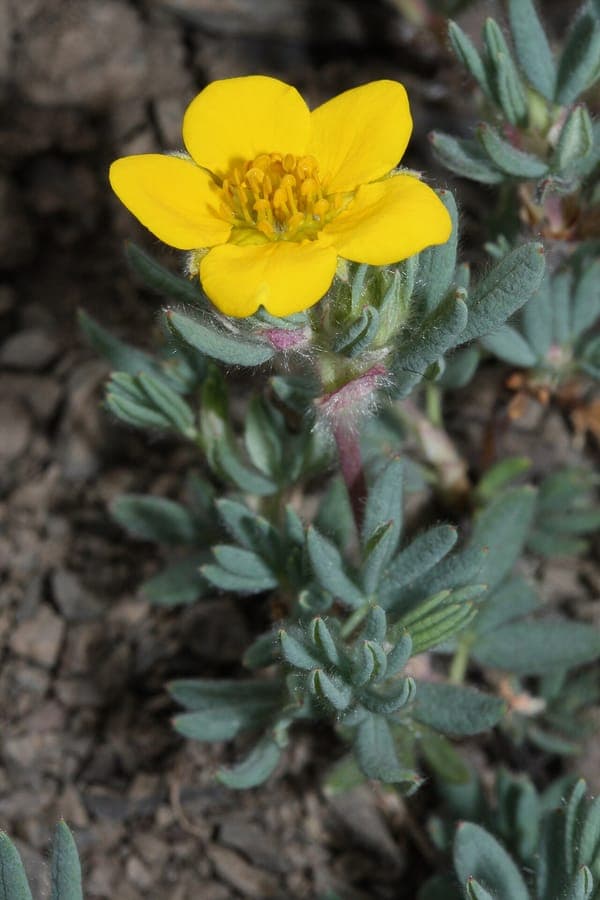
Walter Siegmund (talk) / CC BY-SA 3.0, via Wikimedia Commons
Shrubby cinquefoil: complete guide
Dasiphora fruticosa
Want to see Shrubby cinquefoil: complete guide in your garden?
1 minute, no credit card
Overview
The shrubby cinquefoil (Dasiphora fruticosa) is a reliable, versatile and easy-to-grow shrub from the rose family. This plant is renowned for its abundance of yellow flowers that bloom continuously from June to September.
The plant forms a compact, rounded shrub that grows 60-150 centimeters high depending on the cultivar. The shrubby cinquefoil is extremely frost-hardy and thrives in virtually all soils.
Appearance and bloom
The shrubby cinquefoil has a finely branched appearance with small, feathery leaves that remain green year-round. The leaves are delicate and give the plant an elegant, airy appearance.
The yellow flowers appear in various sizes, from a few centimeters to about three centimeters in diameter. Some varieties produce almost white or orange tints, but most are golden to lemon yellow.
Blooming starts in June and lasts until the first frost in autumn. The plant blooms very profusely.
Ideal location
The shrubby cinquefoil grows best in a full sun to half shade location. A minimum of six hours of direct sunlight per day ensures optimal blooming. The plant can grow in more shade, but will produce fewer flowers.
Ensure an open spot with good air circulation. Avoid planting close to large trees due to root competition.
Soil
The shrubby cinquefoil is remarkably undemanding regarding soil type. The plant grows in practically all soils: sandy, loamy, clayey and highly fertile. The only requirement is good drainage.
In heavy clay soils, adding sand and organic material to the planting hole is helpful. A slightly acidic to neutral pH is preferred, but alkaline soils are also tolerated.
Free design
Want to see Shrubby cinquefoil: complete guide in your garden? Make a free design now.
Watering
Once established, the shrubby cinquefoil is very drought-tolerant. After planting, the plant must be watered regularly until well-established (approximately two growing seasons). After that, additional watering is not necessary.
In pots, water more regularly. Ensure water drains well. Excessive water is harmful.
Pruning
The shrubby cinquefoil willingly undergoes annual pruning to maintain compactness and continuous blooming. After blooming in autumn, or in early spring, cut the plant back by about one-third of its height.
Old, overgrown shrubs can be cut back drastically in spring.
Maintenance calendar
Spring (March-May): Prune for form. Add fertilizer. Resume watering after winter.
Summer (June-August): Water regularly during dry periods. Plant blooms abundantly.
Fall (September-October): Later pruning after blooming. Inspect for damage.
Winter (November-February): Minimal care needed. Plant tolerates frost well. No feeding.
Winter hardiness
The shrubby cinquefoil is exceptionally frost-hardy. The plant tolerates temperatures down to minus 30 degrees Celsius. Throughout Europe, the plant grows outdoors without protection.
Even very young plants tolerate frost well.
Companion plants
The shrubby cinquefoil combines beautifully with other heather-like plants: lavender, rosemary, sage, genista and hypericum. It also works well with silver-leaved foliage.
The yellow flowers work well against other color schemes: purple salvias, blue delphiniums, red geraniums, and white-flowering plants.
Conclusion
The shrubby cinquefoil is one of the most reliable and easy-to-grow garden shrubs. With minimal care, this plant produces months of yellow flowers. For garden design enthusiasts looking for a low-maintenance plant, the shrubby cinquefoil is an excellent choice. Where to buy: Online retailers have good assortments of many varieties available.
Want to see Shrubby cinquefoil: complete guide in your garden? Make a free design now.
Upload a photo, pick a style, and get a photorealistic design with plant list in under a minute.
No credit card required


Similar plants
Siberian crab apple: complete guide
Malus x robusta
Complete guide to the Siberian crab apple (Malus x robusta): location, soil, pruning, winter hardiness and the best companion plants for your garden.
Chinese flowering crabapple (Malus x spectabilis): complete guide
Malus x spectabilis
Meet the Chinese flowering crabapple (Malus x spectabilis): a classic spring bloomer with carmine buds and pink blossom.
Potentilla crassinervia: complete guide
Potentilla crassinervia
Potentilla crassinervia, the Corsican cinquefoil, grows wild on Corsica and Sardinia's peaks. Discover how to grow this hardy alpine rock garden gem.