
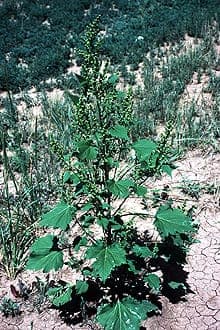
USDA-NRCS PLANTS Database / Public domain, via Wikimedia Commons
Giant marsh elder: complete guide
Cyclachaena xanthiifolia
Want to see Giant marsh elder: complete guide in your garden?
1 minute, no credit card
Overview
Giant marsh elder (Cyclachaena xanthiifolia), also known as giant sumpweed, false ragweed, tall marsh-elder, rag sumpweed and burrweed marsh-elder, is a robust annual herb in the family Asteraceae. Its native range spans a large part of Canada and the United States, from Alberta, Manitoba and Saskatchewan south through the Great Plains, the Midwest and into the western and eastern states as far as Virginia, South Carolina and Texas. The species was described by Fresenius in 1836 under its current name, with synonyms including the well-known Iva xanthiifolia and Euphrosyne xanthiifolia.
During the second half of the twentieth century, giant marsh elder arrived in Europe as an unintentional introduction, most likely via contaminated grain or animal feed. It has since established itself across central and eastern Europe, with confirmed populations in Germany, the Netherlands, Belgium, Austria, Poland, Hungary, Czechia, Romania, Ukraine and Great Britain. In several of these countries it appears on invasive species watchlists because of its wind-dispersed pollen, which can trigger hay fever and respiratory irritation in sensitive individuals.
This guide provides factual information about the plant's botany, habitat requirements and ecological significance. For advice on designing beautiful, responsible garden plantings with native species, visit gardenworld.app.
Appearance and bloom cycle
Cyclachaena xanthiifolia is a stout, erect annual growing 50-200 cm tall depending on soil fertility and moisture. The stems are firm, angular and heavily branched in the upper sections. The leaves are broadly ovate to triangular, roughly hairy on both surfaces, with a distinctly toothed margin. The leaf shape closely resembles that of certain xanthium species (cockleburs), which is reflected in the specific epithet xanthiifolia (xanthium-leaved).
The flowers are inconspicuous: small greenish to yellowish flower heads arranged in dense spike-like clusters arising from leaf axils and branch tips. Flowering occurs from August through October. The plant is entirely wind-pollinated and produces large quantities of lightweight pollen that can be dispersed over long distances. This pollen is a recognised allergen and can cause symptoms in people who are already sensitive to ragweed or grass pollen.
Ideal location
In its native range, giant marsh elder grows on moist, nutrient-rich soils along stream and river banks, lake shores, wetland margins and damp cultivated fields. In Europe it has adapted to a broader range of disturbed habitats: roadsides, railway sidings, brownfield sites, construction zones and waste ground. It is a classic ruderal pioneer that colonises heavily disturbed, open-ground locations.
As a garden plant this species is not recommended, but knowing where it naturally appears is useful: it favours sunny to semi-shaded positions with adequate moisture, fertile soil and minimal plant competition. It is not found on dry, nutrient-poor sandy soils. The presence of this plant typically signals high soil nitrogen levels.
Soil
Giant marsh elder has a strong preference for moist, nitrogen-rich, medium to heavy soil. In its native habitat it typically grows on clay and loam soils along rivers and on damp arable land. In Europe it tends to appear on anthropogenically enriched, disturbed soils in urban and peri-urban areas.
PH tolerance is wide, from slightly acid to neutral (5.5-7.5). Good water retention is more important than drainage; the plant tolerates temporarily waterlogged conditions well. On dry, infertile sandy soils the plant remains small and produces little biomass or seed.
Watering
Giant marsh elder is a moisture-loving plant that belongs naturally in wet or seasonally flooded habitats. In its optimum setting the soil remains regularly moist to wet, especially during germination and early growth from May to June. The plant has high water needs during the growing season; drought in July or August significantly limits its size and seed production.
In a garden situation, were someone to grow this plant for botanical study purposes, a moist to wet location with consistent rainfall or supplementary watering would be needed. Overhead watering increases the risk of powdery mildew on the foliage. In wet spells, no additional water input is required.
Free design
Want to see Giant marsh elder: complete guide in your garden? Make a free design now.
Pruning
As an annual, giant marsh elder does not require pruning in the conventional sense. Anyone wishing to manage or prevent the spread of this plant should remove the flower spikes as soon as they appear in August, before pollen is shed and before seeds develop. Remove dead plants in autumn and dispose of them via general waste rather than composting, to avoid spreading viable seeds.
Because of the allergenic pollen, protective measures when removing flowering plants are advisable: wear a dust mask and gloves. The most effective management strategy is to mow or cut plants before flowering - ideally before August - to prevent pollen dispersal entirely.
Maintenance calendar
April - May: Germination from the soil bank once temperatures rise above 10 degrees Celsius. Young seedlings are much easier to remove than established plants; intervention at this stage is most effective.
June - July: Rapid vegetative growth. The plant reaches its maximum height. Remove any unwanted plants before flowering begins.
August - September: Flowering period. Pollen production at its highest. Avoid disturbance that disperses pollen. Remove flower heads before seeds set.
October - November: Seed ripening and dispersal. Remove plants carefully including the seeds. Do not compost.
December - March: The plant overwinters as seed in the soil. Dormancy is influenced by temperature and moisture levels.
Winter hardiness
Giant marsh elder is an annual plant and does not overwinter as a living plant above ground. The aerial portions are killed by the first autumn frost. It is the seeds that survive the winter, sometimes remaining viable in the soil seed bank for several years, and germinating each spring once soil temperatures rise sufficiently. This persistent seed bank is what makes the plant so difficult to eradicate from established sites.
In USDA zones 3-8 (covering its entire native and introduced range) it is a reliable annual that re-establishes each year. In warmer climates the germination window extends further. The frost sensitivity of the above-ground plant offers no practical winter-kill management opportunity; managing seed production is the key to long-term control.
Companion plants
In the wild, giant marsh elder is typically found alongside other ruderal or waterside species: fat hen (Chenopodium album), stinging nettle (Urtica dioica), common ragwort, creeping thistle (Cirsium arvense) and, in North America, ragweed species (Ambrosia artemisiifolia), with which it shares the burden of allergenic airborne pollen. In Europe it colonises the same disturbed ground as burdock (Arctium) and mugwort (Artemisia vulgaris).
From a garden design perspective, it is strongly advisable to choose native alternatives for wet, open garden positions. Excellent native wetland plants include water forget-me-not (Myosotis scorpioides), purple loosestrife (Lythrum salicaria) and yellow flag iris (Iris pseudacorus). These provide ecological benefits and visual appeal without the allergy risks. If you want advice on responsible native planting schemes for your front garden, gardenworld.app offers tailored design guidance.
Closing thoughts
Giant marsh elder is botanically interesting as a fast-colonising pioneer with a remarkable transcontinental spread, but it is not a desirable garden plant. Its allergenic pollen, vigorous spreading habit and invasive status in Europe make it a plant to manage rather than cultivate. Understanding what it looks like, where it thrives and how to remove it before it sets seed is the most practical knowledge a European gardener can have about this species.
For inspiration on how a garden can look beautiful, ecologically sound and responsibly planted - with native and thoughtfully chosen species - visit gardenworld.app for professional garden design advice.
Want to see Giant marsh elder: complete guide in your garden? Make a free design now.
Upload a photo, pick a style, and get a photorealistic design with plant list in under a minute.
10,000+ gardens designed already
No credit card required


Similar plants
Calendula stellata: complete guide
Calendula stellata
Complete guide to Calendula stellata, the star-flowered marigold from Sicily: location, soil, watering and companion planting tips.
Korean chrysanthemum: complete guide
Chrysanthemum x rubellum
Chrysanthemum x rubellum is a hardy autumn perennial with single pink to copper flowers from August to November. Care and combinations.
Helianthus divaricatus: complete guide
Helianthus divaricatus
Helianthus divaricatus is a North American woodland sunflower with yellow summer blooms, ideal for naturalistic borders and shady edges.