
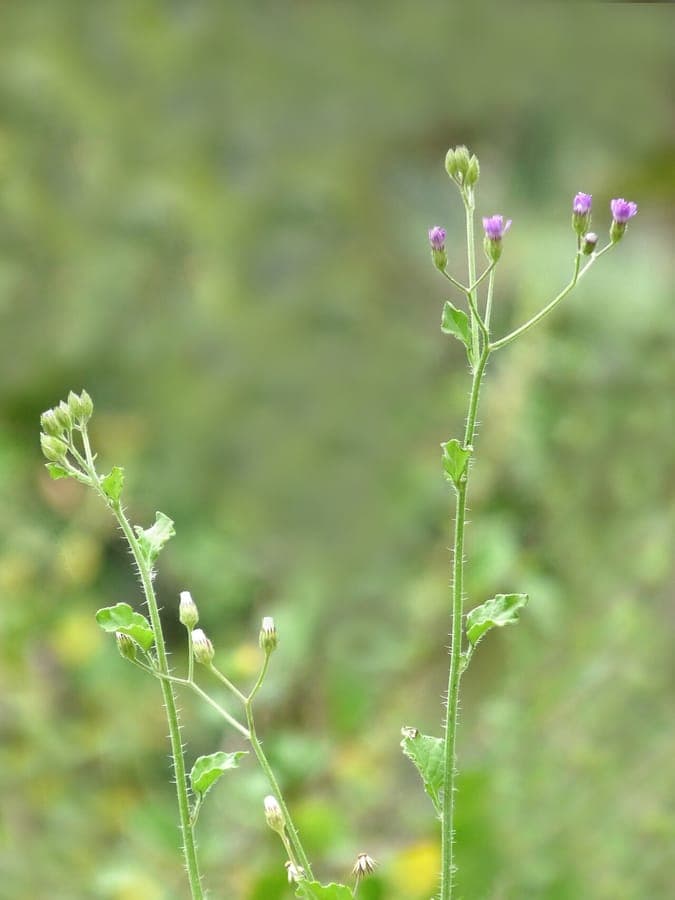
Jeevan Jose, Kerala, India / CC BY-SA 4.0, via Wikimedia Commons
Little ironweed: complete guide
Cyanthillium cinereum
Want to see Little ironweed: complete guide in your garden?
1 minute, no credit card
Overview
Little ironweed (Cyanthillium cinereum), formerly classified under the genus Vernonia, is a slender, cheerful member of the daisy family (Asteraceae) native to tropical and subtropical regions spanning Africa, South and Southeast Asia, Japan, the Pacific Islands and Australia. Its range extends from India and Bangladesh eastward to Japan, from the Andaman Islands to Cape Verde, and from Queensland to Hawaii, with introduced populations across the Americas and parts of Europe. In French-speaking regions it goes by the names vingt-quatre-heures and radie albumine; in German, Graue Vernonie.
In its native range, little ironweed thrives as a pioneer plant on disturbed ground, roadsides and cultivated fields. For gardeners in temperate climates it makes a delightful summer annual or container plant, producing clusters of small, bright purple flowers from June until frost. The blooms are magnets for bees, butterflies and other pollinators. You can find inspiration for pollinator-friendly summer borders featuring plants like this one at gardenworld.app.
The species was reclassified into the genus Cyanthillium by Harold Robinson in 1990. The epithet cinereum (Latin for ashen) refers to the grey, softly hairy underside of the leaves, a feature that also gave rise to the German name Graue Vernonie.
Appearance and bloom cycle
Little ironweed is an upright, branching herbaceous plant reaching 30-100 cm in height depending on conditions. The stems are lightly hairy, greyish-green to pale green, firm and well-branched. The leaves are oblong to ovate, mid-green on the upper surface, softly grey-hairy beneath, and have a lightly toothed margin. They give off a faint herbal scent when rubbed.
The flowers are purple to lilac-pink, composed entirely of disc florets in small heads (capitula) 1-1.5 cm across, gathered into loose, terminal clusters. Blooming runs from June through October in temperate gardens given sufficient warmth. After flowering, the seeds develop a small feathery pappus similar to a thistle or dandelion, aiding wind dispersal. In truly tropical climates the plant flowers nearly year-round; in cooler zones blooming concentrates in the warmest months.
Ideal location
This plant demands full sun and warmth. A position receiving at least six to eight hours of direct sunlight per day is ideal. In the wild it colonises open, often disturbed ground in subtropical and tropical settings. In cooler climates it does best in a sheltered, south-facing spot, perhaps against a warm wall or in a sun-trap corner where daytime heat accumulates.
Little ironweed is very well suited to containers on a terrace or balcony, where it can be moved to shelter before autumn cold arrives. In a border it fits naturally into a warm-season planting scheme alongside other heat-loving annuals and tender perennials. Cool, wet weather suppresses flowering; choosing the warmest available microclimate in the garden is the key to good performance.
Soil
Cyanthillium cinereum is not demanding about soil, which explains its success as a pioneer plant across diverse landscapes. It tolerates poor, dry, freely draining soil, though it also performs well in average garden loam. A slightly acid to neutral pH (5.5-7.0) suits it best. Heavy, waterlogged clay is unsuitable; amend clay soils with coarse sand or perlite to improve drainage before planting.
For containers, use a quality potting mix blended with extra coarse sand or perlite at roughly a 3:1 ratio to ensure free drainage. Always use pots with adequate drainage holes. Feeding is rarely necessary on moderately fertile soil; on very poor ground, a monthly liquid fertiliser formulated for flowering plants can be applied from May through August. Excessive feeding produces lush foliage at the expense of flowers.
Free design
Want to see Little ironweed: complete guide in your garden? Make a free design now.
Watering
Once established, little ironweed has modest water needs. Allow the soil to dry out slightly between waterings rather than keeping it constantly wet. Water at the base of the plant rather than wetting the leaves, which can encourage fungal problems in cool or humid spells. Water young plants more regularly until they are established, then ease off.
In containers, compost dries out faster than open ground. Check the top centimetre of compost every two to three days during hot weather and water when it feels dry. Overwatering causes yellowing leaves and root rot. During rainy periods, supplementary watering is generally unnecessary if drainage is adequate.
Pruning
Light trimming encourages bushier, more floriferous growth. Pinch out the tips of young stems early in the season or when the plant starts to become leggy. This stimulates lateral shoots and produces a more compact, flower-covered habit. Removing spent flowerheads (deadheading) after each flush of blooms encourages repeat flowering and keeps the plant looking tidy.
In frost-free climates, or indoors, little ironweed can survive winter as a short-lived perennial. Cut it back to a framework of sturdy stems in spring. In the UK and northern Europe it is invariably lost to the first frost and is best treated as an annual, with fresh plants raised from seed each spring.
Maintenance calendar
March - April: Sow seed in trays at 20-25 degrees Celsius, or purchase young plants from garden centres. Keep compost lightly moist until germination.
May: Plant out after the last frost date. Water in gently until established.
June - August: Active growing and flowering. Deadhead regularly. Water during dry spells. Apply liquid feed once a month if needed on poor soil.
September - October: Flowering continues in warm weather. Seeds ripen; collect for the following year. Bring container plants inside when night temperatures drop below 10 degrees Celsius.
November - February: The plant cannot survive frost outdoors. In heated rooms it can be overwintered as a houseplant with minimal watering and good light.
Winter hardiness
Little ironweed is not frost-hardy in northern European climates. Outdoors it will perish at temperatures below zero. In USDA zones 9-11 it behaves as a perennial or self-seeding plant that remains outdoors year-round. In zones 7-8 (including most of the UK and northern mainland Europe) it is treated as an annual or overwintered as a container plant brought indoors before the first frost.
Seeds, however, survive readily when stored dry indoors over winter. Collect ripe seed heads in autumn, allow them to dry fully, then store in a paper envelope in a cool, dry, dark place. Seed viability typically lasts two to three years. This makes it simple to restock the garden from your own saved seed each spring.
Companion plants
Little ironweed pairs well with other warm-season, sun-loving plants. Beautiful combinations include ageratum, low-growing zinnias, cosmos and portulaca. In a pollinator garden it works brilliantly beside butterfly bush (Buddleja davidii), verbena and lantana. The purple flower colour contrasts attractively with yellow (Rudbeckia, Helenium) or white (Leucanthemum, white ageratum) neighbours.
Throughout its long flowering period the plant draws impressive numbers of butterflies, bees and hoverflies, making it a standout choice for a wildlife-friendly summer planting. Source plants or seed from specialist nurseries or look for them in the annual and exotic summer-flowering displays at larger garden centres during May and June.
In a mixed border, its airy flowering stems create a pleasing contrast with bold-textured companions such as ornamental grasses or Pennisetum. The fine, feathery quality of the blooms adds lightness to what might otherwise be a heavy planting.
Closing thoughts
Little ironweed is a charming, underrated summer performer for any warm, sunny spot in the garden. Its long blooming period, exceptional appeal to pollinators and undemanding cultivation make it a worthwhile addition to borders, containers and wildlife gardens. Treat it as an annual, sow fresh each spring, and enjoy months of delicate purple flowers. Visit gardenworld.app for more ideas on designing colourful, pollinator-rich summer planting schemes for your front garden.
Want to see Little ironweed: complete guide in your garden? Make a free design now.
Upload a photo, pick a style, and get a photorealistic design with plant list in under a minute.
10,000+ gardens designed already
No credit card required


Similar plants
Calendula stellata: complete guide
Calendula stellata
Complete guide to Calendula stellata, the star-flowered marigold from Sicily: location, soil, watering and companion planting tips.
Korean chrysanthemum: complete guide
Chrysanthemum x rubellum
Chrysanthemum x rubellum is a hardy autumn perennial with single pink to copper flowers from August to November. Care and combinations.
Helianthus divaricatus: complete guide
Helianthus divaricatus
Helianthus divaricatus is a North American woodland sunflower with yellow summer blooms, ideal for naturalistic borders and shady edges.