
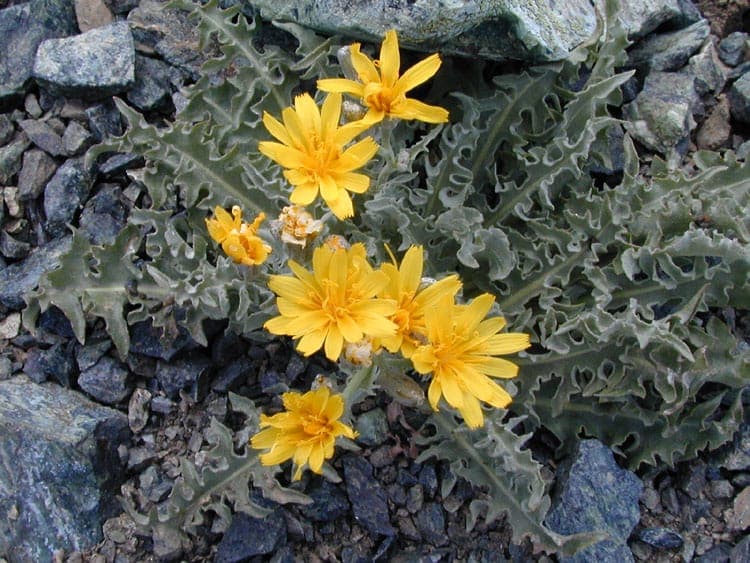
Dianne Fristrom / CC BY-SA 3.0, via Wikimedia Commons
Crepis occidentalis: complete guide
Crepis occidentalis
Want to see Crepis occidentalis: complete guide in your garden?
1 minute, no credit card
Overview
Crepis occidentalis, commonly called western hawk's-beard or grey hawksbeard, is a perennial forb belonging to the daisy family (Asteraceae) and native to western North America. It was formally described by the botanist Thomas Nuttall in 1834, and its natural range encompasses an impressively wide swath of territory: from the Canadian provinces of Alberta and Saskatchewan in the north, south through Washington, Oregon, Idaho, Montana, Wyoming, Colorado, Nevada, Utah and California, reaching as far as Arizona and New Mexico. Throughout this distribution the species colonises open, stony hillsides, sagebrush flats, rocky roadsides and high-elevation meadows - sometimes above 2,000 metres.
Despite its wide natural footprint, Crepis occidentalis remains a relatively little-known garden plant outside enthusiast circles focused on native plantings and dry-climate garden design. That is a genuine oversight. The plant is highly adaptable, reliably drought tolerant once established, and produces a generous flush of bright yellow composite flowers that give the garden a cheerful, naturalistic quality throughout late spring and early summer. If you are planning a dry border or gravel garden, gardenworld.app is a useful tool for visualising how this species combines with companion plants before you commit to planting.
Appearance and bloom cycle
Crepis occidentalis forms a low rosette of deeply lobed, greyish-green leaves that are noticeably hairy on both surfaces - the characteristic that gives rise to its common name 'grey hawksbeard'. Basal leaves typically reach 15 to 30 cm in length, while stem leaves are progressively smaller and clasping. The leaf texture is described botanically as coarse, and when you handle the plant the glandular hairs are easily felt. The overall growth form is described as a single crown, meaning it clumps outward from one central root point rather than spreading by stolons.
Flowering occurs mainly from May through July. Branched stems rise 20 to 50 cm above the leaf rosette, each carrying multiple yellow flower heads (capitula) roughly 1 to 2 cm in diameter. Like all Crepis species, the flowers are composed entirely of ligulate (ray) florets - there are no disc florets - giving each head a clean, dandelion-like appearance. The flowers open fully in sunny weather and are attractive to bees, hoverflies and butterflies. After pollination the heads develop small achenes (seeds) topped with a white pappus, which the wind disperses much like dandelion seeds. Fruit colour is brown at maturity.
Growth rate is described as moderate, meaning the plant establishes steadily over two to three seasons and does not become invasive. Self-seeding may occur in suitable conditions, but the seedlings are easy to manage.
Ideal location
Full sun is strongly preferred. In its native range Crepis occidentalis grows on open, exposed slopes with minimal shade, and it rewards these conditions with its best flowering. A minimum of six to eight hours of direct sun daily is the target; partial shade will be tolerated but tends to produce laxer growth and fewer flowers.
The plant is an excellent candidate for rock gardens, gravel beds, dry prairie-style borders, raised beds and sunny slopes where drainage is sharp. It also performs well in planting pockets between paving stones on sun-drenched terraces. Recommended spacing in a mixed planting is 30 to 45 cm between plants. In smaller gardens, group three plants together for a naturalistic cluster effect that reads well against low ornamental grasses or other fine-textured plants.
Wind exposure is not a problem for an established specimen - the low rosette and wiry flower stems are reasonably resistant to lodging. However, very young transplants benefit from some shelter during their first winter to prevent root heave.
Soil requirements
Well-drained, moderately infertile soil is the key requirement. The species tolerates a broad pH range from 5.7 to 7.5, meaning it is equally at home on mildly acidic sandy soils and on slightly alkaline, calcium-rich substrates. Heavy clay soils that remain waterlogged are unsuitable and will cause root rot within a season or two.
For garden preparation, incorporate 20 to 30% coarse horticultural grit or sharp sand into clay-heavy borders before planting. A depth of 30 cm is sufficient for root establishment. On naturally sandy or stony soils no significant amendment is needed - just ensure the planting position does not collect standing water after rain.
Fertility requirements are low. An annual top-dressing of a balanced slow-release granular fertiliser (5-5-5 NPK) in early spring is more than adequate. Avoid high-nitrogen products, which encourage excessive leaf growth at the expense of flowering. On very poor, gravelly soils a modest application of well-composted garden compost worked lightly into the planting hole will help establishment without making conditions too rich.
Watering
Once established, Crepis occidentalis needs very little supplemental irrigation. Its deep taproot system allows it to access soil moisture far below the surface, making it genuinely drought tolerant rather than merely drought resistant. In its native semi-arid environments it routinely endures months of summer drought without irrigation.
During the first growing season after planting, water regularly - approximately once per week in dry weather, providing enough to wet the soil to a depth of 15 to 20 cm. After year one, reduce irrigation significantly. In a typical temperate garden climate, natural rainfall will supply most of what is needed from spring through autumn. Reserve supplemental watering for extended dry spells of three or more weeks in midsummer.
Overwatering is a more common cause of failure than underwatering with this species. Soggy soil promotes collar rot and fungal problems at the base of the leaf rosette. The standard finger test applies: push a finger 5 cm into the soil - if it feels moist, wait before watering.
Free design
Want to see Crepis occidentalis: complete guide in your garden? Make a free design now.
Pruning
Dead-head spent flowering stems as they finish blooming to maintain a neat appearance and potentially encourage a secondary flush of flowers in late summer. Cut stems cleanly at their base with sharp secateurs. This is most important for plants carrying multiple flowering stems between June and August.
The basal leaf rosette requires minimal intervention. Remove brown, frost-damaged or dead leaves at the start of the growing season in late March or early April, cutting back to the base of each leaf. Avoid cutting into the crown itself, as the growing point is easily damaged. At the end of the season, leave the rosette largely intact rather than cutting it to the ground - the remaining foliage protects the crown from freeze-thaw cycles through winter.
A general tidy-up in late August, cutting spent stems to 5 cm above soil level, keeps the plant attractive without removing the protective leaf mass. Clean your tools between plants to avoid spreading any fungal diseases.
Maintenance calendar
February–March: Remove dead leaf litter from the rosette. Apply a light dressing of balanced granular fertiliser around (not on) the crown. Check for slug damage on emerging young leaves in mild, damp spells.
April–May: Growth accelerates. Keep the surrounding area free of competing weeds. A 3 to 5 cm layer of fine gravel mulch helps retain moisture and suppresses weeds without smothering the crown.
June–July: Peak flowering. Enjoy the golden flower heads. Remove spent stems promptly if a second flush is desired. Water only if the plant shows signs of stress in prolonged drought.
August–September: Possible secondary flowering after dead-heading. Allow a few heads to set seed if self-sown seedlings are welcome. Tidy the plant at the end of August.
October–November: Remove fully dead foliage but keep the rosette intact. A light topdressing of fine grit around the crown aids winter drainage.
December–January: Dormancy. No action needed. Check for frost heave after freeze-thaw cycles and firm in any lifted plants.
Winter hardiness
Crepis occidentalis is reliably cold-hardy, tolerating temperatures down to approximately -20°C (USDA hardiness zone 4). In its native range across the Rocky Mountain foothills and high plains, it routinely experiences severe continental winters with prolonged subzero temperatures and heavy snow. Snow cover actually protects the dormant rosette - problems arise not from cold itself but from excessive winter wet at the crown.
In temperate European gardens the plant is virtually frost-proof if drainage is adequate. The combination of wet soil and hard frost causes crown rot more reliably than bare frost alone. Raised beds, gravel gardens and sloping sites naturally provide the drainage that keeps plants in good condition over winter.
Newly planted specimens in their first winter may benefit from a light covering of coarse grit over the crown to protect against frost heave. Container-grown plants should be kept drier and placed in an unheated but frost-sheltered spot such as a cold greenhouse or garage during the coldest months.
Companion plants
Crepis occidentalis fits beautifully into any dry, sunny planting scheme alongside other drought-tolerant perennials. Strong partners include Salvia nemorosa 'Caradonna' (upright violet spikes, May–July), Achillea millefolium 'Paprika' (warm red yarrow fading to gold), Echinacea purpurea 'Magnus' (purple coneflower, July–September) and Stipa tenuissima (feather grass). These plants share the same cultural requirements and create a planting that reads naturally rather than contrived.
For contrast in form and foliage, try pairing Crepis occidentalis with Sedum telephium 'Autumn Joy', whose thick, blue-green leaves and flat pink-red heads in late summer provide an excellent foil for the looser, yellow-flowered Crepis. Lavandula angustifolia 'Hidcote' (lavender) is another natural companion on alkaline soils, offering aromatic foliage and purple flowers that complement the yellow composites perfectly.
On a practical level, gardenworld.app allows you to plan the full colour palette and flowering sequence of a border in advance, making it easy to select the right combination of species and verify that the display is attractive across all seasons before a single plant is purchased. For those designing a North American prairie-style border, native companions such as Penstemon pinifolius (pineleaf penstemon) and Eriogonum umbellatum (sulphur flower buckwheat) create a coherent regional planting with excellent ecological value for pollinators.
Closing thoughts
Crepis occidentalis rewards the gardener who is prepared to leave it largely to its own devices. It asks for a sunny, free-draining spot, minimal water once established, and occasional tidying after it blooms - nothing more. In return it delivers cheerful golden flowers from May to July and an unobtrusive, tidy rosette for the rest of the year. In an era of increasing summer drought and rising interest in low-maintenance native plantings, this western hawk's-beard deserves far wider cultivation than it currently receives. Look for it at specialist native plant nurseries and wildflower garden centres - or simply try raising it from seed, where it germinates readily at 15 to 18°C with no pre-treatment required.
Want to see Crepis occidentalis: complete guide in your garden? Make a free design now.
Upload a photo, pick a style, and get a photorealistic design with plant list in under a minute.
10,000+ gardens designed already
No credit card required


Similar plants
Calendula stellata: complete guide
Calendula stellata
Complete guide to Calendula stellata, the star-flowered marigold from Sicily: location, soil, watering and companion planting tips.
Korean chrysanthemum: complete guide
Chrysanthemum x rubellum
Chrysanthemum x rubellum is a hardy autumn perennial with single pink to copper flowers from August to November. Care and combinations.
Helianthus divaricatus: complete guide
Helianthus divaricatus
Helianthus divaricatus is a North American woodland sunflower with yellow summer blooms, ideal for naturalistic borders and shady edges.