
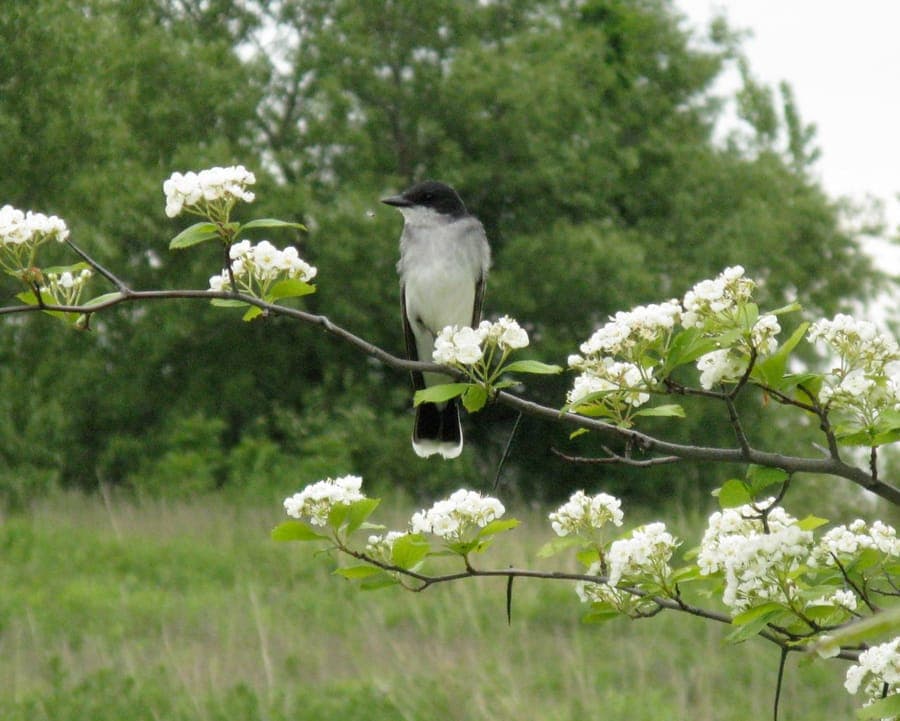
Nadiatalent / Public domain, via Wikimedia Commons
Crataegus succulenta: complete guide
Crataegus succulenta
Want to see Crataegus succulenta: complete guide in your garden?
1 minute, no credit card
Overview
The Succulent Hawthorn (Crataegus succulenta) is a North American hawthorn from the Rosaceae family. This shrub is renowned for its large, fleshy red berries, elegant white flowers, and value to birds. This plant distinguishes itself through exceptionally large fruits compared to other hawthorns.
The Succulent Hawthorn is ideal for gardeners seeking a robust, low-maintenance plant with valuable bird food and decorative berries.
Appearance and bloom
The Succulent Hawthorn grows as a moderately vigorous shrub to small tree with a broad, spreading form. The plant typically reaches 5-8 meters in height with an equivalent spread. The branches are stiff and equipped with thorns of 1-2 centimeters.
The leaves are doubly serrated, deep green, and have subtle texture. In spring (May-June), clusters of small white to light pink flowers appear. These flowers are highly attractive to pollinators.
Following flowering, large round fruits develop, initially green in color. These fruits are notably large - up to 1.5 centimeters diameter - and ripen by September-October to a bright, glossy red. The fleshy texture provides substantial nutritional value for birds.
Autumn color is attractive, with foliage turning red to orange.
Free design
Want to see Crataegus succulenta: complete guide in your garden? Make a free design now.
Ideal location
The Succulent Hawthorn thrives in full sun to partially shaded locations. The plant accepts diverse growing conditions and is highly tolerant of difficult sites.
Use this hawthorn for hedging, as a solitary accent, or in bird gardens. The large berries make it particularly valuable for winter feeding.
Soil
The Succulent Hawthorn is highly tolerant of soil types. The plant grows well in both acidic and neutral soils. The plant is highly suitable for poor soils and dry situations.
Watering
Once established, the Succulent Hawthorn is highly drought-tolerant. Minimal supplemental watering needed in normal weather situations.
Pruning
The Succulent Hawthorn tolerates pruning well. Minimal pruning needed because the plant naturally grows in an attractive form.
Maintenance calendar
March-April: Check for winter damage. May-June: White flowers appear in clusters. Minimal maintenance. July-August: Fruits form and turn green. September-October: Fruits ripen to bright red. Birds visit. November-December: Fruits persist, valuable winter food. January-February: Rest period.
Winter hardiness
The Succulent Hawthorn is very winter hardy and can withstand temperatures down to -25 degrees Celsius.
Companion plants
Combine with other hawthorns and shrubs for diverse bird habitat landscapes.
Conclusion
The Succulent Hawthorn is an exceptionally valuable hawthorn species for bird gardens. Plants are available from most garden centers and nurseries.
Want to see Crataegus succulenta: complete guide in your garden? Make a free design now.
Upload a photo, pick a style, and get a photorealistic design with plant list in under a minute.
No credit card required


Similar plants
Siberian crab apple: complete guide
Malus x robusta
Complete guide to the Siberian crab apple (Malus x robusta): location, soil, pruning, winter hardiness and the best companion plants for your garden.
Chinese flowering crabapple (Malus x spectabilis): complete guide
Malus x spectabilis
Meet the Chinese flowering crabapple (Malus x spectabilis): a classic spring bloomer with carmine buds and pink blossom.
Potentilla crassinervia: complete guide
Potentilla crassinervia
Potentilla crassinervia, the Corsican cinquefoil, grows wild on Corsica and Sardinia's peaks. Discover how to grow this hardy alpine rock garden gem.