
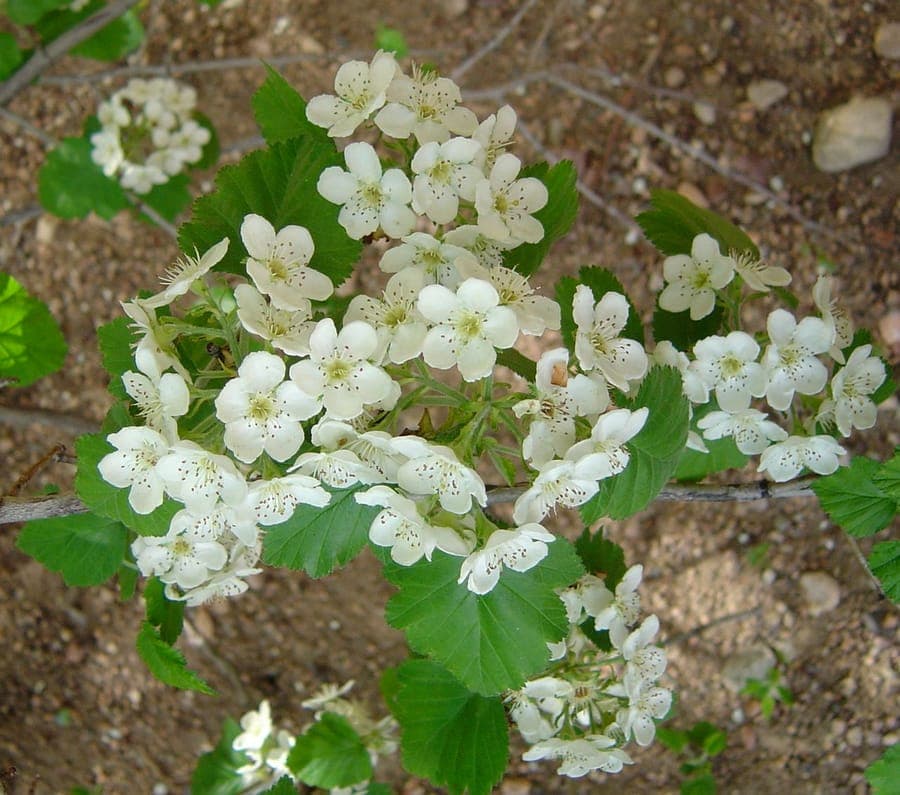
Nadiatalent / Public domain, via Wikimedia Commons
Crataegus mollis: complete guide
Crataegus mollis
Want to see Crataegus mollis: complete guide in your garden?
1 minute, no credit card
Overview
The Arnold Hawthorn (Crataegus mollis) is a showy North American shrub from the Rosaceae family. This plant is renowned for its abundant pink flowers in spring, large red fruits in autumn, and excellent hedging capability. Originally from central and eastern North America, this plant is ideal for gardeners seeking both ecological benefits and visual beauty.
The Arnold Hawthorn perfectly combines the practical aspects of hedging with attractive ornamental qualities. From its pink spring flowers to its red autumn berries, this shrub offers year-round interest.
Appearance and bloom
The Arnold Hawthorn grows as a densely branched shrub with a broad, rounded form. The plant typically reaches 4-6 meters in height with an equivalent spread. The branches are equipped with fine thorns of 2-3 centimeters length, making this plant highly suitable for defensive hedges.
The leaves are deep green and have a velvety texture from which the name is derived. In spring (May-June), abundant clusters of pink to white flowers appear. These flowers are very full and showy, attractive to bees and other pollinators.
Following flowering, large round fruits develop, initially green in color. By September and October, these fruits ripen to a bright red. These fruits are larger than those of many other hawthorns and highly attractive to birds.
Autumn color is spectacular, with foliage turning yellow to red. The red berries persist long on the branches, providing food through winter.
Ideal location
The Arnold Hawthorn thrives in full sun locations, though the plant also tolerates partial shade reasonably well. Ensure the plant receives at least 4-5 hours of direct sunlight daily for optimal flowering and fruit production.
This hawthorn is flexible regarding growing conditions and tolerates moist to normal soils well. The plant is highly suitable for rural gardens, estates, and wildlife habitat parks.
Use this hawthorn for hedging, defensive borders, and wildlife gardens. The large fruits make it particularly valuable for wildlife support.
Free design
Want to see Crataegus mollis: complete guide in your garden? Make a free design now.
Soil
The Arnold Hawthorn is not fussy about soil type. The plant grows well in both acidic and neutral soils, tolerating a pH range of approximately 5.5 to 7.5.
Ideal is moist soil that drains well. Add plenty of organic material at planting time in the form of compost. This improves water retention and nutrient supply.
The plant tolerates poor soils well and is therefore suitable for less demanding garden locations. Mulch around the plant to maintain soil moisture.
Watering
During the first year after planting, regular watering is important to establish a strong root system. Water the plant preferably 2-3 times weekly, especially during dry periods.
Once established, watering can be reduced. The Arnold Hawthorn is drought-tolerant and can manage in normal weather without supplemental watering. During extremely dry periods, however, additional watering may benefit flowering.
Monitor soil moisture during the growing season.
Pruning
The Arnold Hawthorn tolerates pruning well and naturally forms dense hedges. For formal hedges, prune from June to August. For more natural forms, minimal pruning.
Remove dead wood each spring. The thorns provide a natural defensive hedge.
Maintenance calendar
March-April: Check for winter damage. Add compost around the base. May-June: Plant grows vigorously, abundant pink flowers. Adjust water. Prune for hedge forming. July-August: Fruits form and turn green. Prune for hedge forming. September-October: Fruits ripen to bright red. Birds visit abundantly. November-December: Plant goes dormant. Red berries remain visible. January-February: Rest period. Damaged branches can now be better removed.
Winter hardiness
The Arnold Hawthorn is very winter hardy and can withstand temperatures down to -25 degrees Celsius.
Companion plants
Combine well with other hawthorns, Viburnum, and Sambucus for diverse wildlife habitat hedges.
Conclusion
The Arnold Hawthorn is an exceptional hawthorn that combines beauty with practical benefits. Plants are available from most garden centers and nurseries.
Want to see Crataegus mollis: complete guide in your garden? Make a free design now.
Upload a photo, pick a style, and get a photorealistic design with plant list in under a minute.
No credit card required


Similar plants
Siberian crab apple: complete guide
Malus x robusta
Complete guide to the Siberian crab apple (Malus x robusta): location, soil, pruning, winter hardiness and the best companion plants for your garden.
Chinese flowering crabapple (Malus x spectabilis): complete guide
Malus x spectabilis
Meet the Chinese flowering crabapple (Malus x spectabilis): a classic spring bloomer with carmine buds and pink blossom.
Potentilla crassinervia: complete guide
Potentilla crassinervia
Potentilla crassinervia, the Corsican cinquefoil, grows wild on Corsica and Sardinia's peaks. Discover how to grow this hardy alpine rock garden gem.