
Nadiatalent / Public domain, via Wikimedia Commons
Large-thorn hawthorn: complete guide
Crataegus macracantha
Want to see Large-thorn hawthorn: complete guide in your garden?
1 minute, no credit card
Overview
Crataegus macracantha, commonly called the large-thorn hawthorn or long-spined hawthorn, is a robust, multi-stemmed shrub or small tree in the rose family (Rosaceae). Described scientifically in 1838 by Loddiges and Loudon, it grows natively across a wide sweep of North America, from the Canadian provinces of Alberta, British Columbia, Manitoba, Ontario, Quebec and Saskatchewan south through the Great Plains, Midwest and northeastern United States. Gardeners and landscape designers looking for a four-season structural plant with ecological value will find it an outstanding choice for gardens of all sizes.
The species name macracantha translates directly as large-thorned, and the plant lives up to that name. Its thorns can reach 7 cm in length, making it one of the most formidably armed hawthorns available. This same quality makes it an excellent security hedge, effectively impassable to animals and people once established. In the wild it colonises woodland edges, riverbanks and open rocky slopes, but it transitions well into formal or informal garden settings where its seasonal transformations - spring blossom, summer foliage, autumn berries and winter silhouette - provide year-round interest.
If you are planning a front garden makeover and want to understand how a large structural shrub like this fits into your overall planting scheme, gardenworld.app provides visualisation tools that can help you see the finished result before you plant a single root. The large-thorn hawthorn is also one of the best wildlife shrubs available: its flowers attract bees, bumblebees and hoverflies in May and June, while its dense, thorny branches provide safe nesting sites for small birds and its berries feed thrushes, blackbirds, fieldfares and redwings throughout autumn and winter.
Appearance and bloom cycle
Mature large-thorn hawthorn plants grow into broad, multi-stemmed shrubs or small trees between 400 and 600 cm tall and roughly as wide. Growth rate is moderate, averaging 20 to 40 cm per year under good conditions. The branching is dense and irregular, with numerous thorns up to 7 cm long projecting from the stems at various angles. In winter, when the plant is leafless, the silhouette of pale grey-brown branches studded with long, dark thorns creates a striking architectural feature.
Leaves emerge in early April, starting bright lime-green before deepening to a rich, glossy dark green by midsummer. Each leaf is broadly egg-shaped to inversely egg-shaped, with moderately deep lobes along the margins and a smooth to slightly hairy underside. Autumn colour ranges from orange-red to deep burgundy before leaf fall in late October or November.
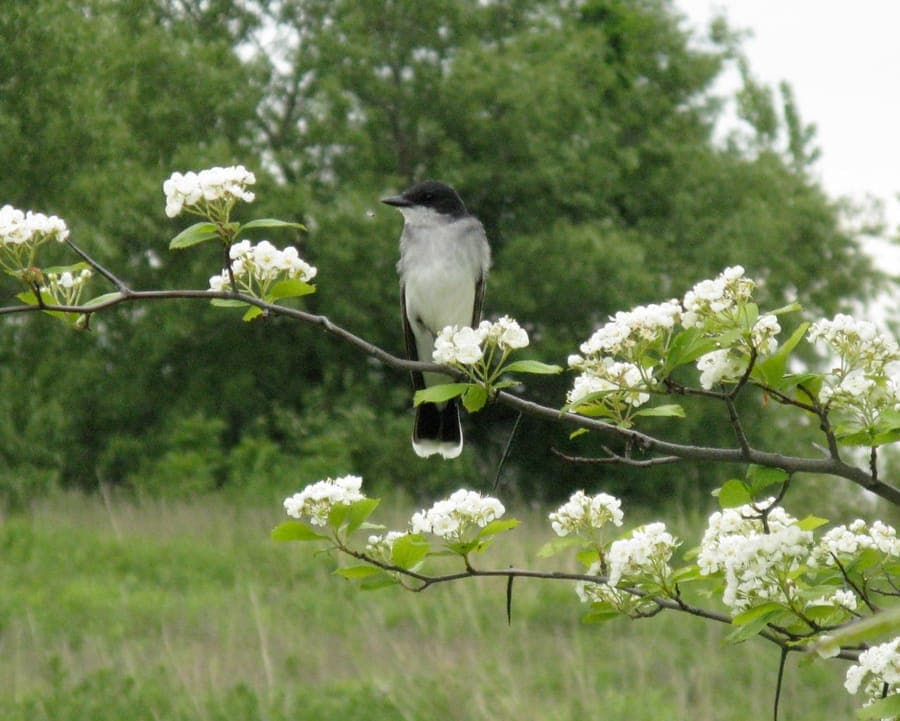
Flowering begins in May and extends into early June, with the entire crown covered in flat-topped clusters of white five-petalled flowers. Each flower is about 1.5 cm in diameter, with prominent yellow-tipped stamens that give the clusters a creamy, almost frothy appearance at close range. The scent is delicately sweet with a slightly pungent undertone. Fruits develop through summer and ripen to bright or deep red by September and October. Each berry-like pome is about 1 cm in diameter, containing three to five hard seeds. They are not particularly palatable raw but are used in preserves and infusions in parts of North America.
Ideal location
Full sun to partial shade suits the large-thorn hawthorn well. In full sun the flowering and fruiting are most spectacular, and the plant develops the densest, most impenetrable structure. Partial shade - up to four hours of shade per day - is tolerated without major problems, though flowering density may be reduced. A south- or west-facing position in temperate gardens makes the most of available light.
This species is exceptionally wind-tolerant and can be planted in fully exposed positions, making it an ideal shelterbelt or field boundary plant. Urban conditions, including air pollution, compacted soils and reflected heat from buildings, are handled with ease. Because of its extreme cold hardiness (see below), it can be used across almost the entire United Kingdom, Ireland, the Netherlands, Belgium and Germany without concern about winter damage.
For hedging purposes, space plants 60 to 100 cm apart. For a specimen tree or large feature shrub, allow at least 300 cm in all directions to give the crown room to develop its full spread. Planted against a fence or wall it can be trained as an espaliered screen, though this requires regular attention to maintain a neat shape.
Soil requirements
Crataegus macracantha tolerates an unusually wide range of soils, which is one of its key practical advantages. It grows well in loam, clay, sandy and stony soils. The preferred pH range is 4.8 to 7.5, accommodating both lightly acidic and lightly alkaline conditions. It will cope with temporarily waterlogged clay soils but does not appreciate permanently wet ground, which can lead to root rot over time.
For best results, prepare the planting pit to a depth and width of at least 50 cm, breaking up any compaction and incorporating a generous bucket of well-rotted garden compost or leaf mould. In sandy soils, the addition of compost helps water retention. In heavy clay, mixing in coarse horticultural grit (about 20% by volume) improves drainage without making the soil excessively dry.
Fertilisation is rarely needed on average garden soils. On very poor sandy or gravelly ground, apply a top-dressing of well-rotted compost in early spring. Avoid nitrogen-heavy feeds, which promote leafy growth at the expense of flowers and berries. A balanced slow-release granular fertiliser in spring every two to three years is sufficient to maintain vigour on impoverished soils.
Free design
Want to see Large-thorn hawthorn: complete guide in your garden? Make a free design now.
Watering
During the first growing season after planting, water deeply twice a week during dry spells, particularly when temperatures exceed 20 °C. This encourages the roots to explore deeply into the soil profile, which is key to establishing a drought-tolerant plant. Once a plant has been in the ground for two full growing seasons it rarely needs supplemental watering under normal rainfall conditions in western Europe.
Mature plants can endure dry spells of two to three weeks without visible stress. During prolonged drought - more than four weeks with little or no rain - give the plant a thorough, slow soak at the root zone to avoid leaf scorch and reduced flowering the following year. Avoid shallow, frequent watering, which encourages surface roots and reduces long-term drought tolerance.
A mulch layer of 5 to 8 cm of composted bark, wood chips or straw laid around the base of the plant (but not touching the trunk) conserves soil moisture, regulates soil temperature and suppresses competing weeds, particularly in the first two years after planting.
Pruning
In most garden situations, the large-thorn hawthorn needs only minimal pruning. Remove dead, diseased or crossing branches during late winter dormancy - from mid-February to early March is ideal in the UK and northern Europe - before new growth begins. Always use thick leather gloves and a sharp pair of loppers or pruning shears, as the thorns are hard and pointed enough to cause significant injury.
For formal or informal hedges, light trimming once a year after flowering (June) or in late summer (August) maintains shape without sacrificing too much of the following year's fruit production. Never remove more than one-third of the year's growth in a single pruning session, as hard cutting back stimulates soft, vigorous, thorn-poor regrowth that is more susceptible to disease.
When grown as a specimen shrub or small tree, restrict intervention to the removal of inward-growing or crossing branches to improve airflow and reduce the risk of powdery mildew. Standard or half-standard training is possible but requires consistent formative pruning over several years to build a clean trunk and balanced crown. Garden centres across the UK regularly stock Crataegus macracantha as a hedging plant and occasionally as a standard tree.
Maintenance calendar
January–February: inspect the plant for winter damage, dead wood and structural problems. Note work to be done but hold off cutting until late winter.
March: carry out late-winter pruning - remove dead and damaged wood. Apply a thin mulch around the base if not already in place.
April–May: watch for new growth; check for powdery mildew symptoms (white powdery patches on young leaves) and fire blight (blackened, scorched-looking shoot tips). Remove affected growth promptly.
May–June: flowering period. Leave the plant undisturbed and enjoy the blossom display and insect activity.
July–August: fruitlets develop. Optional light hedge trimming after bloom. Watch for aphid colonies or spider mite during sustained dry spells.
September–October: berries ripen to bright red. The plant is highly attractive to birds during this period. This is also an excellent time for new planting.
November–December: after leaf fall, inspect the branch structure. Replenish the mulch layer for winter protection of shallow roots.
Winter hardiness
Crataegus macracantha is among the hardiest hawthorns available for garden use, surviving temperatures as low as -30 °C, which corresponds to USDA hardiness zone 3. In the United Kingdom, Ireland, the Netherlands, Belgium and Germany, even the coldest winters pose no threat to established plants. The species has proven itself equally tough in the continental climates of central North America, where temperatures of -25 °C and below are not uncommon.
Newly planted specimens in their first and second winters may be slightly more vulnerable than fully established plants. In very cold areas or during exceptional frost events, young plants can be given an extra layer of dry mulch at the base. Wrapping the crown is generally unnecessary except for very small plants in exposed positions.
From the third winter onwards, the plant is fully self-sufficient and needs no winter protection. Its dense, thorny crown also provides valuable shelter for overwintering birds and small mammals, adding another dimension to its ecological contribution in the garden.
Companion plants
The large-thorn hawthorn works well alongside a wide range of shrubs and perennials in naturalistic and wildlife garden settings. For a woodland-edge effect, combine it with elder (Sambucus nigra), dog rose (Rosa canina) and spindle (Euonymus europaeus), creating a multi-layered habitat that supports a broad range of insects and birds throughout the year.
At the base of the shrub, plant shade-tolerant perennials such as hardy geraniums (Geranium pratense, G. macrorrhizum), catmint (Nepeta 'Six Hills Giant') or foxglove (Digitalis purpurea) to fill the ground plane with colour and nectar. These plants appreciate the dappled light beneath the hawthorn's outer canopy and help create a complete, layered planting composition.
For a mixed flowering hedge, combine Crataegus macracantha with Crataegus laevigata 'Paul's Scarlet' for contrast between white and pink blossom, or with hazel (Corylus avellana) and blackthorn (Prunus spinosa) for a traditional British hedgerow effect that is also exceptional for wildlife. The website gardenworld.app can help you design such a hedgerow planting in the context of your whole garden, showing how different heights, textures and flower colours can be balanced across the seasons.
Closing
Crataegus macracantha is one of those plants that deserves far more prominence in European gardens than it currently enjoys. Its exceptional winter hardiness, formidable thorns, generous May blossom, vivid autumn berries and outstanding wildlife value make it a true four-season shrub. Whether you grow it as a solitary specimen, as part of a mixed border or as a wildlife hedge, it asks very little in return - a well-drained spot, an occasional prune and patience - and delivers year after year.
Want to see Large-thorn hawthorn: complete guide in your garden? Make a free design now.
Upload a photo, pick a style, and get a photorealistic design with plant list in under a minute.
10,000+ gardens designed already
No credit card required


Similar plants
Siberian crab apple: complete guide
Malus x robusta
Complete guide to the Siberian crab apple (Malus x robusta): location, soil, pruning, winter hardiness and the best companion plants for your garden.
Chinese flowering crabapple (Malus x spectabilis): complete guide
Malus x spectabilis
Meet the Chinese flowering crabapple (Malus x spectabilis): a classic spring bloomer with carmine buds and pink blossom.
Potentilla crassinervia: complete guide
Potentilla crassinervia
Potentilla crassinervia, the Corsican cinquefoil, grows wild on Corsica and Sardinia's peaks. Discover how to grow this hardy alpine rock garden gem.