
Rolf Engstrand / CC BY-SA 4.0, via Wikimedia Commons
Corydalis nobilis: complete guide
Corydalis nobilis
Want to see Corydalis nobilis: complete guide in your garden?
1 minute, no credit card
Overview
Corydalis nobilis, commonly known as Noble Corydalis or Siberian Larkspur, is a remarkable garden plant native to the mountains of Central Asia and Siberia. This member of the Papaveraceae family is treasured for its elegant flower spikes and delicate foliage.
This plant behaves as an ephemeral - remaining dormant underground for much of the year, then producing a brilliant display of flowers. After blooming, the above-ground portions disappear entirely, making room for other plants.
Appearance & Bloom Cycle
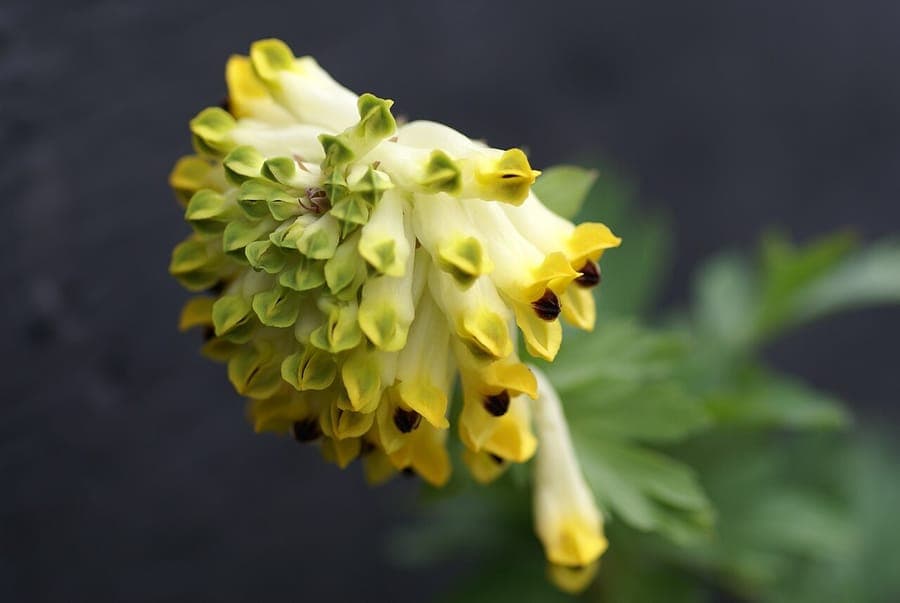
Corydalis nobilis distinguishes itself through its striking bicolored flowers. The blooms are primarily soft yellow with a distinctive blue-green tint on the upper lip of each flower. These blooms appear in April and May.
The leaves are finely dissected with a delicate grayish-green hue. They are twice or three times divided and give the plant an airy appearance.
After blooming, brownish pod-shaped fruits develop containing seeds. These seeds can produce self-sown seedlings.
Ideal Location
Corydalis nobilis thrives in partial to light shade. Choose a spot that receives plenty of indirect sunlight in spring. Beneath deciduous trees or shrubs that leaf out later create perfect conditions.
Avoid full sun during the growing season. The plant prefers sheltered locations protected from strong winds.
Free design
Want to see Corydalis nobilis: complete guide in your garden? Make a free design now.
Soil Requirements
Corydalis nobilis performs best in consistently moist, well-draining soil rich in organic matter. An ideal pH range is between 6.0 and 7.0. Excellent drainage is essential.
Watering
During growth and bloom, Corydalis nobilis requires regular watering. Keep soil consistently moist but never waterlogged. As flowers fade, gradually reduce watering.
Once established, deep roots allow this plant to tolerate drier periods.
Pruning
Corydalis nobilis requires no pruning. Allow flower spikes to wither naturally. Remove only obviously dead material.
Maintenance Calendar
March-April: Planting time. April-May: Flowering period. June: Foliage fades. July-September: Plant dormancy. October-November: Optional seed collection. December-February: Winter dormancy.
Winter Hardiness
Corydalis nobilis is exceptionally winter hardy, originating from mountain regions. It tolerates temperatures below minus-20 degrees Celsius.
Companion Plants
Corydalis nobilis combines beautifully with snowdrops, cyclamen, scillas, and hepatica.
Closing Thoughts
Corydalis nobilis is a treasure for gardeners seeking distinctive plants. Its yellow and blue-green blooms bring playful elegance to any garden. For more information, visit gardenworld.app for comprehensive guides. Start with a few bulbs and observe how they flourish.
Want to see Corydalis nobilis: complete guide in your garden? Make a free design now.
Upload a photo, pick a style, and get a photorealistic design with plant list in under a minute.
No credit card required


Similar plants
Papaver gorodkovii: complete guide
Papaver gorodkovii
Papaver gorodkovii, the arctic poppy, thrives from Alaska to Russia's Far East. Discover how to grow this rare, extremely cold-hardy rock garden treasure.
Papaver setiferum: complete guide
Papaver setiferum
Papaver setiferum is a hardy giant Caucasian poppy with fiery red blooms. Discover siting, soil, deadheading and winter hardiness.
Pale Poppy: complete guide
Papaver alboroseum
Discover pale poppy (Papaver alboroseum) - rare alpine poppy with white-pink flowers. Precious beauty from Kamchatka. Cultivation in alpine and rock gardens.