
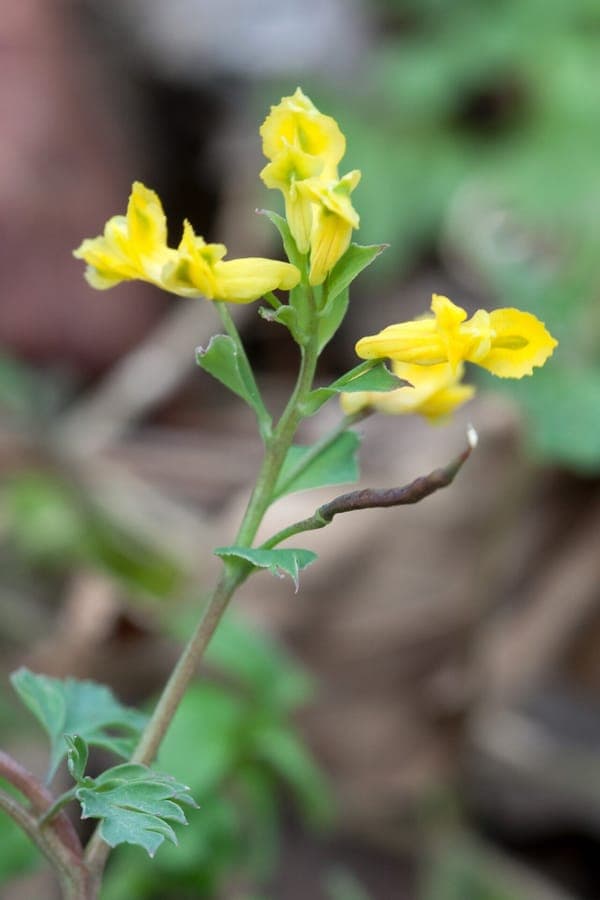
Kaldari / Public domain, via Wikimedia Commons
Yellow harlequin: complete guide
Corydalis flavula
Want to see Yellow harlequin: complete guide in your garden?
1 minute, no credit card
Overview
Corydalis flavula, commonly known as yellow harlequin, yellow fumewort, or pale corydalis, is a delicate annual or biennial herb belonging to the poppy family, Papaveraceae. Native to the eastern and central regions of North America - from southern Ontario and New York south through the Appalachians and the Mississippi basin to the Gulf states - it naturally inhabits moist deciduous woodlands, shaded stream banks, and humus-rich forest floors. It has historically been documented across Alabama, Illinois, Indiana, Kentucky, Missouri, Ohio, Pennsylvania, Tennessee, Virginia, and West Virginia, among many other states.
The species name 'flavula' comes from the Latin for yellowish, aptly describing the plant's most striking feature: its cluster of small, tubular, bright yellow flowers that appear at the very start of spring, often before most other wildflowers have awakened. Within the genus Corydalis - a diverse group of some 300 species distributed across the Northern Hemisphere - flavula holds a distinctive place as a North American native with finely divided, blue-green foliage and a charming ephemeral character. It belongs to the same genus as the more widely grown Corydalis solida and the celebrated blue Corydalis flexuosa, but brings something different: a warm, sunny tone in a traditionally cool-season palette.
For gardeners designing naturalistic woodland or shade gardens, Corydalis flavula offers exactly the kind of spontaneous, layered planting that feels both beautiful and effortless. It self-seeds freely, colonising gaps between stepping stones and the edges of shade beds with a quiet persistence that rewards those who notice the small details. You can explore gardenworld.app for curated shade garden layouts that incorporate early-season corydalis species as part of a layered planting strategy.
Appearance and bloom cycle
Corydalis flavula typically grows to 15–25 cm in height, forming loose, slightly ascending clumps with a spread of 20–30 cm. The foliage is its first attraction: leaves are twice-pinnate, delicately dissected, and blue-green to grey-green in colour, giving the plant an airy, ferny quality. Each leaf is composed of multiple small, obovate to spoon-shaped leaflets with slightly notched tips. The overall texture is fine and soft, forming a gentle mound that catches filtered light beautifully against a dark woodland soil background.
The flowers are classically Corydalis in form: tubular, with a distinctive spur at the rear and two spreading outer petals at the front, creating a characteristic two-lipped appearance. In Corydalis flavula, the flowers are bright yellow, occasionally with a pale cream edge to the outer petals. They are arranged in loose racemes of 5–15 flowers at the tips of slender, erect stems. Individual flowers measure about 1–1.5 cm in length. Bloom time spans from February through early May, with the peak usually in March and April depending on local temperatures and exposure. In mild winters, the first flowers can appear as early as January.
After flowering, the plant produces small, elongated seed pods of 2–3 cm containing glossy black seeds. Each seed is equipped with a fatty appendage called an elaiosome, which attracts ants. The ants collect the seeds and carry them to their nests, effectively distributing the plant over short distances - a process known as myrmecochory. This ant-mediated dispersal makes Corydalis flavula particularly suitable for informal, naturalistic gardens where a degree of self-seeding is welcomed. By late June, the above-ground parts die back completely, and the plant survives until spring as seeds in the soil.
Ideal location
Corydalis flavula thrives in partial to full shade. In its natural habitat it grows beneath the canopy of deciduous trees, where dappled light filters through and the soil stays consistently moist without becoming waterlogged. In the garden, ideal positions include the base of mature deciduous trees, the north or east side of walls and fences, the shaded edge of a shrub border, and the underplanting of large canopy trees in a woodland garden scheme.
The plant does not tolerate direct midday sun for more than two to three hours: prolonged exposure causes the foliage to pale and wilt, accelerates flowering to the point of collapse, and shortens the plant's lifespan significantly. Equally, dense, deep shade with minimal light penetration is unsuitable. The sweet spot is a position that receives bright, indirect light for most of the day, or direct morning sun for one to two hours followed by full shade. In USDA hardiness zones 4 through 8, it can be grown reliably in the open garden year-round.
In urban gardens and small spaces, Corydalis flavula works well along the base of a north- or east-facing fence, in the shadow of a shed, or as an underplanting in large containers kept in a sheltered, shaded corner of a patio. When grown in pots, pay particular attention to drainage and moisture retention, as containers can both dry out and become waterlogged more quickly than open ground.
Soil requirements
The single most critical factor for Corydalis flavula is soil quality. The plant requires a loose, humus-rich, lightly moist soil with a pH between 4.8 and 6.8. This moderately acid-to-neutral range suits most temperate garden soils, but the best performance is achieved on a light, well-structured woodland-type soil abundant in organic matter.
Heavy clay soils that remain wet in winter are problematic: the combination of low temperature and poor aeration around the roots and germinating seeds can lead to fungal rot. Improve clay soils by incorporating generous amounts of garden compost, leaf mould, or composted bark at a depth of 20–30 cm before planting or sowing. Sandy soils drain freely but dry out too quickly; amend them with well-rotted leaf mould or coir compost to improve moisture retention without reducing drainage.
An annual mulch of 5–7 cm of leaf mould or fine composted bark applied each autumn serves multiple purposes: it moderates soil temperature, suppresses weeds, retains moisture through dry spells, and gradually releases nutrients as it breaks down. Avoid lime-rich fertilisers and lime applications, as Corydalis flavula is sensitive to high soil alkalinity. Good-quality woodland planting compost, available at most garden centres, provides an excellent ready-made growing medium with the right pH and humus content.
Watering
Corydalis flavula is not particularly drought-tolerant and requires consistent light moisture throughout its active growing period, which runs from February to June. The soil should feel damp to the touch at a depth of 3–5 cm but never waterlogged. Even brief periods of complete drying out during the growing season can weaken the plants, reduce flowering, and diminish the seed set that is essential for perpetuating the colony.
During dry spells, water two to three times per week in the morning, directing the water at the base of the plant rather than overhead to keep the foliage dry and reduce the risk of fungal diseases. Rainwater is preferable to chlorinated tap water, particularly on light, sandy soils where chlorine can affect microbial activity that maintains soil structure. Cold tap water applied directly to the roots in early spring can stress the plants; allow it to stand in a watering can for a few hours first.
A good mulch layer reduces watering needs considerably by slowing evaporation. Once the above-ground parts die back in June, no supplementary watering is needed unless the summer is exceptionally dry, in which case occasional light watering around the planting area helps maintain the soil conditions needed for good seed germination in autumn. In containers, a self-watering system or moisture-retaining granules in the compost can help maintain the balance between moisture and drainage.
Free design
Want to see Yellow harlequin: complete guide in your garden? Make a free design now.
Pruning
Corydalis flavula requires virtually no pruning in the conventional sense. As an annual or short-lived plant, the above-ground stems and leaves die back naturally after seed set, usually by June, leaving nothing that needs to be cut. The dead plant material can remain in place as a natural mulch layer that protects the seeds germinating beneath it and adds organic matter to the soil as it decomposes.
If you wish to limit self-seeding in a tidily maintained border, the seed pods can be removed by hand as soon as the flowers have dropped and before the pods ripen fully. However, removing too many pods will significantly reduce the next season's colony, and if done every year, the plant will eventually disappear from the garden. A practical compromise is to remove half the pods, concentrating on areas where spread is least desired, while allowing the rest to ripen naturally.
For planting schemes where neatness is important, the dead stems and leaves can be cut to ground level in June or July using sharp scissors or pruning shears. Sterilise tools between plants with isopropyl alcohol to avoid spreading any fungal spores. No other pruning intervention is needed. Avoid digging around the base of the planting in summer, as this can disturb germinating seeds or young seedlings that may not yet be visible above the surface.
Maintenance calendar
January – February: In mild winters, the first seedlings emerge in February. Check the mulch layer and top up if frost has disturbed it. No watering needed unless the winter is exceptionally dry.
March: Full active growth. Weed around young plants before competing vegetation establishes. Keep soil lightly moist. Apply a thin top-dressing of leaf mould or garden compost if the soil looks depleted.
April: Peak flowering. Enjoy the display. Watch for aphid colonies on the soft new growth and treat if necessary with an insecticidal soap. Water regularly during dry spells.
May: Flowering ends and seed pods form. Decide on your self-seeding strategy. Begin removing dead flower stems if tidiness is required. Keep the soil moist to encourage good seed development.
June – August: Die-back period. The above-ground parts yellow and collapse. Remove old stems once dry. The planting area can be filled in with summer annuals if desired. Avoid deep soil cultivation.
September – October: Fresh seedlings from spring-sown seeds may appear. This is also an ideal time to sow new seed directly into prepared soil. Apply a fresh layer of autumn mulch, 5–7 cm deep.
November – December: Final seasonal tidy. Remove fallen tree leaves that might smother young seedlings. Check soil pH and amend with sulphur if the pH has risen above 6.8.
Winter hardiness
Corydalis flavula is remarkably cold-hardy for such a delicate-looking plant. It overwinters as seeds in the soil, and the seeds can withstand temperatures down to approximately -25 °C, placing the species well within USDA hardiness zones 4 through 8. In practice, this means the plant can be cultivated without winter protection across most of temperate Europe and North America.
If autumn seedlings are present with one or two true leaves, these are also reasonably cold-hardy. A light covering of pine needles or straw, 3–5 cm deep, will provide effective protection during hard frosts. Avoid using dense or wet mulching materials such as fresh leaves in thick layers, as these can encourage grey mould (Botrytis cinerea) on the young tissue. In coastal areas with mild winters, no additional protection is needed.
The plant recovers well from late spring frosts. Leaves damaged by a late-April frost are quickly replaced by new growth from undamaged buds, and the flowers themselves are frost-tolerant down to about -4 °C for short periods. In areas with very harsh winters - sustained temperatures below -20 °C with little snow cover - a slightly thicker protective layer in November is a sensible precaution. You can find more tips on protecting early-blooming perennials and annuals at gardenworld.app.
Companion plants
Corydalis flavula pairs beautifully with a wide range of shade-tolerant spring companions. The clear yellow of its flowers works particularly well alongside the blues and purples of Scilla siberica (Siberian squill), Muscari armeniacum (grape hyacinth), and Pulmonaria officinalis (lungwort). This yellow-and-blue combination is a time-honoured pairing in shade garden design, evoking the dappled light and spontaneous energy of a deciduous woodland in April.
For larger mixed borders, combine Corydalis flavula with Hosta sieboldiana 'Elegans', whose large, glaucous leaves emerge just as the corydalis is setting seed, neatly filling the gap left by its die-back. Astilbe 'Fanal' adds deep crimson plumes from June onwards, ensuring colour continuity. Plant corydalis at 20–30 cm spacing, hostas at 50–60 cm, and astilbes at 40–50 cm for a well-proportioned arrangement.
In a naturalistic woodland scheme, excellent additional companions include Anemone nemorosa (wood anemone), Erythronium dens-canis (dog's-tooth violet), Allium ursinum (ramsons), and Trillium grandiflorum (great white trillium). All of these share the same preference for moist, humus-rich, shaded positions and a spring-active, summer-dormant growth pattern, creating a tapestry of sequential blooms from February through June that mimics the natural rhythm of a deciduous forest floor.
Closing
Corydalis flavula may be one of the quieter gems in the world of spring wildflowers, but its unassuming presence in a shaded corner of the garden carries a genuine charm. The bright yellow flowers in the grey weeks of late winter and early spring bring a warmth that is out of proportion to the plant's small stature, and the feathery, blue-green foliage is attractive in its own right long after the blooms have faded. Virtually care-free once established, the plant rewards patience with an ever-expanding colony that grows more effective with each passing year.
For those who want to try it, seeds are available from specialist wildflower nurseries and botanical garden seed exchanges. Sow fresh seed in autumn directly into a prepared, humus-rich, shaded bed, or start indoors in damp seed compost, cold-stratified at 4 °C for six to eight weeks before moving to a cool, bright indoor windowsill. With the right spot and a little initial attention to soil and moisture, yellow harlequin will reward you with years of quiet, golden-yellow spring colour.
Want to see Yellow harlequin: complete guide in your garden? Make a free design now.
Upload a photo, pick a style, and get a photorealistic design with plant list in under a minute.
10,000+ gardens designed already
No credit card required


Similar plants
Papaver gorodkovii: complete guide
Papaver gorodkovii
Papaver gorodkovii, the arctic poppy, thrives from Alaska to Russia's Far East. Discover how to grow this rare, extremely cold-hardy rock garden treasure.
Papaver setiferum: complete guide
Papaver setiferum
Papaver setiferum is a hardy giant Caucasian poppy with fiery red blooms. Discover siting, soil, deadheading and winter hardiness.
Pale Poppy: complete guide
Papaver alboroseum
Discover pale poppy (Papaver alboroseum) - rare alpine poppy with white-pink flowers. Precious beauty from Kamchatka. Cultivation in alpine and rock gardens.