
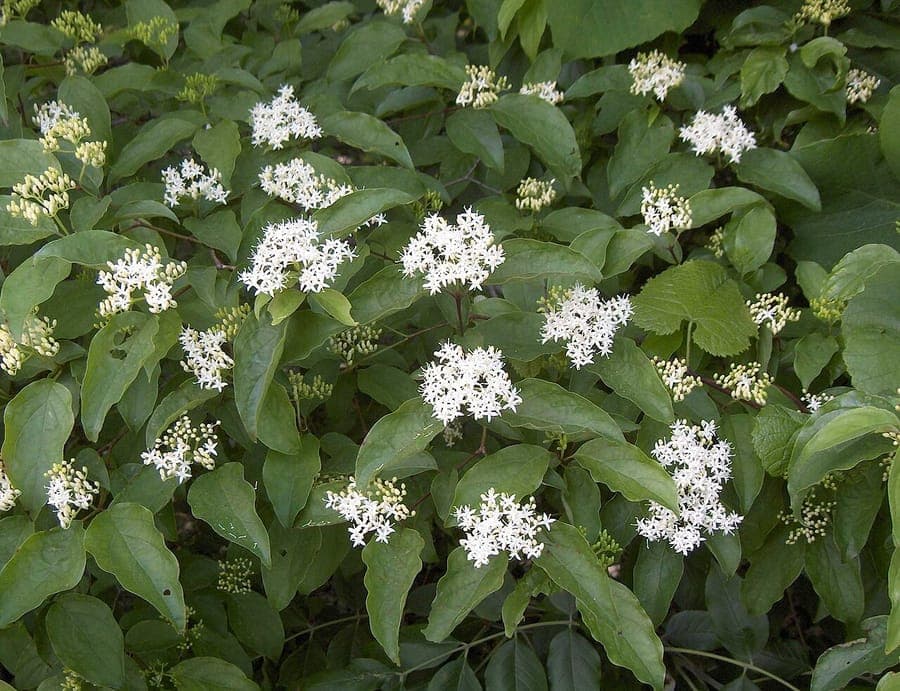
photo by John Knouse / Public domain, via Wikimedia Commons
Roughleaf dogwood: complete guide
Cornus drummondii
Want to see Roughleaf dogwood: complete guide in your garden?
1 minute, no credit card
Overview
Cornus drummondii, commonly called roughleaf dogwood or Drummond's dogwood, is a fast-growing, multi-stemmed shrub native to central and eastern North America. Named after the Scottish botanist Thomas Drummond, the species was formally described by C.A. Meyer in 1845 and belongs to the dogwood family Cornaceae. Its native range stretches from Ontario and New York southwards through the Great Plains and Midwest to Texas, Louisiana and the Gulf States - a distribution that reflects its remarkable adaptability to a wide range of soils, moisture regimes and climates.
In European gardens, roughleaf dogwood is far less commonly planted than its close relatives Cornus alba and Cornus sericea, yet it offers comparable ornamental value combined with outstanding ecological benefits. The shrub is a food source for more than forty bird species, a nectar resource for pollinators during its May and June flowering period, and a structural element of outstanding year-round interest. At gardenworld.app you can explore garden design concepts that incorporate robust native-style shrubs like this one into cohesive, low-maintenance planting schemes.
Mature plants typically reach 2 to 4 metres in height and spread at least as wide. The growth rate is fast, especially on moist, fertile soils, where plants can put on 40 to 60 cm of new growth per season. This vigour makes it an excellent choice for screening, wildlife hedging, streamside planting and erosion control.
Appearance and bloom cycle
The leaves are the plant's most distinctive vegetative feature: broadly ovate to elliptic, 5 to 10 cm long, they are covered on the upper surface with stiff, forward-pointing hairs that give the leaf a sandpaper-like texture - the source of the common name 'roughleaf'. The underside is pale green and softly hairy. Leaf margins are entire or very slightly wavy.
In autumn, the foliage turns to shades of burgundy, crimson and purple before dropping, giving the plant a final burst of colour that rivals that of many deliberately ornamental shrubs. The bare winter stems are reddish-brown to purplish-brown, providing structural interest and colouration that is especially prominent after the first hard frosts.
Flowering begins in May and extends into June. The individual flowers are tiny, white and four-petalled, held in broad, flat-topped corymbs 4 to 8 cm across. Each corymb contains dozens of flowers and the display, taken across the whole shrub, is generous and eye-catching. The fragrance is faintly sweet and honeyed, attractive to bumblebees, hoverflies, mining bees and numerous butterfly species.
Fruits ripen in August and September. They are small, round drupes approximately 6 mm in diameter, turning from green to creamy white when fully ripe. The white colouration is unusual among dogwoods and gives the plant a distinctive appearance in late summer. Berries are readily consumed by thrushes, waxwings, robins and many migratory warbler species, making the plant a significant food source during autumn migration.
Ideal location
Roughleaf dogwood is highly adaptable in terms of light requirements. It thrives in full sun, where flowering is most prolific, but grows equally well in partial shade and tolerates light woodland shade. In its natural habitat it colonises forest edges, streambanks, roadsides and open prairie margins - environments where light levels and soil moisture can vary considerably.
In a European garden context, a position in full sun to partial shade will give the best results. The plant is well suited to urban conditions and tolerates air pollution, compacted soils and reflected heat from hard surfaces - qualities that make it useful in urban planting schemes, car parks and roadside plantings. It also performs well in coastal gardens, tolerating moderate wind exposure.
For use as a hedge or screen, plant at 80 to 120 cm centres. For a naturalistic grouping or a mixed shrub border, space plants 150 to 200 cm apart to allow each specimen to develop its characteristic arching, multi-stemmed form without becoming overcrowded.
Soil requirements
Cornus drummondii is genuinely tolerant of a wide range of soil types. Sandy soils, loams, clay soils and silty riverside soils are all acceptable, provided drainage is at least adequate. The species tolerates temporary waterlogging significantly better than most ornamental shrubs, which makes it valuable for rain gardens and swales, though it does not enjoy permanently saturated conditions.
The preferred soil pH ranges from 4.5 to 7.5 - one of the broadest ranges of any woody ornamental, meaning that almost no amendment is needed for the average European garden soil. Plants perform best when established in a soil enriched with a generous amount of well-rotted compost at planting time. A 10-cm layer of composted bark or leaf mould mixed into the backfill will help newly planted shrubs establish quickly.
Once established, Cornus drummondii is a low-nutrition plant; a single application of a slow-release general fertiliser in early spring is sufficient to maintain vigorous growth. Avoid high-nitrogen feeds that encourage excessive leafy growth at the expense of flowering and fruiting.
Free design
Want to see Roughleaf dogwood: complete guide in your garden? Make a free design now.
Watering
Established plants are drought-tolerant and rarely require supplemental watering in temperate climates with regular rainfall. However, during the first growing season after planting, consistent moisture is essential to allow the root system to develop. Water newly planted shrubs thoroughly once a week, applying approximately 10 litres per plant, and more frequently during prolonged dry spells in summer.
A mulch layer of 7 to 10 cm of composted wood chip or bark around the base of the plant - kept clear of the stems - will conserve moisture, regulate soil temperature, suppress weeds and gradually improve soil structure as it breaks down. Renew the mulch layer annually in spring.
In containers, water requirements are much higher. Use a pot of at least 60 litres with adequate drainage holes. Check the moisture level at 5 cm depth weekly and water as soon as the compost feels dry at that depth. Container-grown plants will also benefit from a slow-release fertiliser tablet or granules incorporated at planting and topped up each spring.
Pruning
Cornus drummondii requires minimal pruning to maintain a healthy, attractive shape. The primary reasons to prune are to stimulate fresh, colourful winter stems, to remove dead or crossing branches, and to control size in restricted spaces.
For winter stem colour, adopt a coppicing rotation similar to the approach used for Cornus alba 'Sibirica' and Cornus sericea 'Flaviramea': each year in early spring, cut one-third of the oldest, woodiest stems back to just above ground level. This produces a constant supply of young, richly coloured stems while retaining enough mature growth to support flowering and fruiting. Alternatively, cut the entire plant back to 20 cm every two to three years for maximum stem effect, accepting that flowering will be reduced in the year of cutting.
Light formative pruning to shape the plant or remove unwanted sucker growth can be carried out at any time during the growing season. Always use clean, sharp secateurs or loppers and disinfect tools between plants. Garden centres stock a wide range of suitable pruning tools for both light and heavier work.
Maintenance calendar
January–February: Enjoy the winter stem colour. Assess which stems will benefit from spring pruning. Hold off cutting if severe frost is forecast.
March: Complete pruning before bud break. Apply a slow-release general fertiliser or a top-dressing of compost around the base.
April–May: Monitor for aphids on new growth; these are rarely serious but worth watching. Leaf development begins in earnest.
May–June: Peak flowering period. Avoid pruning now. Enjoy the activity of pollinators visiting the flower clusters.
July: Fruits begin to develop. Carry out any light shaping after the flowers have faded if needed.
August–September: Fruits ripen to white. Bird activity increases. If possible, delay any cutting back to allow wildlife to benefit from the berries.
October–November: Autumn leaf colour develops. Leaves fall. Top up mulch as needed.
December: Dormancy. Reddish-brown stems prominent. No action required.
Winter hardiness
Cornus drummondii is exceptionally cold-hardy, rated to USDA hardiness zones 3 to 9. In its native range it survives winter temperatures of -35 °C and below. In the milder climate of northern Europe (USDA zones 7–8 for most of the UK, Belgium and the Netherlands), it is completely hardy and requires no winter protection whatsoever.
In the first winter after planting, young stems may experience minor tip damage during hard frosts, but the plant will regenerate vigorously from the base in spring. Protecting the root zone with a 10-cm mulch layer during the first winter is recommended as an insurance measure. Established plants are impervious to the temperatures experienced in any normal north-west European winter.
Unlike some thin-barked ornamentals, roughleaf dogwood does not suffer from frost cracking of the bark, making it a genuinely low-maintenance choice even in gardens that experience occasional severe winters.
Companion plants
The naturalistic character of Cornus drummondii suits it well to mixed planting schemes that celebrate ecological function alongside ornamental beauty. In a shrub border setting, it combines excellently with Viburnum lentago (nanny berry), Symphoricarpos albus (snowberry) and Sambucus canadensis (elderberry), all of which share similar cultural requirements and jointly support a diverse range of wildlife.
For a prairie-inspired mixed planting, combine roughleaf dogwood with tall ornamental grasses such as Panicum virgatum 'Northwind' or Miscanthus sinensis 'Gracillimus' and bold herbaceous perennials including Echinacea purpurea, Rudbeckia fulgida var. sullivantii 'Goldsturm' and Liatris spicata. These combinations peak in summer and early autumn and provide months of continuous interest.
In wetter areas or rain garden plantings, pair Cornus drummondii with Iris pseudacorus, Carex acutiformis and Filipendula ulmaria for a streamside composition that will support aquatic insects and nesting birds simultaneously.
For four-season planting inspiration that incorporates shrubs like Cornus drummondii into front garden or border designs, gardenworld.app offers customised planting plans based on your specific site conditions.
Closing thoughts
Cornus drummondii is a genuinely versatile, ecologically valuable shrub that deserves far wider use in European gardens than it currently receives. Its combination of spring flowers, summer fruits, autumn leaf colour, winter stem colour and year-round wildlife value is difficult to match. Add to this its exceptional hardiness, broad soil tolerance, drought resilience and fast growth, and you have a shrub that rewards gardeners in every season while asking very little in return.
Want to see Roughleaf dogwood: complete guide in your garden? Make a free design now.
Upload a photo, pick a style, and get a photorealistic design with plant list in under a minute.
10,000+ gardens designed already
No credit card required


Similar plants
Toughleaf Dogwood: complete guide
Cornus asperifolia
Toughleaf dogwood is a suckering, thicket-forming shrub native to the southeastern US, ideal for wildlife hedges on damp, low-lying ground.
Silky dogwood (Cornus obliqua): complete guide
Cornus obliqua
Silky dogwood: cultivation, care tips, and garden uses. White flowers, colorful berries, and stunning fall foliage.
Cornus glabrata: complete guide
Cornus glabrata Benth.
Cornus glabrata, known as brown dogwood, is an attractive native shrub from California and Oregon. With its smooth leaves, delicate flowers, and striking berries, it is an ideal choice for naturalistic gardens and wildlife habitats.