
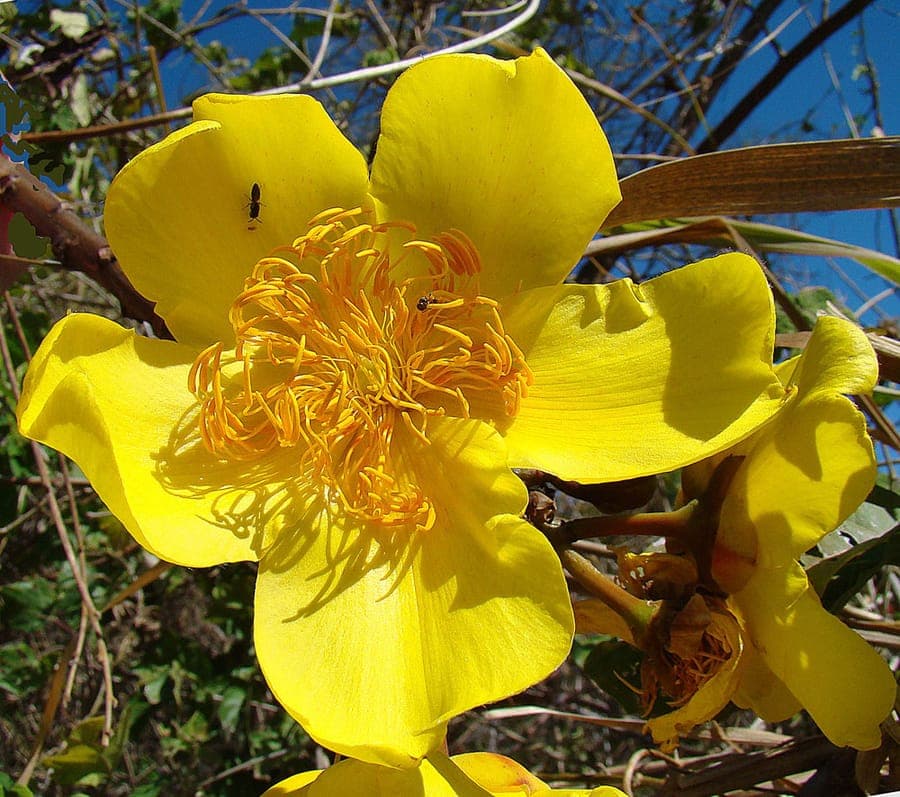
Dick Culbert from Gibsons, B.C., Canada / CC BY 2.0, via Wikimedia Commons
Buttercup Tree: complete guide
Cochlospermum vitifolium
Want to see Buttercup Tree: complete guide in your garden?
1 minute, no credit card
Overview
The Buttercup Tree, known scientifically as Cochlospermum vitifolium, is one of the most dazzling flowering trees of tropical Central and South America. Native to a vast range stretching from Mexico through Guatemala, Costa Rica, Venezuela and Colombia down to Bolivia and Brazil, this tree transforms open savannas and forest edges with an explosion of vivid yellow flowers that appear while the branches are still bare. The sight of a leafless tree covered in large golden blooms is truly unforgettable. Outside its native range - which encompasses USDA zones 10 to 12 - the Buttercup Tree is grown as a container specimen or greenhouse plant in temperate countries. It cannot survive frost and must be kept warm throughout the winter months. Garden enthusiasts who enjoy exotic container plants will find this species highly rewarding, and gardenworld.app can help you visualise how tropical flowering trees could fit into your own outdoor space.
Appearance and bloom cycle
In its native habitat Cochlospermum vitifolium grows into a tree of 6 to 10 metres, with a broad and somewhat open crown. The leaves are deeply five-lobed and resemble grape vine leaves - hence the species name 'vitifolium' meaning 'with vine-like leaves'. Individual leaves can reach 20 to 30 cm in width, giving the tree a lush, tropical appearance during the growing season. The flowers are the real star of the show: each bloom is 8 to 12 cm across, with five rounded, overlapping petals of pure butter yellow, surrounding a central boss of golden stamens. The flowering season typically runs from February to April, coinciding with the end of the dry season in its homeland. At this point the tree is leafless, making the flowers even more striking. After flowering, rounded seed capsules develop, which split open at maturity to reveal seeds wrapped in silky cotton-like fibres - earning the plant its alternative English name 'Silk Cottontree'.
Ideal location
The Buttercup Tree demands a position in full sun. In the wild it grows on open savannas and forest margins with unobstructed access to direct sunlight throughout the day. As a container plant in temperate climates, move it outdoors to your warmest, sunniest terrace or patio position for the entire summer season. Some shelter from strong winds is advisable, as the large leaves can tear. When temperatures fall below 10 degrees Celsius in autumn, bring the plant inside to a sunny conservatory, heated greenhouse, or a well-lit room with large windows. The species is at home in USDA zones 10 to 12, corresponding to minimum temperatures above -1 degrees Celsius. In mild Mediterranean gardens it can be planted out in sheltered spots, but in northern Europe year-round outdoor cultivation is not feasible.
Soil
The Buttercup Tree thrives in a free-draining, moderately fertile growing medium. A mixture of good quality peat-free compost and perlite in a ratio of roughly 2 to 1 works well in containers. The plant is naturally adapted to lean, sometimes dry soils in the wild, so excessive fertility is not required and overly rich composts can lead to soft, lush growth that is more susceptible to pests. Always ensure pots have adequate drainage holes and consider placing a layer of coarse gravel or expanded clay pebbles in the base of the container to prevent waterlogging. The preferred pH range is slightly acid to neutral, between 6.0 and 7.0. Repot every two to three years when roots fill the container, moving up to the next pot size and refreshing the growing medium completely.
Watering
Watering should mirror the natural seasonal rhythm of the plant. During the active growing season from May to September, water regularly whenever the top few centimetres of compost feel dry, but never allow the pot to sit in standing water. In winter, when the plant typically drops its leaves and enters dormancy, reduce watering to a minimum - just enough to prevent the roots from desiccating completely. This dry rest period is crucial, as it mimics the dry season in the native habitat and encourages strong flowering the following spring. Rainwater is preferable to tap water as it is free from calcium deposits. Feed every two weeks during the growing season with a liquid fertiliser formulated for flowering plants to build up the energy reserves needed for next year's blooms.
Free design
Want to see Buttercup Tree: complete guide in your garden? Make a free design now.
Pruning
The Buttercup Tree generally requires little pruning. After the flowering period, remove any dead or damaged branches using clean, sharp secateurs. If the plant outgrows its allocated space, light shaping can be carried out after blooming and before the new leaves emerge. Always cut back to a node or lateral branch and treat larger wounds with a wound sealant to prevent disease entry. Avoid heavy pruning in summer as this can interfere with the formation of next year's flower buds. Remove spent seed capsules after the seeds have dispersed to redirect the plant's energy away from seed production and towards vegetative growth and root development.
Maintenance calendar
January to February: plant is dormant; water minimally; keep above 10 degrees Celsius. March to April: flowers appear on bare branches; resume cautious watering as leaves begin to emerge. May: move outdoors after the last frost date; begin liquid feeding. June to August: peak growing season; water regularly; feed every two weeks; inspect weekly for pests. September: taper off feeding; reduce watering gradually. October: bring indoors before the first frost. November to December: enforce dry rest; keep cool but frost-free. For ideas on how to incorporate exotic container specimens into a cohesive garden design, visit gardenworld.app.
Winter hardiness
The Buttercup Tree has no frost tolerance whatsoever. Temperatures below 5 degrees Celsius cause damage, and frost will kill the plant outright. Its natural climate zone - USDA 10 to 12 - means it requires essentially frost-free conditions year-round. In Belgium and the Netherlands the tree must come indoors every autumn without exception. The optimal overwintering temperature is between 12 and 18 degrees Celsius. Good light is important, though the plant can survive a period of reduced light better than it can tolerate cold. Leaf drop in winter is perfectly normal and should not cause alarm: the bare stems will break into fresh growth as temperatures rise and day length increases in spring. Avoid placing the plant near cold draughts or unheated windows during the winter months.
Companion plants
The large, bright yellow flowers of the Buttercup Tree pair beautifully with other tropical and subtropical container plants. Red or orange Hibiscus rosa-sinensis creates a vivid, complementary colour contrast. Bougainvillea in purple or magenta tones adds drama and volume. For a softer combination, Strelitzia reginae - the bird of paradise - echoes the exotic theme without competing in colour intensity. Large-leaved Canna cultivars provide textural contrast next to the lobed foliage of Cochlospermum. On the terrace, repeat the warm-yellow theme with Lantana camara, which flowers throughout summer and attracts pollinators. Choose companions that share the same overwintering requirements - warmth, good light, and a dry rest - to simplify care during the colder months.
Companion plants for the conservatory
In a greenhouse or conservatory setting, the Buttercup Tree combines well with other dry-season deciduous tropicals such as Plumeria species and Jatropha integerrima. These plants share a similar strategy: they drop their leaves during a cool dry winter and produce spectacular flowers in spring. Grouping them together creates a display that cycles through dramatic bare-branched flowering in late winter and lush foliage throughout summer.
Closing
The Buttercup Tree is a plant of extremes: bare branches blazing with golden flowers in late winter, then a full canopy of broad, vine-like leaves through the growing season. For gardeners prepared to provide warm overwintering conditions, it delivers a flowering spectacle that few other container plants can match. Its combination of exotic appeal, manageable care requirements, and remarkable seasonal transformation make it a worthy addition to any collection of tropical specimens. Explore gardenworld.app to discover how flowering tropical trees and other exotic plants can be incorporated into a striking garden or terrace design.
Want to see Buttercup Tree: complete guide in your garden? Make a free design now.
Upload a photo, pick a style, and get a photorealistic design with plant list in under a minute.
10,000+ gardens designed already
No credit card required


Similar plants
Acer pycnanthum: complete guide
Acer pycnanthum
Acer pycnanthum, the Japanese swamp maple, is a fast-growing tree with early red flowers and brilliant autumn color, ideal for damp garden settings.
Freeman maple: complete guide
Acer × freemanii
Everything about the Freeman maple (Acer x freemanii): a fast-growing shade tree with spectacular autumn colour for large gardens.
Silver vine: complete guide
Actinidia polygama
Discover silver vine (Actinidia polygama): a hardy climbing plant with silvery foliage, loved by gardeners and cats alike.