
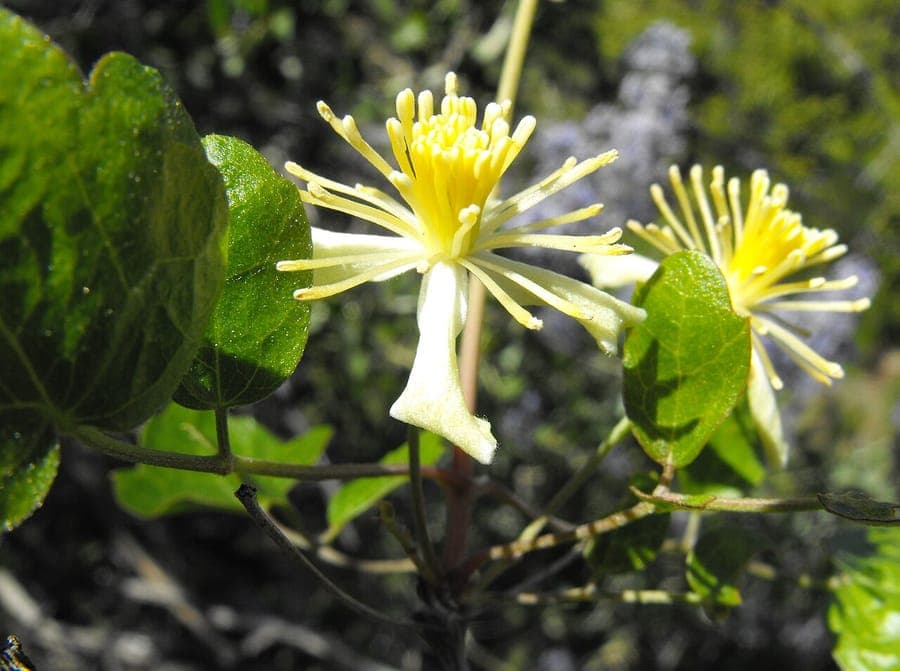
Stickpen / Public domain, via Wikimedia Commons
Clematis pauciflora: complete guide
Clematis pauciflora
Want to see Clematis pauciflora: complete guide in your garden?
1 minute, no credit card
Overview
Clematis pauciflora, commonly called ropevine clematis, is an elegant, woody climbing vine from the Ranunculaceae family. Native to southern California and northwestern Mexico, this clematis is valued for its exceptional drought tolerance and delicate white flowers with hairy sepals.
The plant is renowned for its elegant growth habit and discrete flowering. Ropevine clematis can thrive for years with minimal maintenance and without supplemental water once established. This makes it an excellent choice for warm, dry gardens throughout southern Europe.
Appearance and bloom
Ropevine clematis grows as a fine, delicate climbing vine with elegant, slender stems. The leaves are small, elegantly arranged, and give the plant a refined appearance. From April through May, small white flowers with hairy sepals appear.
The flowers are more modest in size compared to many other clematis varieties, but appear in profusion. They create an elegant, airy display. After flowering, silvery seed heads with long silky hairs develop, remaining decorative for months.
Ideal location
Place ropevine clematis in a warm, sunny location, preferably against a south or west-facing wall. The plant also tolerates partial shade but flowers most abundantly in full sun. Ensure good air circulation to prevent fungal diseases.
The plant grows slowly and typically reaches only 2-3 meters. This suits smaller gardens or wall spaces. Provide support via trellis or twine.
Soil
Ropevine clematis thrives on dry, poor soil and is not particular about composition. Sandy, loamy, and clayey soils are all well-tolerated. The plant prefers slightly acidic to neutral soil (pH 6-7). Waterlogging must be absolutely avoided.
Amend with compost at planting, but thereafter no supplemental feeding is necessary. This plant actually thrives on poor, dry soils.
Free design
Want to see Clematis pauciflora: complete guide in your garden? Make a free design now.
Watering
Once established, ropevine clematis is exceptionally drought-tolerant. This may be the greatest advantage of this variety. Water regularly only during the first growing season. Thereafter, virtually no water is needed, even during very dry summers.
In wet climates, extra drainage may be necessary to prevent root rot. Ensure water drains quickly.
Pruning
Ropevine clematis requires very minimal pruning. The plant flowers on old wood and should never be heavily cut. Remove only dead or extremely tangled growth. Light shaping after bloom is acceptable but not necessary.
Excessive pruning causes the plant to lose its elegant growth form and flowering. It is better not to prune at all than to prune too much.
Maintenance calendar
May-June: Plant in warm location. July-August: Allow plant to grow, virtually no maintenance. September-October: Seed heads remain decorative. November-April: Winter dormancy, no maintenance. Following spring: Plant slowly regenerates growth.
Winter hardiness
Ropevine clematis is hardy to zone 8, meaning it can remain outdoors throughout much of southern Europe but requires caution in cold regions. In severe winters, some stem dieback may occur, but plants usually regenerate from roots.
In very cold areas, protection or indoor overwintering is recommended.
Companion plants
Combine ropevine clematis with other greenery such as small vines and herbs. The white flowers contrast nicely with dark-leaved plantings. On warm walls, it grows beautifully between stones and moss.
In dry gardens, it pairs well with lavender, rosemary, and other Mediterranean herb shrubs.
Conclusion
Ropevine clematis is ideal for those seeking elegant, low-maintenance dry-climate charm. Once established, this plant can thrive for decades without supplemental water or feeding. Perfect for warm, dry corners in Mediterranean and California gardens.
Plant retailers routinely stock this variety. For garden design inspiration, consult gardenworld.app.
Want to see Clematis pauciflora: complete guide in your garden? Make a free design now.
Upload a photo, pick a style, and get a photorealistic design with plant list in under a minute.
No credit card required


Similar plants
Drummond's anemone: complete guide
Anemone drummondii
Discover Drummond's anemone (Anemone drummondii): a silvery-grey mountain plant for cool rock gardens and alpine troughs.
Korean clematis: complete guide
Clematis serratifolia
Clematis serratifolia is a hardy climber with fragrant yellow bell flowers in August-September. Pruning group 3, location and care tips.
Aquilegia brevistyla: complete guide
Aquilegia brevistyla
Discover Aquilegia brevistyla, the elegant North American columbine. Growing tips, shade tolerance, and design ideas for woodland and shadowed gardens.