
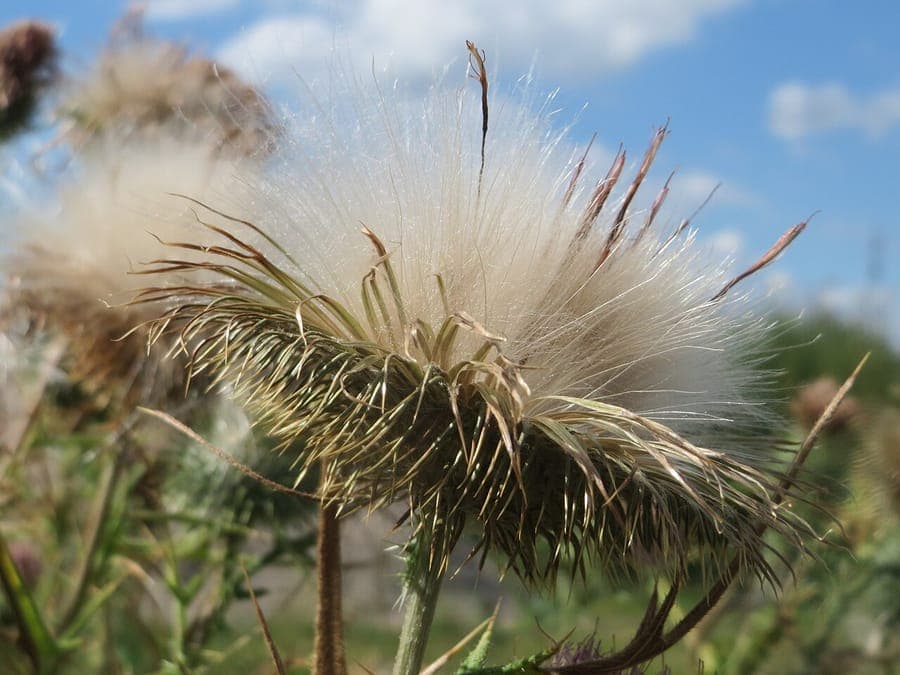
AnRo0002 / CC0, via Wikimedia Commons
Bull thistle: complete guide
Cirsium vulgare
Want to see Bull thistle: complete guide in your garden?
1 minute, no credit card
Overview
Bull thistle, scientifically known as Cirsium vulgare, is a biennial herb from the Asteraceae family distributed across Europe to Siberia and Northwest Africa. This vigorous plant is recognized for its distinctive purple-violet flower heads and dense spine-covered foliage. While often dismissed as a noxious weed, bull thistle plays an ecological role as nectar source for butterflies and beneficial insects.
Appearance and Bloom Cycle
Bull thistle typically reaches 0.5 to 1.5 meters in height. During the first year, plants develop dense basal rosettes with deeply lobed, spine-covered leaves that radiate close to the ground. In the second year, a central flowering stem emerges, branching extensively and reaching full height.
Flower heads are vibrant purple to violet, arranged in solitary or clustered terminal positions, each 2-3 cm in diameter. The blooming period extends from June to August, with individual flowers remaining open for weeks. After pollination, distinctive seed heads develop, featuring feathery bristles (pappus) that facilitate wind dispersal.
Ideal Location
Bull thistle thrives in full sun positions on well-drained soils. The plant adapts to various soil textures including sandy, loamy, and clay soils with moderate fertility. It demonstrates exceptional tolerance to windy sites and is well-suited for meadow plantings, roadside areas, and naturalized landscape designs.
Soil Requirements
Bull thistle is notably undemanding regarding soil conditions. It tolerates pH ranges from 4.5 to 7, growing successfully on both acidic and neutral substrates. The plant performs well in soils with low to moderate nutrient levels, precisely the conditions where many ornamental plants struggle. Its deep taproot system enables efficient mineral and water uptake from depths unavailable to shallow-rooted species.
Free design
Want to see Bull thistle: complete guide in your garden? Make a free design now.
Watering
Newly established plants benefit from regular irrigation during the first 4-6 weeks. Once established, bull thistle is remarkably drought-tolerant, requiring minimal supplemental watering. The deep root system accesses moisture reserves even during extended dry periods. In temperate climates with adequate precipitation, no additional irrigation is necessary.
Pruning and Maintenance
In naturalized settings, bull thistle requires minimal intervention. For seed production, allow plants to mature completely. To prevent unwanted self-seeding, remove flower heads before seed maturation. In formal gardens, cut stems back to ground level in late autumn or early spring.
Maintenance Calendar
First year focuses on allowing rosette establishment with occasional weeding in competitive situations. The second year provides full flowering from June through August. Summer deadheading prevents excessive self-seeding in managed areas. Autumn is optimal for seed collection from mature heads.
Winter Hardiness
Bull thistle is fully hardy in USDA zones 3 to 9, tolerating temperatures down to -40°C. The plant requires no special winter preparation and thrives throughout most temperate climates without protective measures.
Companion Plants
Combine bull thistle with nectar-rich flowers including Cornflower, Cosmos, and Poppy species. Tall grasses provide structural contrast and ecological support. Herbaceous perennials like Salvia and Rudbeckia create cohesive pollinator-friendly gardens.
Closing Thoughts
Bull thistle deserves greater appreciation in gardens emphasizing ecological value and natural aesthetics. With minimal care requirements, it provides sustained insect nourishment and striking summer interest. Whether cultivated intentionally or appearing uninvited, bull thistle represents a connection to wild natural systems.
Discover more about native plants and sustainable gardening at gardenworld.app, where you'll find expert guidance on plant selection and landscape design. Visit gardenworld.app to explore comprehensive plant databases and create your perfect garden plan.
Want to see Bull thistle: complete guide in your garden? Make a free design now.
Upload a photo, pick a style, and get a photorealistic design with plant list in under a minute.
No credit card required


Similar plants
Calendula stellata: complete guide
Calendula stellata
Complete guide to Calendula stellata, the star-flowered marigold from Sicily: location, soil, watering and companion planting tips.
Korean chrysanthemum: complete guide
Chrysanthemum x rubellum
Chrysanthemum x rubellum is a hardy autumn perennial with single pink to copper flowers from August to November. Care and combinations.
Helianthus divaricatus: complete guide
Helianthus divaricatus
Helianthus divaricatus is a North American woodland sunflower with yellow summer blooms, ideal for naturalistic borders and shady edges.