
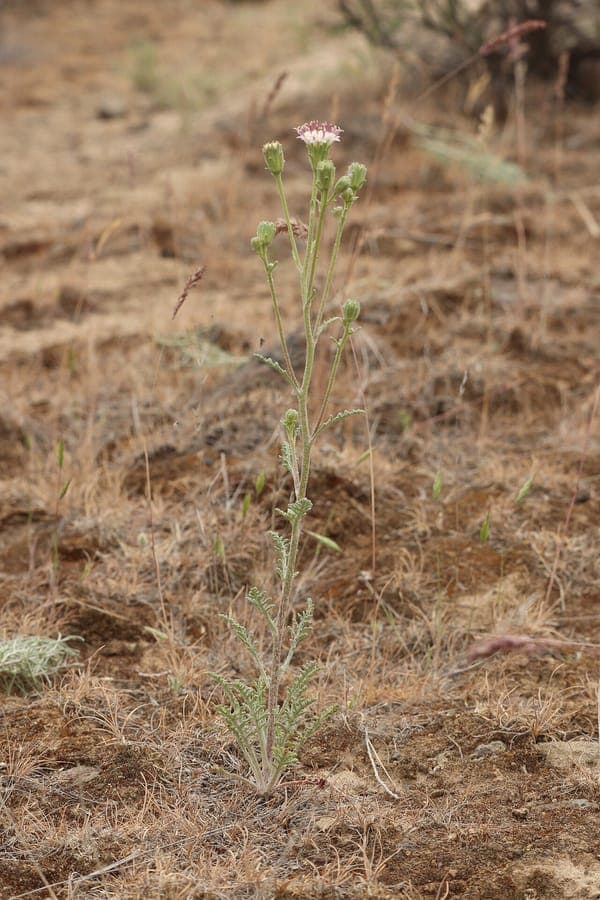
Walter Siegmund (talk) / CC BY-SA 4.0, via Wikimedia Commons
Hoary pincushion: complete guide
Chaenactis douglasii
Want to see Hoary pincushion: complete guide in your garden?
1 minute, no credit card
Overview
Chaenactis douglasii, commonly called hoary pincushion or dusty maiden, is an annual to biennial herbaceous wildflower in the daisy family (Asteraceae). It is native to western North America, ranging from British Columbia and Alberta south through Washington, Oregon, Idaho, Montana, Nevada, California, Colorado, Utah, Wyoming, North and South Dakota, New Mexico, and Arizona.
The common names capture two of the plant's most distinctive visual qualities: 'hoary' refers to the grey-white woolly pubescence covering the stems and leaves, and 'dusty maiden' to the mealy, flour-dusted impression the foliage creates on warm summer days. The pale cream to white flower heads, each shaped like a soft rounded cushion, explain the third name - 'pincushion'. The botanical name Chaenactis derives from the Greek for 'gaping ray', although this species carries disc florets only, with no ray florets at all - a distinguishing character within the Asteraceae.
The plant's natural range spans a remarkable diversity of dry, open habitats: sandy riverbeds and lake shores, rocky canyon slopes, open sagebrush steppe, and disturbed soils, from low-elevation valleys to alpine meadows above 3,500 m. It is a characteristic component of the sagebrush ecosystems of the Intermontane West. The species is named after the Scottish botanist David Douglas, who collected extensively in the Pacific Northwest during the 1820s and brought numerous new species to European botanical attention.
In garden settings, Chaenactis douglasii is a rewarding choice for rock gardens, gravel gardens, dry borders, green roofs, and naturalistic prairie-style plantings. Its long flowering season, compact size, and genuine pollinator value make it an attractive but rarely grown addition to the drought-tolerant planting palette.
Appearance & bloom cycle
Chaenactis douglasii is a compact, erect plant, typically 15–50 cm tall. The stems are upright and branch freely in the upper portion; the entire plant is covered in a grey-white, woolly-glandular pubescence that creates the characteristic 'dusty' appearance. The leaves are pinnately divided to finely dissected, alternate, and emit a faint resinous fragrance when bruised.
The flowering period typically runs from May through August, varying with elevation. At lower elevations, blooming can begin in May; at alpine sites above 2,500 m, it may not begin until July. The flower heads consist entirely of disc florets with no ray florets - an unusual trait for the daisy family. Individual florets are tubular, cream-white with a slight pink or lavender tinge, and packed into dense, rounded heads 1–2 cm in diameter. The heads carry a light, pleasant fragrance that attracts small bees, hoverflies, and beetles in abundance.
In cultivation with a warm, dry position, garden plants typically bloom from June through September. After flowering, the fruits (cypselae) ripen, each equipped with four pappus scales that facilitate wind dispersal. On suitable open, gritty soils, the plant self-seeds readily, maintaining its presence over multiple years without replanting.
Ideal location
Full sun is essential. Partial shade results in leggy, weakly flowering plants that tend to collapse. A south- or southwest-facing position receiving maximum daily sun is optimal.
The plant is best suited to rock gardens, gravel gardens, raised beds, dry slopes, and green roofs. It also performs well in containers filled with a very freely draining substrate. In naturalistic wild-style gardens it fits naturally among other dry-steppe pioneers.
Good air circulation matters. In its natural habitat, Chaenactis douglasii almost always grows in open, wind-exposed positions. In a sheltered garden with stagnant, humid air, the plant becomes susceptible to powdery mildew and other fungal conditions. Allow 25–35 cm spacing between plants for annual cultivation, or 30–40 cm for longer-term plantings.
Soil requirements
The optimal pH range is 5.8–7.0. The species thrives on lean, sandy or gritty substrates that drain rapidly after rain. In rich, nitrogen-heavy garden soil the plant becomes lush, floppy, and flower-shy.
Drainage is the most critical factor. Even brief waterlogging can be fatal. On heavy clay soils, incorporate generous amounts of coarse grit (8–12 mm) and sharp sand before planting. A 10–15 cm drainage layer of gravel beneath the planting zone is worthwhile in clay-dominant gardens.
Additional fertiliser is neither needed nor beneficial. On lean ground the plant is more compact, floriferous, and resistant to lodging. Use an inorganic mulch of fine gravel or decomposed granite around the planting zone rather than organic material, which retains moisture and can cause crown rot.
Free design
Want to see Hoary pincushion: complete guide in your garden? Make a free design now.
Watering
Chaenactis douglasii is a pronounced drought-tolerant plant that survives rainless summers in its native sagebrush habitat without supplemental irrigation. In a well-chosen European garden position, additional watering is generally unnecessary.
In the first year after sowing or transplanting, moderate watering aids establishment: once weekly to thorough wetting until the plant is clearly anchored (four to six weeks). After this, watering frequency can be sharply reduced or eliminated except in extreme drought lasting more than four weeks.
Avoid wetting the foliage - the woolly pubescence traps moisture and promotes fungal development. Drip irrigation at the plant's base is the best approach when supplemental water is needed. Do not water during autumn and winter.
Pruning
Chaenactis douglasii requires almost no pruning. As an annual or biennial it expends its energy in one or two seasons of full flowering. Deadhead spent flower heads promptly if self-seeding is not wanted; leave them on the plant if you want natural spread and seed for birds.
On second-year plants, cutting stems back to about 10 cm after flowering can stimulate basal rosette development and extend the plant's life into a third season in favourable conditions. However, this is not essential for a healthy plant.
In winter, leaving the dried stems standing is beneficial: they provide structural interest, modest windbreak protection for the crown, and seed-foraging opportunities for finches and sparrows. Remove them in March at the start of the new season.
Maintenance calendar
March: Remove last year's dead stems and leaf litter. Check basal rosettes for signs of new growth. No fertilising.
April: Growth resumes. On low-elevation sites, flower buds may already be visible. Water only if soil is completely dry.
May–June: Flowering begins. Creamy-white heads emerge. Pollinators become active. Water sparingly.
July–August: Peak bloom and seed set. Remove spent heads if self-seeding is undesirable.
September: Seed ripening complete. Seeds can be collected for deliberate sowing. Above-ground parts begin to die back.
October–November: Plant withdraws. No intervention needed. Leave stems in place for winter protection.
December–February: Dormancy. No watering, no pruning. Monitor drainage during prolonged wet periods.
Winter hardiness
Chaenactis douglasii is a notably cold-hardy herbaceous plant. The species is native to mountain ranges where temperatures regularly fall to -20 °C and below; it is reliably hardy in USDA zones 4–8. The basal crown survives hard frost well provided the soil drains freely.
In the Netherlands, Belgium, and northern France, the plant is fully hardy in the open ground on a well-drained, dry site. The main overwintering risk is wet soil combined with frost - the most common cause of loss in temperate garden conditions. A mulch layer of gravel around the stem base helps keep the crown dry.
Young seedlings in their first autumn are slightly more vulnerable than established rosettes. In the first winter, a light covering of pine branches or extra gravel over the crown during prolonged hard frost (below -10 °C) offers useful protection. From the second year onward, the plant is fully self-reliant.
Companion plants
Chaenactis douglasii pairs beautifully with other drought-tolerant, open-habitat North American natives:
- Artemisia frigida (Fringed sage): The silver-grey, finely divided foliage creates a perfect visual foil for Chaenactis's cream-white flower heads, and both species share identical habitat preferences for dry, gritty soils.
- Phlox austromontana (Mountain phlox): A low-growing perennial native to the same rocky habitats, blooming before Chaenactis in spring and extending seasonal interest.
- Eriogonum umbellatum (Sulphur-flower buckwheat): Bright yellow clusters complement the white tones of Chaenactis beautifully and share a preference for well-drained mountain soils.
- Festuca idahoensis (Idaho fescue): A fine-textured, blue-grey ornamental grass with identical environmental requirements - its upright tufts provide textural contrast without competing for space.
- Linum lewisii (Blue flax): Clear blue flowers alongside white Chaenactis blooms create a classic colour pairing in naturalistic dry borders.
To design your own rock or gravel garden incorporating hoary pincushion and companion natives, the planning tool at gardenworld.app lets you visualise planting combinations before you dig a single hole. For more inspiration on drought-tolerant and naturalistic planting styles, visit gardenworld.app.
Closing
Chaenactis douglasii is one of those quietly accomplished wildflowers that rewards the patient, observant gardener far more than its modest appearance initially suggests. Its cream-white pincushion heads, aromatic foliage, and cloud of attending bees and hoverflies make it a genuine contributor to a dry, naturalistic garden ecosystem. Given full sun, lean and free-draining soil, and minimal interference, it delivers flowers from June to September, self-seeds politely on suitable ground, and asks almost nothing in return. For any gardener with a dry, sunny spot that proves difficult to plant, hoary pincushion deserves serious consideration.
Want to see Hoary pincushion: complete guide in your garden? Make a free design now.
Upload a photo, pick a style, and get a photorealistic design with plant list in under a minute.
10,000+ gardens designed already
No credit card required


Similar plants
Calendula stellata: complete guide
Calendula stellata
Complete guide to Calendula stellata, the star-flowered marigold from Sicily: location, soil, watering and companion planting tips.
Korean chrysanthemum: complete guide
Chrysanthemum x rubellum
Chrysanthemum x rubellum is a hardy autumn perennial with single pink to copper flowers from August to November. Care and combinations.
Helianthus divaricatus: complete guide
Helianthus divaricatus
Helianthus divaricatus is a North American woodland sunflower with yellow summer blooms, ideal for naturalistic borders and shady edges.