
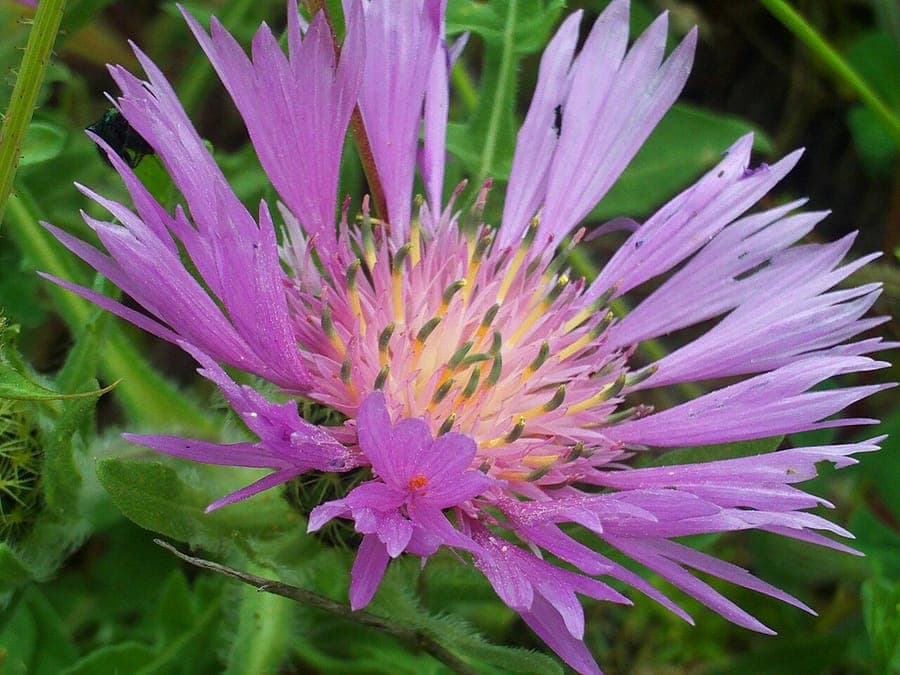
Javier martin / Public domain, via Wikimedia Commons
Purple Knapweed: complete guide
Centaurea pullata
Want to see Purple Knapweed: complete guide in your garden?
1 minute, no credit card
Overview
Purple knapweed (Centaurea pullata) is a charming annual or biennial plant belonging to the daisy family Asteraceae. Native to the western and central Mediterranean basin, its natural range extends from Portugal and Spain through southern France and Italy to North Africa, including Morocco, Algeria and Tunisia. Carl Linnaeus first described the species scientifically in 1753 in his Sp. Pl. The epithet "pullata" is derived from the Latin word for mourning clothing, referencing the dark, nearly black involucral bracts that frame the vivid purple florets.
For gardeners looking for a summer-blooming plant that demands little water and thrives on poor, well-drained soils, purple knapweed is an excellent choice. On gardenworld.app you can visualise how Mediterranean plants like this knapweed might look combined in your own front garden, creating a cohesive drought-tolerant planting scheme.
Appearance and bloom cycle
Centaurea pullata forms an upright, lightly branched plant that typically reaches 30 to 60 cm in height. The stems are pale green and covered in fine woolly hairs, bearing deeply pinnate, lance-shaped leaves. The lower leaves are stalked and relatively large, while the upper leaves are smaller and clasp the stem directly.
Flowers appear from May through June. Each flower head has a distinctive rounded base composed of dark, near-black phyllaries (involucral bracts) with fringed margins. From this dark involucre emerge ray florets in intense purple-violet, which is why this plant is commonly called purple knapweed. The disc florets at the centre release nectar and pollen that attract bees, bumblebees and butterflies in abundance. After flowering, small achenes (cypsela) develop, each tipped with short bristle-like pappus hairs.
The striking contrast between the dark involucre and the bright purple florets gives the plant an elegant, jewel-like appearance. In mass plantings or used as an accent between pale-flowered companions and grey-leaved plants, purple knapweed creates a memorable visual impact.
Ideal location
Purple knapweed requires an open, sunny position. A minimum of six hours of direct sunlight per day is desirable. In shaded positions the stems stretch towards the light, become floppy and the plant produces significantly fewer flowers. In its Mediterranean homeland it grows on dry hillsides, roadsides and disturbed ground, always in full sun.
This plant suits rock gardens, gravel gardens, Mediterranean-style borders and herb gardens. Its moderate height also makes it a good candidate for large terracotta pots or containers on a sunny terrace or balcony. Planting in a sheltered position, away from strong wind, produces sturdier flower stems and better blooms.
On gardenworld.app you can upload a photo of your garden and receive a photorealistic redesign showing how plants like purple knapweed could transform your front yard.
Soil
Centaurea pullata is undemanding when it comes to soil. It grows best in well-drained, light to moderately infertile soil with a pH between 7.0 and 7.5. Heavy clay or poorly drained soils are unsuitable: waterlogged roots quickly cause rotting. Sandy or lightly loamy soils suit this plant perfectly.
On rich, fertile soil the plant produces plenty of foliage but fewer flowers, and the stems become floppy. It is therefore better not to add fertiliser. A thin layer of fine gravel or grit around the base of the plant helps excess moisture drain away quickly and keeps the crown dry, reducing the risk of fungal disease. A lightly calcareous soil does the plant no harm; quite the contrary, it thrives in it.
Free design
Want to see Purple Knapweed: complete guide in your garden? Make a free design now.
Watering
Purple knapweed is strongly drought tolerant and needs virtually no supplemental water once established. During prolonged dry spells and heat waves the soil can be lightly moistened, but it is essential that the roots do not remain wet for long. Water at the base of the plant rather than overhead to keep the foliage dry and reduce the risk of leaf spot disease.
For freshly planted specimens, regular watering during the first four to six weeks is recommended to help develop a strong root system. After that the plant is fully self-sufficient under typical north-west European conditions and needs considerably less water than most garden plants. Excessive watering shortens the flowering season and weakens the plant.
Pruning
For an extended flowering season, deadheading - removing spent flower heads - is worthwhile. Cutting off faded flower heads just above the first side shoot encourages the plant to form new buds, potentially extending the display by several weeks.
If you want to collect seed for the following season, allow a few flower heads to develop into mature fruits. The seeds are easy to store in a dry, cool place.
After flowering, once the plant starts to yellow, it may be removed entirely or cut back to just above ground level if grown as a biennial. No intensive or formative cutting is necessary; purple knapweed requires only minimal maintenance.
Maintenance calendar
January - February: Store seed in a cool, dry place or source fresh seed from specialist garden centres. Plan the border layout.
March: Sow indoors on a lightly heated windowsill or in a cold frame (10-15 degrees Celsius). Sow seeds shallowly and cover lightly with seed compost.
April: Direct sow outdoors after the last frost, or transplant seedlings to their final position at a spacing of approximately 25 cm.
May - June: Peak flowering. Deadhead regularly to prolong display. Little to no additional water needed unless drought is prolonged.
July: Flowering may continue if deadheaded promptly. Consider a second sowing for autumn colour.
August - September: Allow a few seed heads to ripen for seed collection or self-seeding. Plant starts to decline.
October - December: Remove spent plants or leave for seed. Lightly turn the bed over for the following season.
Winter hardiness
Centaurea pullata is a warmth-loving Mediterranean plant typically grown as an annual in north-west Europe. It is not frost hardy in the British, Dutch or Belgian climate and will die back after the first freeze. In mild coastal regions with gentle winters (USDA zone 8b and above) it can overwinter as a biennial.
In USDA zone 7 and colder it is advisable to sow fresh plants each year. In favourable years it self-seeds reliably; watch for seedlings in spring that can be transplanted to their final positions.
Companion plants
Purple knapweed pairs beautifully with other Mediterranean drought-tolerant plants. Some attractive combinations:
- Lavandula angustifolia (lavender): the silvery stems and purple lavender spikes complement the deep-purple knapweed heads perfectly.
- Stachys byzantina (lamb's ear): the grey, felted foliage provides a calming backdrop for the intense knapweed colours.
- Erigeron karvinskianus (Mexican daisy): small white to pink flowers create contrast with the intense purple.
- Salvia officinalis (sage): grey-green leaves and blue flowers harmonise beautifully with the knapweed.
- Gaura lindheimeri: graceful white butterfly-like flowers move elegantly alongside the sturdy knapweed stems.
Avoid pairing with moisture-loving plants such as hostas or astilbes, as the watering and soil preparation they require can be harmful to the knapweed.
Closing thoughts
Purple knapweed is a versatile, low-maintenance plant for the Mediterranean border, the rock garden and sunny borders on lean soils. Its intensely purple flowers attract bees and butterflies and bring a lively character to the garden from May through July. For more inspiration about drought-tolerant plants and Mediterranean garden styles, gardenworld.app offers an extensive platform for exploring garden designs and visualising them based on your own front garden photo.
Want to see Purple Knapweed: complete guide in your garden? Make a free design now.
Upload a photo, pick a style, and get a photorealistic design with plant list in under a minute.
10,000+ gardens designed already
No credit card required


Similar plants
Calendula stellata: complete guide
Calendula stellata
Complete guide to Calendula stellata, the star-flowered marigold from Sicily: location, soil, watering and companion planting tips.
Korean chrysanthemum: complete guide
Chrysanthemum x rubellum
Chrysanthemum x rubellum is a hardy autumn perennial with single pink to copper flowers from August to November. Care and combinations.
Helianthus divaricatus: complete guide
Helianthus divaricatus
Helianthus divaricatus is a North American woodland sunflower with yellow summer blooms, ideal for naturalistic borders and shady edges.