
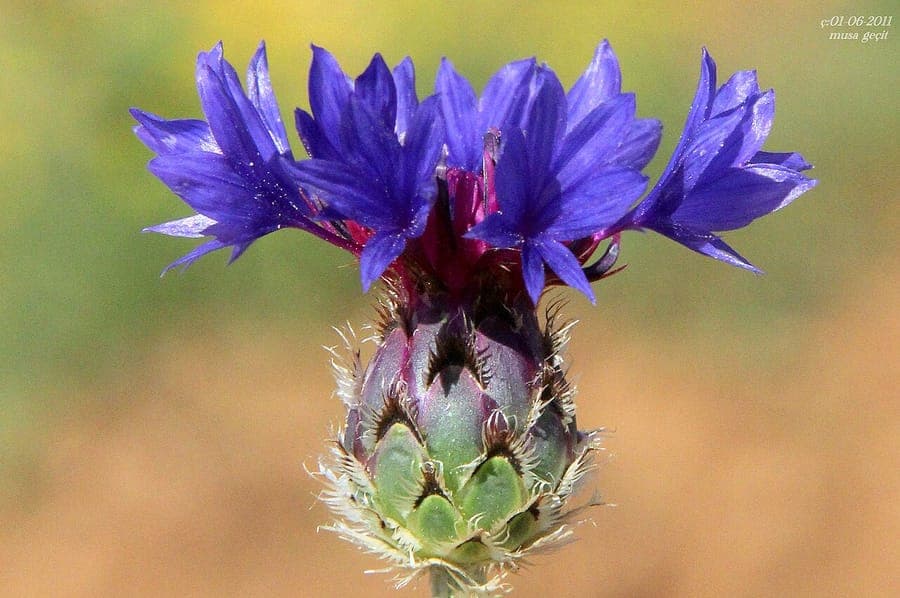
Musa geçit / CC BY-SA 3.0, via Wikimedia Commons
Low cornflower: complete guide
Centaurea depressa
Want to see Low cornflower: complete guide in your garden?
1 minute, no credit card
Overview
The low cornflower (Centaurea depressa) is a compact, vivid-flowered annual native to the steppe regions of Turkey, Iran, the Caucasus and Central Asia, extending east to the western Himalayas. A close relative of the common cornflower (Centaurea cyanus), it differs most noticeably in its much shorter stature: where Centaurea cyanus regularly reaches 60 to 90 cm, Centaurea depressa rarely exceeds 20 to 35 cm, making it a much more useful plant for the front of a border or for a wildflower meadow planting where height needs to be kept in check. It has been introduced into several European countries as a garden ornamental, and on gardenworld.app it features in inspiration boards for naturalistic, pollinator-friendly summer borders.
The species name depressa means 'pressed down' or 'low-growing' in Latin, accurately describing the compressed, cushion-like growth habit that sets it apart from other cornflower species. First described in 1808 by the Prussian-Russian botanist Friedrich August Marschall von Bieberstein from Caucasus material, the species has also appeared in botanical literature as Cyanus depressus and Centaurea anatolica.
Appearance and bloom cycle
Centaurea depressa grows as a bushy, strongly-branched annual forming a rounded mound 20 to 35 cm tall and 25 to 40 cm wide. The stems are slightly whitish-hairy and bear elongated, grey-green leaves that run a little way along the stem in a winged manner. The foliage texture is soft and slightly felty to the touch.
The flowers are the plant's outstanding feature. Each flower head measures 3 to 5 cm across with the characteristic ray florets at the margin forming a frilled crown in vivid blue to violet-blue. The central disk florets are somewhat darker in shade. Flowering runs from May through August with peak production in June and July. Because the plant branches so freely and carries flower heads on many stems simultaneously, a well-grown specimen creates a dense, intensely coloured carpet of blue during the peak weeks of summer.
After flowering, small achenes with a short feathery pappus develop. In open, well-drained conditions the plant self-sows reliably, returning the following year without replanting.
Ideal location
Full sun is essential for Centaurea depressa to perform at its best. In its natural habitat it grows on dry, rocky or calcareous hillsides, field margins and gravelly river terraces under intense sunlight. In the garden it needs an open, south or south-west facing position with no overhead shade. Half shade is tolerable but results in less prolific flowering and slightly lax growth.
The low cornflower is well suited to dry borders, chalk gardens, gravel paths, wildflower meadows, window boxes and as a companion plant in kitchen gardens. It also thrives in traditional cornfield-style plantings together with field poppies, chamomile and other arable annuals, recreating the look of a summer meadow.
Soil
Dry, lean, freely-draining soil is what Centaurea depressa does best in. It tolerates calcareous, stony and sandy substrates without complaint and has no need for added nutrients. On rich, humus-heavy soil the plant may produce more foliage than flowers and becomes susceptible to powdery mildew. The ideal soil pH range is 6.5 to 8.0, making slightly alkaline calcareous soils entirely suitable.
If your garden soil is heavy clay, improve the planting area by working in coarse sand or grit to a depth of 20 to 30 cm before sowing. No mulch is required, and heavy mulching can make the soil too fertile and retain too much moisture, both of which are counterproductive for this plant.
Watering
Once established, the low cornflower is strongly drought tolerant. In its Central Asian homeland it survives dry summers with minimal rainfall. In a European garden setting, supplementary watering is rarely needed during a normal season. During prolonged dry spells of more than two weeks, a weekly deep watering at the base of the plant is sufficient to maintain good flower production.
Young seedlings benefit from slightly more regular moisture in the first two weeks after germination, but once rooted they become largely self-sufficient. Overwatering is the most common error: waterlogged soil leads to root rot and a marked reduction in flowering. Always water at the base and allow the soil to dry between applications.
In containers, water a little more frequently than in open ground, but always let the potting mix dry at least partially between waterings. Terracotta pots with generous drainage holes are preferable to glazed or plastic containers.
Free design
Want to see Low cornflower: complete guide in your garden? Make a free design now.
Pruning
As an annual, Centaurea depressa needs no pruning in the traditional sense. Deadheading, however, makes a noticeable difference to the length of the flowering season. Remove spent flower heads as soon as the ray florets begin to turn brown, and the plant will redirect its energy into producing new buds on the side branches rather than into seed production. With regular deadheading the display can be extended by three to four weeks.
If you want the plant to self-seed for the following year, stop deadheading in late July or August and allow the last flower heads to ripen fully. Seeds survive mild to moderately cold winters well in an open, light soil and germinate the following spring without assistance. Remove the dead plant material in autumn but do not dig the soil deeply so as not to bury the surface-lying seeds.
To save seed deliberately, pick ripe flower heads just before they open, allow them to dry on a paper tray in a warm, airy place, then store the cleaned seed in a cool, dry location until spring.
Maintenance calendar
March to April: sow directly outdoors on the final site once the soil is workable and night frosts are past. Cover seed with no more than 5 mm of soil. For an earlier start, sow indoors from mid-February at 15 degrees Celsius.
April to May: thin seedlings to 20 to 25 cm apart. No feeding. Watch for slugs on young seedlings.
May to August: flowering season. Deadhead regularly to prolong the display.
July to August: allow the last flower heads to ripen for self-seeding or seed collection.
September to October: remove dead plants. Lightly rake the surface to improve germination conditions for self-sown seeds.
November to February: dormant season. No action needed.
Winter hardiness
Centaurea depressa is a true annual and does not survive winter as a living plant. Top growth is killed by the first hard autumn frost. The seeds are reasonably frost hardy and survive mild to moderately cold winters in open, light soil. In USDA zones 3 to 9 the species behaves as a reliable summer-flowering annual. In gardens with open, undisturbed soil it often self-seeds and returns year after year without any intervention from the gardener.
In cold, wet winters or in heavy clay soils, seed survival is uncertain. Fresh seed is readily available in spring from specialist wildflower seed suppliers and from many larger garden centres as part of meadow mixes or as a single species. Gardenworld.app can help you plan a colourful pollinator border where self-seeding annuals like Centaurea depressa are given the right conditions to naturalise over time.
Companion plants
The vivid blue of Centaurea depressa pairs beautifully with warm yellow, orange and white tones in a summer border. Effective companions include:
- Common cornflower (Centaurea cyanus): the taller sister species repeats the blue tone and adds vertical structure.
- Field poppy (Papaver rhoeas): brilliant red poppies beside low blue cornflowers are the classic arable wildflower combination.
- Corn marigold (Glebionis segetum): yellow daisy-like flowers complement the blue with a cheerful contrast.
- Pot marigold (Calendula officinalis): orange flowers on the same type of dry, sunny soil blooming at the same time.
- Chamomile (Anthemis tinctoria): yellow-centred white flowers add lightness and attract additional pollinators.
Closing
The low cornflower is one of those understated garden plants that over-delivers season after season. Its compact size makes it more versatile than the standard cornflower, its blue is as intense and as beautiful, and its tolerance of dry, lean conditions means it succeeds in spots where many other annuals would struggle. Sow it in spring, deadhead it through summer, and let it self-seed in autumn - a simple routine that rewards with weeks of brilliant blue. If you want to work Centaurea depressa into a larger planting plan alongside other drought-tolerant summer annuals, gardenworld.app lets you design and visualise the full composition before buying a single seed packet.
Want to see Low cornflower: complete guide in your garden? Make a free design now.
Upload a photo, pick a style, and get a photorealistic design with plant list in under a minute.
10,000+ gardens designed already
No credit card required


Similar plants
Calendula stellata: complete guide
Calendula stellata
Complete guide to Calendula stellata, the star-flowered marigold from Sicily: location, soil, watering and companion planting tips.
Korean chrysanthemum: complete guide
Chrysanthemum x rubellum
Chrysanthemum x rubellum is a hardy autumn perennial with single pink to copper flowers from August to November. Care and combinations.
Helianthus divaricatus: complete guide
Helianthus divaricatus
Helianthus divaricatus is a North American woodland sunflower with yellow summer blooms, ideal for naturalistic borders and shady edges.