
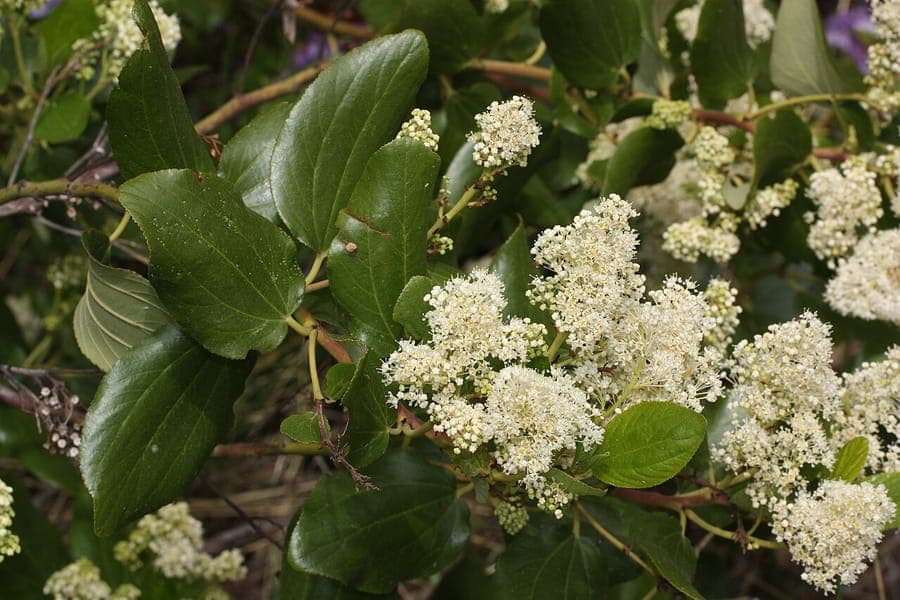
Walter Siegmund (talk) / CC BY-SA 3.0, via Wikimedia Commons
Snowbrush ceanothus: complete guide
Ceanothus velutinus
Want to see Snowbrush ceanothus: complete guide in your garden?
1 minute, no credit card
Overview
Ceanothus velutinus, commonly called snowbrush ceanothus, snowbrush, or mountain balm, is a resilient evergreen to semi-deciduous shrub belonging to the buckthorn family (Rhamnaceae). Native to western North America - from British Columbia and Alberta south through Washington, Oregon, Idaho, Nevada, California, Wyoming, Colorado, and South Dakota - it colonises open mountain slopes, dry coniferous woodland margins, and disturbed or post-fire terrain with remarkable vigour.
The species is a true nitrogen-fixing pioneer. Through root symbiosis with the actinomycete bacterium Frankia, it converts atmospheric nitrogen into plant-available forms, enriching depleted soils and facilitating the recovery of surrounding vegetation. This ecological role makes it particularly valuable in restoration gardens, on stony slopes, and in any setting where the soil is lean and free-draining.
The botanical epithet 'velutinus' (velvety) refers to the soft pubescence on young stems. A more distinctive character is the thick, resinous coating on the dark, shiny upper leaf surface, which gives off a rich, balsamic scent on warm days - this is the 'mountain balm' of its folk name. The foliage was historically used by indigenous peoples as a soap substitute, earning the plant its alternative name 'soapbrush' or 'tobacco brush'.
In garden settings, snowbrush typically grows 50–200 cm tall and 100–200 cm wide, forming a dense, spreading mound. Growth rate is moderate. In its natural range it can reach 3 m on favourable sites, though European garden specimens rarely approach this size.
Appearance & bloom cycle
Ceanothus velutinus produces broad-ovate leaves, 4–8 cm long and 3–6 cm wide, with three prominent veins running from near the base of the leaf blade - a reliable identification feature among western ceanothus species. The upper leaf surface is dark green and varnish-shiny thanks to the resinous wax layer; the underside is paler and softly hairy. Leaves are alternate along the stems and, depending on the climate, may persist through mild winters or drop in colder conditions.
Flowering takes place from late May to July, typically peaking in June. The tiny white flowers are individually inconspicuous but are gathered into dense, elongated panicles 5–15 cm in length that appear at the tips of the current season's growth. The fragrance is distinctive - sweet, honey-like, with slightly resinous undertones - and is detectable from several metres away. On warm, sunny June mornings, a well-established plant can fill an entire corner of the garden with scent.
The flowers are magnets for pollinators: bumblebees, honeybees, hoverflies, and butterflies gather in numbers. After flowering, small three-lobed capsules develop and ripen to dark brown by August. The hard-coated seeds are adapted to germinate after fire or heat treatment; in cultivation, propagation from cuttings in late summer is more reliable.
Autumn colour is subdued - leaves turn yellow-green or light brown - but the compact, branching structure of the shrub remains an interesting winter silhouette.
Ideal location
Full sun is ideal for the richest flowering and strongest scent production. A south- or southwest-facing position in the garden maximises sun hours and encourages the resin glands to work at full capacity. Partial shade is tolerated, but flowering will be less abundant and the characteristic scent less intense.
The plant is perfectly suited to dry, sloping ground, rock gardens, woodland edges, and poor-soil borders. It is not suitable for wet or waterlogged positions - excess winter moisture at the roots is the single most common cause of plant loss. On erosion-prone slopes, the extensive root system, including a deep, woody crown, anchors soil effectively.
When planting multiple specimens, allow 100–150 cm between plants. This spacing permits each shrub to develop its characteristic open, spreading habit. In rock gardens, snowbrush works beautifully as a specimen plant among stones and drought-tolerant perennials.
Soil requirements
Ceanothus velutinus is tolerant of a wide range of soil types, provided drainage is excellent. The optimal pH falls between 6.5 and 8.3 - the shrub thus thrives in both slightly acidic and calcareous soils. Heavy clay is strongly contraindicated: saturated roots in winter cause root rot and rapid decline.
Sandy, stony, or light loamy soils are ideal. Overly rich, nitrogen-loaded soils can produce rank, leafy growth at the expense of flowering. As a nitrogen-fixer, this plant genuinely needs no fertiliser - a distinct advantage on impoverished, degraded soils where other shrubs struggle.
If your garden soil is heavy, improve the planting spot by incorporating coarse grit or gravel to a depth of 30–40 cm before planting. Avoid large amounts of compost, which retains moisture and can destabilise the balance that suits this plant.
Free design
Want to see Snowbrush ceanothus: complete guide in your garden? Make a free design now.
Watering
Once established, snowbrush ceanothus is one of the most drought-tolerant shrubs available for temperate gardens. In its native mountain habitat it endures dry Rocky Mountain and Cascade summers without any supplemental water. The same principle applies in the European garden: after the first growing season, the shrub requires virtually no irrigation.
During the establishment year, however, consistent moisture is important. Water once per week, thoroughly wetting the root zone, then allow the soil to dry completely before the next application. Drip irrigation or direct soil watering is preferable to overhead sprinklers, which wet the foliage and can promote leaf-spot diseases.
In prolonged summer heat with no rain for more than three weeks, a single deep watering may benefit even established plants. In winter, additional water is never needed - wet conditions at this time are actively harmful.
Pruning
Little pruning is required, but light maintenance immediately after flowering in July or August keeps the plant compact and encourages strong blooming the following year. Since ceanothus flowers on the current season's wood, do not prune in autumn or winter - this removes the flowering potential and weakens cold hardiness.
After the blooms fade, deadhead the old flower clusters and lightly trim any wayward stems back to a strong lateral branch. This promotes compact, bushy growth. Hard renovation pruning is rarely necessary; when an old specimen has grown untidy, gradual rejuvenation over two to three years - removing one quarter of the oldest stems each year down to about 30 cm - is more reliable than a single drastic cut.
Avoid heavy pruning in late summer or autumn, as this stimulates soft growth that will be vulnerable to the first frosts.
Maintenance calendar
March–April: Inspect after winter for frost damage. Remove dead wood back to living tissue. Check drainage; top-dress with coarse grit if drainage has deteriorated.
May: Monitor the first flower buds. On favourable sites, blooming can begin in late May. Water only if no rainfall for more than two weeks.
June–July: Peak flowering. Enjoy the scent and pollinator activity. Deadhead after blooms fade and carry out any light corrective pruning.
August: Seed capsules ripen. Collect seeds if desired for experimental sowing. No further pruning.
September–October: The plant winds down. Apply a light mulch of coarse grit or gravel around the base if a hard winter is expected. Stop all fertilising.
November–February: Dormancy. No watering, no pruning, no intervention. Monitor drainage during prolonged wet spells.
Winter hardiness
Ceanothus velutinus is notably more cold-hardy than most ornamental ceanothus cultivars sold in garden centres. The species tolerates temperatures down to approximately -20 °C, placing it firmly in USDA hardiness zone 5 and even the borderline of zone 4. In the Benelux, northern France, and Germany, winter cold is therefore rarely a limiting factor, provided drainage is sound.
The critical risk in northwest Europe is not extreme cold but the combination of frost and saturated soil. Wet roots in winter, particularly on heavy clay, cause far more damage than low temperatures alone. A well-drained site makes protective measures such as fleece or straw unnecessary in most winters.
Newly planted specimens in their first year are more vulnerable. In the first winter, protect the root zone with a thick layer of straw or pine branches around the base if hard frosts below -10 °C are forecast. From the second year onward, the plant is fully self-sufficient.
Companion plants
Snowbrush ceanothus combines well with other drought-tolerant, low-nutrient plants. Particularly successful groupings include:
- Artemisia tridentata (Big sagebrush): Silver-grey foliage provides striking contrast to the glossy dark green leaves of ceanothus. Both species share the same preference for dry, alkaline soils.
- Penstemon pinifolius and Penstemon davidsonii: Low-growing, tubular-flowered penstemons native to the same mountain regions - ideal companions at the base of the shrub.
- Mahonia aquifolium (Oregon grape): A fellow North American shrub for sunny, well-drained sites; offers complementary leaf texture and yellow spring flowers.
- Eriophyllum lanatum (Woolly sunflower): A low, yellow-flowered perennial perfectly matched to the same dry, open habitats.
- Festuca glauca (Blue fescue): This ornamental grass adds colour contrast and has identical environmental preferences to ceanothus.
- Salvia nemorosa (Balkan sage): Thrives in the same sunny, dry conditions and extends interest with violet spikes from June through August.
For a complete garden design incorporating snowbrush ceanothus and other drought-tolerant plants, try the design tool at gardenworld.app to visualise the combinations in your own front garden. More inspiration for naturalistic, low-water planting schemes is available on gardenworld.app.
Closing
Ceanothus velutinus is an undervalued shrub that deserves a far wider place in European dry gardens. Its combination of nitrogen-fixing capability, drought resilience, generous white flowering, and distinctive balsamic fragrance make it genuinely versatile - suitable for rock gardens, dry slopes, wildlife gardens, and low-maintenance front yards. Once established, it almost looks after itself, requires no fertiliser, and rewards the gardener with a spectacular June display year after year.
If you have a sunny, dry corner that defeats most plants, give snowbrush ceanothus a chance. The scent alone - warm, sweet, and unmistakable on a June morning - makes the investment worthwhile.
Want to see Snowbrush ceanothus: complete guide in your garden? Make a free design now.
Upload a photo, pick a style, and get a photorealistic design with plant list in under a minute.
10,000+ gardens designed already
No credit card required


Similar plants
Point Reyes ceanothus: complete guide
Ceanothus gloriosus
The Point Reyes ceanothus is an evergreen Californian groundcover with blue flowers. Location, soil and pruning explained in detail.
Santa Barbara ceanothus: complete guide
Ceanothus impressus
Ceanothus impressus rewards a sunny wall with deep blue flowers in March-May. Location, soil, pruning and winter protection explained.
Redstem ceanothus: complete guide
Ceanothus sanguineus
Ceanothus sanguineus is a hardy, deciduous shrub with reddish stems and creamy white flower clusters in June. Care and companions.