
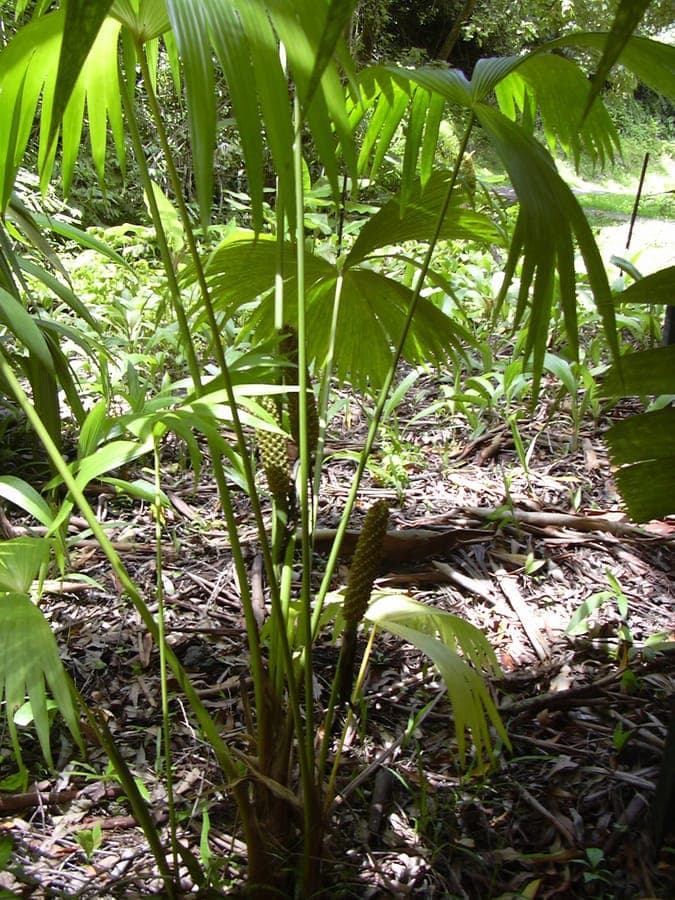
Forest & Kim Starr / CC BY 3.0, via Wikimedia Commons
Panama-hat-palm: complete guide
Carludovica palmata
Want to see Panama-hat-palm: complete guide in your garden?
1 minute, no credit card
Overview
The Panama-hat-palm (Carludovica palmata) is a fascinating tropical plant originating from Central and South America. The plant is famous because its leaves are used to make Panama hats. This impressive plant with large, woven leaves is the perfect choice for the living room or conservatory.
Appearance and bloom
Carludovica palmata is an herbaceous plant that can reach 1.5 to 2.5 meters in height. The plant features characteristic large leaves resembling palm fronds but actually composed of multiple segments. The leaves are light green and can become quite large - up to 60 centimeters. The plant produces small, inconspicuous flowers growing in clusters. The fruits are yellow.
Ideal location
This plant thrives in partially shaded, warm locations. Place it near a window with indirect sunlight. Direct sun rays can cause leaf burn. The plant grows well in living rooms with temperatures between 18 and 25°C. Protect from drafts and temperature fluctuations.
Soil
The plant grows well in nutritious, airy potting soil. Add peat and perlite for improved drainage. Nutrient-rich, humus-rich soil is desired. The plant prefers neutral to slightly acidic soil. Ensure good drainage in pots - waterlogging is harmful.
Watering
Keep the soil regularly moist but not waterlogged. Water when the top layer feels moist. During growth (April-September), water regularly. During dormancy (October-March), water less frequently. Ensure water drains well. Drip irrigation works well for this plant.
Free design
Want to see Panama-hat-palm: complete guide in your garden? Make a free design now.
Pruning
Pruning is almost unnecessary, but damaged leaves can be removed. Remove yellow or brown leaves immediately. Rinse the leaves regularly with water to remove dust. This keeps the plant healthy and attractive.
Maintenance calendar
April-May: provide nutrients, check for pests. June-August: water regularly, rinse leaves. September-October: reduce fertilizer, water less. November-March: minimal care, frost-free environment.
Winter hardiness
Carludovica palmata is not winter hardy. The plant tolerates no frost or temperatures below 10°C. In tropical and subtropical areas, the plant grows outdoors. In temperate regions, container cultivation and indoor overwintering are necessary. Protect from cold wind.
Companion plants
In living rooms, the Panama-hat-palm pairs well with other tropical plants. Try combinations with monstera, anthurium, and other foliage plants. Palms and banana plants also form attractive combinations. In conservatories, it pairs beautifully with orchids.
Conclusion
Carludovica palmata brings tropical charm to your living room. A unique plant with history. Provide warm, humid conditions and enjoy it for years. Purchase your specimen from specialized nurseries.
Gardenworld.app helps you design tropical and subtropical plant combinations.
Want to see Panama-hat-palm: complete guide in your garden? Make a free design now.
Upload a photo, pick a style, and get a photorealistic design with plant list in under a minute.
No credit card required


Similar plants
Acer pycnanthum: complete guide
Acer pycnanthum
Acer pycnanthum, the Japanese swamp maple, is a fast-growing tree with early red flowers and brilliant autumn color, ideal for damp garden settings.
Freeman maple: complete guide
Acer × freemanii
Everything about the Freeman maple (Acer x freemanii): a fast-growing shade tree with spectacular autumn colour for large gardens.
Silver vine: complete guide
Actinidia polygama
Discover silver vine (Actinidia polygama): a hardy climbing plant with silvery foliage, loved by gardeners and cats alike.