
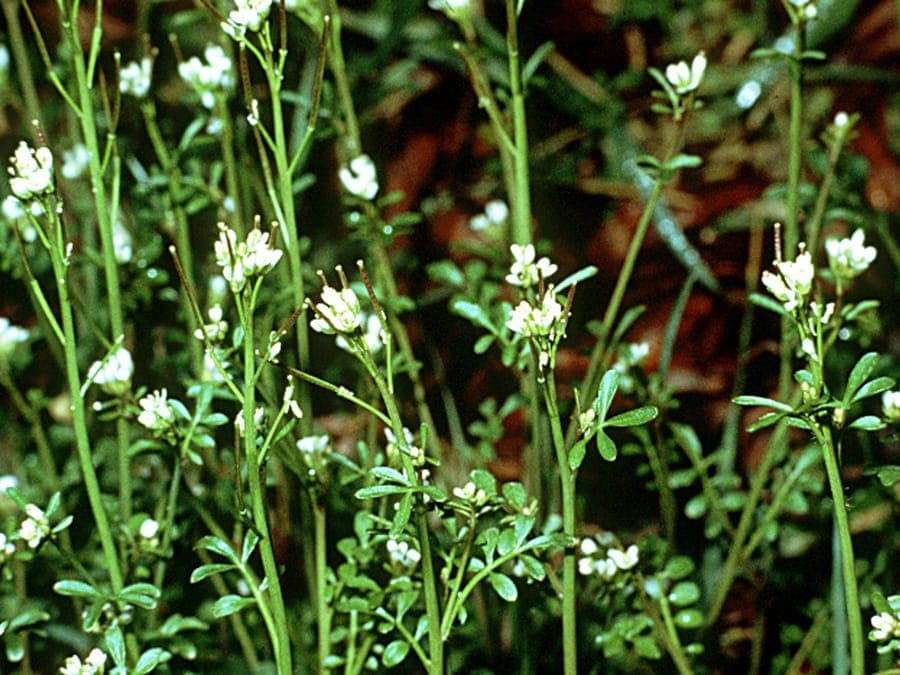
Robert H. Mohlenbrock. USDA SCS. 1989. Midwest wetland flora: Field office illustrated guide to plant species. Midwest National Technical Center, Lincoln. Courtesy of USDA NRCS Wetland Science Institute. / Public domain, via Wikimedia Commons
Pennsylvania bittercress: complete guide
Cardamine pensylvanica
Want to see Pennsylvania bittercress: complete guide in your garden?
1 minute, no credit card
Overview
Cardamine pensylvanica, commonly called Pennsylvania bittercress or Quaker bittercress, is an annual to biennial herb in the mustard family, Brassicaceae. First documented by the botanist Muhlenberg and formally described by Willdenow in 1800, it is among the most widespread members of the large genus Cardamine, with a native range stretching from the subarctic Yukon and Alaska across all of Canada and the contiguous United States down to the Bahamas. It has also been introduced to parts of the Caribbean. This extraordinary range speaks to the plant's adaptability across vastly different climates, from boreal forest margins to subtropical coastal swamps.
In the garden, Pennsylvania bittercress earns its place in moist, partly shaded settings that challenge many other ornamental plants. Its finely divided, pinnate leaves give a delicate, ferny texture to pond margins, bog gardens and the shady understory of trees. The tiny white flowers, borne in elongating racemes, are a welcome early food source for small bees and flies emerging in the first warm weeks of spring. At gardenworld.app you can see how wetland-edge plants like this one transform shady, damp corners of a front garden into something genuinely attractive.
The genus Cardamine is one of the largest in the Brassicaceae, with over 200 described species. Cardamine pensylvanica is closely related to the Eurasian Cardamine flexuosa (wavy bittercress) and Cardamine hirsuta (hairy bittercress), and has been treated as a variety or subspecies of both in older taxonomic treatments. It differs in its preference for consistently moist to wet soils, its somewhat larger stature and its primarily North American distribution. More than ten synonyms have been recorded, reflecting the species' taxonomic complexity and the difficulty of separating closely related annual Cardamine taxa.
Appearance and bloom cycle
Cardamine pensylvanica forms a basal rosette of pinnately compound leaves, each 5–15 cm long and composed of three to nine pairs of small, rounded to oval leaflets. The leaflet surfaces are smooth to slightly hairy, bright green and soft in texture. From the rosette, one or more branching flowering stems grow erect, reaching 15–45 cm tall depending on moisture availability and light conditions. The stems bear alternate pinnate leaves similar to the basal rosette but progressively smaller toward the tips.
Flowering occurs from March through May in temperate European climates, occasionally beginning in February in sheltered mild-winter locations. The flowers are very small - individual petals only 2–3 mm wide - but are produced in such numbers along the branched racemes that the plant presents a frothy white haze that contrasts attractively with the bright green foliage. Each flower has four white petals in the classic cruciform arrangement of the Brassicaceae. The flowers are hermaphrodite and self-compatible, though small bees and flies do visit for the pollen.
After pollination, narrow siliques (seed pods) 1.5–2.5 cm long develop along the stem. The seeds are small, round and dark brown to nearly black. At maturity the pods dehisce explosively, flinging the seeds several centimetres from the parent plant. This mechanism, common to many Cardamine species, allows rapid colonisation of suitable moist ground. A single plant can produce hundreds of seeds; in a garden setting with adequate moisture, self-seeding populations establish quickly and reliably.
Ideal location
Cardamine pensylvanica is a plant of wet, shaded or partly shaded habitats. In its natural range it grows along stream banks, in vernal pools, in wet meadows, along drainage ditches and in the understory of riparian forests. In the garden it performs best in similar conditions: alongside a pond or stream, in a bog garden, under the canopy of moisture-retaining trees, or in a low-lying corner that collects water.
Full sun on dry soil is unsuitable and will cause the plant to bolt quickly, produce poor seed and die without establishing a self-seeding colony. Half to full shade with reliably moist soil is the ideal combination. The plant tolerates periodic flooding and is an excellent choice for planting on the margins of garden ponds or along natural-looking rain garden channels.
In terms of climatic zones, Pennsylvania bittercress spans USDA zones 3–9, making it suitable for virtually all temperate garden climates from Scandinavia to the Mediterranean coast. Spacing for transplanted seedlings should be 15–20 cm apart to allow room for natural spreading.
Soil requirements
Cardamine pensylvanica thrives in rich, moist to wet, humus-rich soils with a pH between 4.8 and 6.8. This slightly to moderately acidic preference suits woodland garden soils, peat-enriched bog substrates and the naturally acidic soils under conifers or oaks. It will also grow on neutral soils but appreciates the added moisture retention that high organic matter provides.
The ideal soil is the kind found on the floor of a mixed deciduous wood: dark, spongy, full of decomposed leaf matter, consistently moist but never stagnant. Amending the planting area generously with leaf mould, garden compost or composted bark will dramatically improve performance on lighter soils. On sandy soils, incorporate a 10 cm layer of peat-free moisture-retaining compost before planting and apply a thick bark mulch to prevent rapid drying.
Avoid very alkaline soils and soils with poor organic content; these lead to chlorosis of the fine leaves and reduced vigour. Near a pond or stream where natural moisture is abundant, no special soil preparation is needed - the plant will establish readily in the existing waterside soil.
Free design
Want to see Pennsylvania bittercress: complete guide in your garden? Make a free design now.
Watering
As a plant of naturally wet habitats, Cardamine pensylvanica has a high moisture requirement. In the garden, the soil around the plant should be kept consistently moist; even brief dry spells cause wilting and premature leaf drop. During warm, dry weather in spring and summer, water at least every other day - or daily if the plant is in a sunny position.
Rainwater or non-softened tap water is preferable; repeatedly applying heavily chlorinated or very hard water gradually inhibits root function. A 5 cm bark mulch around the plants greatly reduces the frequency of watering needed by slowing surface evaporation. Near a pond or in a bog bed with a liner retaining moisture, supplemental irrigation is often unnecessary.
During the flowering and seed-setting period, adequate moisture is especially important for good pod development. Keep the soil moist right through May and June, when the siliques are ripening. After the seeds disperse and the parent plants die back, reduce watering gradually - but maintain moisture for any autumn seedlings that germinate.
Pruning
As an annual or biennial, Cardamine pensylvanica undergoes its entire life cycle without requiring any pruning. The plant germinates, grows, flowers, sets seed and dies within one or two seasons. The only maintenance worth undertaking is removing the dead stems after seed dispersal to keep the planting tidy. If self-seeding is desired - which is the simplest way to maintain a colony - leave the stems in place until the pods have fired all their seeds, then pull the dry stems away from the ground.
If you wish to control the spread, cut the flowering stems before the siliques fully mature; collect the stems rather than composting them on-site, as seeds can continue to develop in cut stems. In a wilder, more naturalistic garden setting, no intervention at all is necessary - the plant will self-regulate according to available moisture and space.
Maintenance calendar
January–February: Keep soil moist but unfrozen if possible. Seeds overwintering in the soil need no care. Remove any heavy leaf fall that might smother emerging seedlings.
March–April: First seedlings appear when soil temperatures exceed 5 °C. Maintain consistent moisture. Early flowers open in mild conditions. Remove competing weeds to give seedlings space.
May–June: Full bloom and rapid pod development. Water every other day or daily in dry weather. Decide whether to remove stems before pod opening or allow self-seeding. Feed once with diluted liquid fertiliser if foliage looks pale.
July–August: Parent plants die after seeding. Remove dead stems. New seedlings may germinate in the moist soil beneath. Keep moisture levels up to support the new generation.
September–October: Autumn seedlings emerge and form overwintering rosettes. Transplant any to desired locations. Top up bark mulch for winter protection.
November–December: Overwintering rosettes go semi-dormant. Keep soil just moist. No feeding needed. Check for slug damage on young rosette leaves.
Winter hardiness
Cardamine pensylvanica is cold-hardy from USDA zones 3 to 9, reflecting its subarctic origin in northern Canada and Alaska. Seeds in the soil survive deep winter freezing without any harm. Young overwintering rosettes tolerate light to moderate frost well and resume growth as soon as soil temperatures rise above 5 °C in late winter. Only prolonged hard frost combined with severely dry soil - unusual in the maritime climates of Western Europe - poses any real risk to overwintering plants.
The plant requires no winter protection in northern European gardens. A light layer of fallen leaves over rosettes will help in regions where hard frost without snow cover is common. In milder coastal climates, the plant may remain green throughout winter and produce its first flowers as early as February, shortening the gap between autumn germination and first bloom considerably.
In wet and mild winter conditions, there is a low risk of fungal rot on overwintering rosettes; ensure good air circulation by not covering plants too thickly with mulch, and remove any black or slimy leaves promptly.
Companion plants
Cardamine pensylvanica is a natural companion for other moisture-loving, shade-tolerant species. Alongside a pond, it combines beautifully with Caltha palustris (marsh marigold), whose bold yellow flowers and rounded leaves provide a strong textural contrast to the fine, ferny foliage of the bittercress. Both species thrive in the same boggy conditions and flower around the same time in April and May.
For taller structure in the wet garden, Filipendula ulmaria (meadowsweet) and Iris pseudacorus (yellow flag iris) make excellent companions, filling in the mid and upper layers above the low-growing bittercress carpet. Lysimachia nummularia (creeping Jenny) covers bare ground between larger clumps and helps retain soil moisture. In a shaded woodland-edge planting, Primula elatior (oxlip), Anemone nemorosa (wood anemone) and Pulmonaria officinalis (lungwort) create a charming early-spring combination with Cardamine pensylvanica.
For gardeners seeking a low-maintenance, wildlife-friendly wet corner, Cardamine pensylvanica can form the ground layer beneath moisture-loving shrubs such as Cornus sericea (red osier dogwood) or Viburnum opulus (guelder rose). At gardenworld.app, you can plan and visualise a complete wetland-inspired garden design that incorporates native species like this one.
Closing
Cardamine pensylvanica is modest in size but generous in its ecological contribution. Its early flowers sustain small pollinators before most other plants are in bloom. Its freely self-seeding habit makes it one of the easiest plants to establish in the right conditions - give it moisture, some shade and good soil, and it will reward you with a self-perpetuating colony that requires almost no maintenance year after year. For shaded pond margins, bog gardens and moist woodland corners, it is a first-rate native plant choice.
Want to see Pennsylvania bittercress: complete guide in your garden? Make a free design now.
Upload a photo, pick a style, and get a photorealistic design with plant list in under a minute.
10,000+ gardens designed already
No credit card required


Similar plants
Brassica cretica: complete guide
Brassica cretica
Brassica cretica, the Cretan cabbage, grows wild on Aegean cliffs. Discover how to grow this drought-tolerant, yellow-flowered Mediterranean perennial.
Corsican cabbage: complete guide
Brassica insularis
Corsican cabbage is a rare Mediterranean rock cabbage with white flowers and blue-green leaves. Location, soil and winter protection.
Prostrate cabbage: complete guide
Brassica procumbens
Prostrate cabbage is a creeping North African cliff plant with yellow flowers. Discover location, soil type and winter protection.